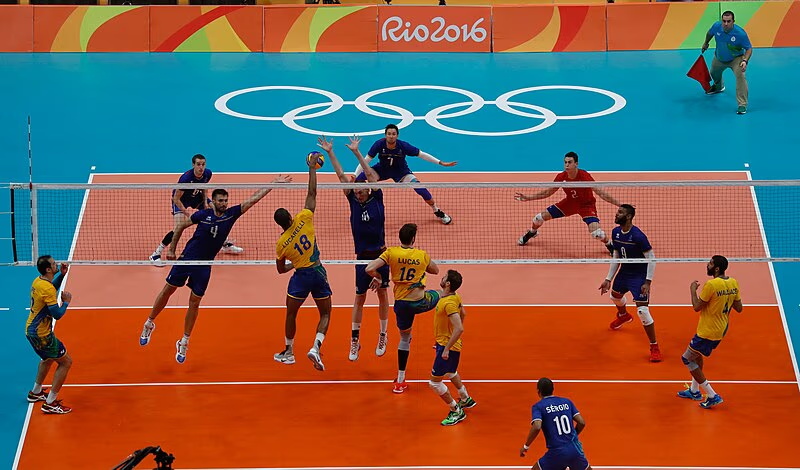















Section 1: Introduction
1.1 Overview and History
Volleyball was invented in 1895 by William G. Morgan at the YMCA in Holyoke, Massachusetts, USA. Originally called "Mintonette," the sport was designed as a less physically demanding alternative to basketball. The Fédération Internationale de Volleyball (FIVB) was founded on April 18, 1947, in Paris, France, and has served as the international governing body for the sport ever since. Volleyball became an Olympic sport at the 1964 Tokyo Olympic Games.
These rules are based on the FIVB Official Volleyball Rules 2025–2028, approved by the 37th FIVB World Congress and effective from January 1, 2025. This edition governs all FIVB World and Official Competitions. National federations may adapt these rules for their own competitions at age-group, recreational, or developmental levels, provided the adaptations do not conflict with FIVB principles.
1.2 Objective of the Game
The object of the game is to send the ball over the net to ground it on the opponent's court, and to prevent the ball from being grounded on one's own court (Rule 1.2, FIVB Official Volleyball Rules 2025–2028). Each team is entitled to a maximum of three contacts to return the ball across the net. The ball is put in play with a service, hit by the server over the net to the opponents. The rally continues until the ball is grounded on the playing court, goes "out," or a team fails to return it properly.
1.3 Governing Structure
The FIVB is headquartered in Lausanne, Switzerland, and governs 222 affiliated national federations worldwide as of 2025. The FIVB administers international competitions including the FIVB Volleyball Nations League, FIVB Volleyball World Championships, FIVB World Cup, and Olympic Volleyball Tournaments. The FIVB Rules of the Game Commission is responsible for interpreting, updating, and disseminating official rules globally.
1.4 Scope of Application
The FIVB Official Volleyball Rules 2025–2028 apply to all FIVB and World Confederation competitions. For national, regional, or age-group competitions, the respective confederation or national federation may introduce adaptations, provided these are notified to the FIVB. Adaptations are not permitted in Olympic Games, FIVB World Championships, or FIVB World Cup competitions.
Section 2: Equipment
2.1 The Ball (Rule 3, FIVB Official Volleyball Rules 2025–2028)
The ball shall be spherical, made of a flexible leather or synthetic leather case with a bladder inside made of rubber or a similar material (Rule 3.1). The ball must have the following specifications:
- Circumference: 65–67 cm (25.6–26.4 in)
- Mass: 260–280 g (9.2–9.9 oz)
- Inside pressure: 0.300–0.325 kg/cm² (294.3–318.82 mbar or hPa; 4.26–4.61 psi)
- Color: Uniform light color, or a combination of colors. Balls used in FIVB World and Official Competitions must bear the FIVB Logo and the official FIVB approval mark.
All balls used in a match must have the same characteristics regarding circumference, weight, pressure, type, and color (Rule 3.3). In FIVB World and Official Competitions, three balls are used. In this case, 6 ball retrievers are positioned, one at each corner of the free zone and one behind each referee (Rule 3.4).
2.2 Net and Posts (Rule 2, FIVB Official Volleyball Rules 2025–2028)
The net is placed vertically over the centre line. Its dimensions and specifications are as follows (Rule 2.1):
- Length: 9.50–10.00 m (31.2–32.8 ft)
- Width: 1.00 m (3.28 ft)
- Mesh: 10 cm × 10 cm (3.94 × 3.94 in) square mesh
- Top band: Horizontal band of white canvas, 5 cm (1.97 in) wide, sewn along the full length of both sides of the net (Rule 2.2)
- Side bands: White vertical band, 5 cm wide and 1 m long, fastened to the net at the sidelines (Rule 2.3)
- Antennae: Flexible rods, 1.80 m (5.91 ft) long and 10 mm (0.39 in) in diameter, made of fiberglass or similar material; alternating 10 cm bands of contrasting colors, preferably red and white; placed at the outer edge of each side band; considered part of the net (Rule 2.4)
2.3 Net Height
The net height is measured from the centre of the playing court (Rule 2.1):
- Men: 2.43 m (7 ft 11⅝ in)
- Women: 2.24 m (7 ft 4⅛ in)
- Mixed (men and women together): 2.43 m
The height of the net may be slightly higher at the sidelines but must not exceed 2 cm (0.79 in) above regulation height (Rule 2.1). Net posts are placed 0.50–1.00 m outside the sidelines (Rule 2.5). Posts are 2.55 m high and preferably adjustable. Posts must be fixed to the floor without guy wires; padding to protect players is required in FIVB World and Official Competitions.
2.4 Team Equipment
Team equipment includes jerseys, shorts, and shoes. Under Rule 4.3 (Players' Equipment), jerseys must be numbered 1–18 on the front and back. The number on the front must be at least 10 cm (3.94 in) high, and on the back at least 15 cm (5.91 in) high. Numbers must be in a color clearly contrasting with that of the jersey. The Libero player must wear a jersey (or jacket/bib for the Libero) of a contrasting color from that of the other team members (Rule 4.3.4).
Shoes must be flexible and lightweight with rubber or leather soles, without heels (Rule 4.3.3). Players are not permitted to wear objects that may cause injury or give artificial advantage; smooth and/or protective braces may be worn (Rule 4.3.5).
Section 3: Playing Area
3.1 Dimensions of the Playing Court (Rule 1.1, FIVB Official Volleyball Rules 2025–2028)
The playing court is a rectangle measuring 18 m × 9 m (59.06 ft × 29.53 ft), surrounded by a free zone which is a minimum of 3 m (9.84 ft) wide on all sides. The free playing space is the space above the playing area which is free from any obstruction. The minimum height from the playing surface to the free playing space is 7 m (22.97 ft) in FIVB World and Official Competitions; the minimum height is 12.5 m (41 ft) for Olympic Games.
3.2 Playing Surface (Rule 1.2)
The playing surface must be flat, horizontal, and uniform. Indoor surfaces must be of wood or synthetic material. Only smooth surfaces without dangerous or irregular elements are allowed. For FIVB World and Official Competitions, only wooden or synthetic surfaces are permitted. Outdoor courts may have a natural or artificial surface approved by the FIVB.
3.3 Court Lines (Rule 1.3)
All lines are 5 cm (1.97 in) wide. Lines must be a light color, different from the color of the floor and from any other lines. Two sidelines and two end lines mark the playing court. Both sidelines and end lines are drawn inside the dimensions of the playing court. The centre line divides the playing court into two equal courts each measuring 9 m × 9 m (29.53 ft × 29.53 ft); this line extends beneath the net from sideline to sideline.
3.4 Attack Line (Rule 1.3.3)
In each court, an attack line is drawn 3 m (9.84 ft) from the axis of the centre line to delimit the front zone. The attack line is extended beyond the sideline by 5 short lines, each 15 cm (5.91 in) long, 5 cm wide, and spaced 20 cm (7.87 in) apart, to a total length of 1.75 m (5.74 ft) from the sideline. This extension indicates the attack line for the back-row players.
3.5 Zones and Areas (Rules 1.4–1.5)
- Front Zone: Bounded by the axis of the centre line and the edge of the attack line nearest to the net (Rule 1.4.1).
- Back Zone: Bounded by the back edge of the attack line and the inside edge of the end line (Rule 1.4.2).
- Service Zone: 9 m (29.53 ft) wide area behind each end line. The server must be within this zone, behind the end line, at the moment of service contact (Rule 1.4.3).
- Substitution Zone: The part of the free zone on the side of the scorer's table, between the attack line and the end line (Rule 1.4.4).
- Libero Replacement Zone: The part of the free zone on both sides between the attack line extension and the end line (Rule 1.4.5).
- Warm-up Areas: Positioned at the corners of the playing court in FIVB World and Official Competitions; approximately 3 m × 3 m each (Rule 1.5).
3.6 Temperature and Lighting
For FIVB World and Official Competitions, the minimum temperature is 16°C (61°F) and the maximum is 25°C (77°F). The illumination level on the playing surface must be 1,000–1,500 lux (Rule 1.2 notes). Outdoor competitions should avoid direct sunlight in players' eyes.
Section 4: Players & Officials
4.1 Teams (Rule 4.1, FIVB Official Volleyball Rules 2025–2028)
A team consists of a maximum of 14 players: 12 players and 2 Liberos (Rule 4.1.1). In FIVB World and Official Competitions, teams may register up to 14 players; 12 regular players and 2 Liberos. Only 6 players per team may be on the court during play. One player is designated as team captain, identified on the score sheet and on the court by a stripe (underlining the number) on the jersey (Rule 4.1.2).
Teams must also include non-playing members: a head coach, an assistant coach, a trainer, and a doctor/medical staff. In FIVB World and Official Competitions, a maximum of 8 team members (non-players) may occupy the team bench (Rule 4.1.3).
4.2 The Libero Player (Rule 8, FIVB Official Volleyball Rules 2025–2028)
The Libero is a defensive specialist. Key rules governing the Libero include:
- Teams may designate up to 2 Liberos from the registered roster (Rule 8.1).
- The Libero wears a jersey (or jacket/bib for the Libero, in FIVB competitions) of a contrasting color from all other team members (Rule 8.1).
- The Libero is restricted to playing in the back row only and is not allowed to complete an attack hit from anywhere if the ball is entirely above the top of the net at the moment of contact (Rule 8.4.1).
- The Libero may not serve, block, or attempt to block (Rule 8.4.2).
- If the Libero sets the ball overhand using finger action in the front zone, a player may not complete an attack hit from above the height of the net (Rule 8.4.3).
- Libero replacements are unlimited but must occur during a dead ball; a Libero may only replace and be replaced by the same player (Rule 8.3). The Libero must remain out for at least one rally before re-entering (Rule 8.3.2).
- If a second Libero is designated, the replacement procedure between the two Liberos follows Rule 8.5 (effective from 2025 rules cycle).
4.3 Player Positions and Rotation (Rule 7)
At the moment of service, all players must be within their respective courts and in the rotational order recorded on the line-up sheet (Rule 7.1). Players are numbered in a rotational order 1–6, starting from the right back position and moving counterclockwise. After each side-out (opponent's loss of rally), the winning team rotates: all players move one position clockwise (Rule 7.3.1).
Positional faults occur if any player is not in their correct position at the moment the server contacts the ball. The positional relationship requires:
- Each front-row player to be closer to the centre line than the corresponding back-row player (Rule 7.4.1)
- Each right-side player to be closer to the right sideline than the corresponding centre player (Rule 7.4.2)
- Each left-side player to be closer to the left sideline than the corresponding centre player (Rule 7.4.3)
4.4 Substitutions (Rule 15)
Substitution is the act of a player replacing another player on the court. In each set, each team is allowed a maximum of 6 substitutions (Rule 15.2). One or more players may be substituted at the same time (Rule 15.3). A player from the starting line-up may leave the game and return, but only once per set and only to the position of the player who replaced them (Rule 15.2). A substitute player may enter the game only once per set.
4.5 Match Officials (Rule 23)
The officiating team for FIVB World and Official Competitions consists of:
- First Referee (R1): Directs the match from start to end; has authority over all members of both teams and officiating team; his/her decisions are final (Rule 23.1).
- Second Referee (R2): Assists the first referee; controls the net, posts, and centre line; authorizes substitutions and timeouts; supervises the scorer's table (Rule 23.2).
- Scorer (official scorer and assistant scorer): Records all events before and during the match as directed by the second referee (Rule 23.3).
- Line Judges (4): Signal whether the ball is in or out on all boundary lines; monitor the server's foot faults; signal out balls touched by the receiving team (Rule 23.4).
- Ball Retrievers (6 in FIVB competition): Keep balls ready for service and at the referees' positions between rallies (Rule 23.5).
Section 5: Rules of Play
5.1 Playing Actions — The Rally (Rule 11)
A rally is the sequence of playing actions from the moment of the service hit by the server up to the moment the ball is out of play (Rule 11.1). If the serving team wins a rally, it scores a point and continues to serve. If the receiving team wins the rally, it scores a point and gains the right to serve; its players rotate one position clockwise before serving.
The ball may touch any part of the body (Rule 11.2). The ball must be hit, not caught or thrown; it may momentarily come to rest on any part of the body (Rule 11.2). The ball may touch the net, including while crossing it (Rule 11.3.1). The ball that touches a post, ropes, or any other object outside the net's side bands is considered out. A ball sent to the opponent's court must pass over the net within the crossing space — the area between the antennae and their imaginary extensions (Rule 11.3.2).
5.2 Team Hits (Rule 12)
Each team is entitled to a maximum of 3 contacts with the ball to return it to the opponent's side (Rule 12.1). If more contacts are made, a fault of "Four Hits" is called. The contacts allowed per team include a block contact (Rule 12.2):
- A block contact does not count as a team's first contact; the blocked team retains its 3 hits.
- The first contact of a team may be made by any part of the body.
- The ball may contact various parts of the body sequentially, provided the contacts occur simultaneously (Rule 12.3).
Double contact (Rule 12.4): A player hits the ball twice in succession or the ball contacts various parts of his/her body in succession. Exception: during the first hit of a team (including a block), simultaneous contacts with different body parts are permitted.
5.3 Service (Rule 13)
Service is the act of putting the ball into play by the right back-row player, who hits the ball with one hand or any part of the arm from the service zone (Rule 13.1). The server must hit the ball within 8 seconds after the first referee's whistle for service (Rule 13.2.1). At the moment of contact with the ball, the server must not touch the end line or the playing court, nor the ground outside the service zone; after the hit, they may step or land outside the service zone (Rule 13.2.2).
The ball must be tossed or released from the hand(s) and hit with one hand or any part of the arm before it touches the ground. Only one toss is allowed; the ball may be re-tossed or moved only if no attempt at service is made (Rule 13.2.3). The server may move freely within the service zone. Flying service (jump serve) is permitted.
Service faults include: violation of service order, service faults during execution (foot fault, illegal contact), and service that goes into the net, under the net, out of bounds, or touches a player of the serving team before crossing the net.
5.4 Attack Hit (Rule 14)
An attack hit is any action directing the ball toward the opponent except a service or block (Rule 14.1). When the ball is entirely above the top of the net, any player may complete an attack hit except:
- A back-row player must take off from behind (and not touching) the attack line to hit the ball when it is entirely above the top of the net (Rule 14.2).
- The Libero may not complete an attack hit if the ball is entirely above the height of the net at the moment of contact (Rule 14.3).
- No player may attack a ball on the opponent's side of the net (Rule 14.4).
5.5 Block (Rule 15)
Blocking is the action of players close to the net to intercept the ball coming from the opponent by reaching higher than the top of the net (Rule 15.1.1). Only front-row players are permitted to complete a block; a back-row player or Libero who completes a block commits a fault (Rule 15.1.3). A block attempt is when a player attempts to block without contacting the ball. Multiple players may participate in a block simultaneously.
A block contact is not counted as a team hit (Rule 15.1.2). After a block, the team is entitled to 3 hits to return the ball. The first hit after the block may be by any player, including the one who executed the block.
Blocking faults (Rule 15.4) include: blocking the ball in the opponent's space (Rule 15.4.1); blocking the ball beyond the antennae (Rule 15.4.2); screening (deliberately blocking the line of sight or the path of the ball to the opponent's court during service — Rule 15.4.3).
5.6 Timeouts and Technical Timeouts (Rules 18–19)
Each team is entitled to a maximum of 2 timeouts per set (Rule 18.1), each lasting 30 seconds (Rule 18.2). In FIVB World and Official Competitions, in addition to the 2 regular timeouts, two Technical Timeouts of 60 seconds each are applied automatically when the leading team reaches the 8th and 16th points in sets 1–4 (Rule 19.1). No technical timeouts are used in the deciding set (set 5); only the two regular timeouts apply.
5.7 Intervals and Change of Courts
Intervals between sets last 3 minutes (Rule 20.1). During this time, teams change courts. In the deciding (fifth) set, teams change courts when one team reaches 8 points without interrupting the continuity of service and rotation (Rule 20.2). An interval between the fourth and fifth set may be extended up to 5 minutes at the request of a team, by decision of the FIVB or World Confederation (Rule 20.1).
Section 6: Scoring
6.1 Rally Point System (Rule 6, FIVB Official Volleyball Rules 2025–2028)
Volleyball uses the rally point system: a point is scored on every rally regardless of which team served. The team that wins a rally scores a point (Rule 6.1.1). When the receiving team wins a rally, it scores a point and gains the right to serve (side-out), with all players rotating one position clockwise (Rule 6.2).
6.2 Structure of a Match (Rules 5–6)
A match is played in the best of five sets (Rule 5.1). A team wins the match by winning three sets. Sets 1–4 are won by the first team to reach 25 points, with a minimum lead of 2 points; there is no set point cap — play continues until one team achieves a 2-point lead (Rule 6.3). The deciding set (set 5) is played to 15 points, with a minimum 2-point lead (Rule 6.4).
If a match is forfeited by a team before it starts, the opponent wins the match 3–0, and each set 25–0 (Rule 6.5). If a team is incomplete for a set, the opponent wins that set (Rule 6.5). If a match is forfeited during play, the result as it stands is recorded if the score meets the minimum requirements, or the opponent wins 3–0 and each incomplete set is scored 25–0 (Rule 6.5).
6.3 Point, Set, and Match Awards
A point is awarded when (Rule 6.1):
- The ball is grounded on the opponent's playing court.
- The opponent commits a fault.
- The opponent receives a penalty.
For ranking purposes in tournaments, teams receive:
- Match won 3–0 or 3–1: 3 points for the winner, 0 for the loser.
- Match won 3–2: 2 points for the winner, 1 for the loser.
Ranking in group play is determined in order by: match points, set ratio, point ratio, and then results between tied teams (FIVB competition regulations, applied alongside Rule 6).
6.4 Determining Set and Match Winners
The first team to win 3 sets wins the match. If both teams have won 2 sets, the deciding (fifth) set is played to 15 points with a 2-point lead. There is no maximum score in any set — play continues until one team leads by 2 points. Teams change courts in the deciding set when the first team reaches 8 points (Rule 20.2).
Section 7: Violations & Penalties
7.1 Faults and Consequences (Rule 6.1, FIVB Official Volleyball Rules 2025–2028)
A fault is a playing action that is contrary to the rules. The referees judge faults and determine the consequences according to the rules. If two or more faults are committed successively, only the first fault is considered. If two or more faults are committed simultaneously by opponents, a double fault is declared and the rally is replayed (Rule 6.1.2).
7.2 Playing Faults
- Foot fault (Rule 13.2.2): Server contacts the end line or court, or steps outside the service zone, at the moment of service contact. Consequence: point and service to opponent.
- Four Hits (Rule 12.1): A team contacts the ball more than 3 times before returning it over the net. Consequence: point to opponent.
- Double Contact (Rule 12.4): A player hits the ball twice in succession or contacts it with two body parts non-simultaneously. Consequence: point to opponent (except on first team contact including a block).
- Catch/Carried Ball (Rule 11.2): The ball is caught or thrown rather than hit; it visibly comes to rest during contact. Consequence: point to opponent.
- Net Fault — Player (Rule 16.2): A player touches the net or the top band between the antennae during play. Consequence: point to opponent. Contact with net below the top band or net posts does not constitute a fault unless it interferes with play.
- Crossing the Centre Line (Rule 11.3.3): A player touches the opponent's court with any part of the body beyond the centre line, while it constitutes a fault only when it interferes with the opponent's play. Contact with the centre line itself (or over the line when not interfering) is permitted as of the 2025 rules.
- Penetration Under the Net (Rule 16.3): A player penetrates into the opponent's space under the net, interfering with play. Consequence: point to opponent.
- Ball Out of Bounds (Rule 11.3): Ball lands outside the court lines (excluding contact with antenna/post/objects outside the court boundaries). Consequence: point to opponent.
- Attack Hit Fault (Rule 14.2–14.5): Including back-row player attacking above net height from in front of the attack line, Libero attacking above net height, or attacking from the opponent's space. Consequence: point to opponent.
- Blocking Fault (Rule 15.3–15.4): Back-row player or Libero completes a block; player blocks beyond the antenna; player screens the server. Consequence: point to opponent.
- Serve Fault (Rule 13.3): Ball fails to pass over the net, lands out of bounds, passes over or outside the antenna, touches a player of the serving team. Consequence: point and service to opponent.
- Positional/Rotation Fault (Rule 7.4–7.7): A player is not in the correct position at service contact, or the team serves out of rotation order. Consequence: point to opponent; team returns to correct rotation order and any points won while in faulty rotation are canceled.
7.3 Conduct Penalties (Rule 21)
Misconduct includes rude behavior, offensive behavior, and aggression. Sanctions are applied progressively (Rule 21.1):
- Warning (yellow card): No point or service lost; recorded in the score sheet. Issued for minor unsportsmanlike conduct.
- Penalty (red card): Opponent awarded a point and service. Issued for rude conduct after a warning or for serious rude conduct directly.
- Expulsion (red + yellow cards shown together): Player/coach must leave the playing area for the remainder of the set. No further point lost. Issued for offensive conduct.
- Disqualification (red + yellow cards shown separately): Player/coach must leave the competition venue for the remainder of the match. Issued for aggression or repeated offensive conduct.
Delay sanctions (Rule 21.2) may be applied for delays caused by a team: delay warning (yellow card), then delay penalty (red card) for each subsequent delay in the same set. Delay sanctions are recorded on the score sheet and are independent of conduct sanctions.
7.4 Illegal Substitution and Lineup Errors
An illegal substitution (Rule 15.6) results in a point for the opponent and the team returns to its correct lineup. If the illegal substitution is discovered after play has resumed, the illegally substituted player must leave; any points won during the illegal substitution are cancelled and awarded to the opponent (Rule 15.6.2). Lineup errors discovered during or after a set follow Rule 7.5 (line-up sheet errors).
Section 8: Safety Considerations
8.1 Player Safety — Court and Equipment Standards
The FIVB Official Volleyball Rules 2025–2028 and FIVB Medical Regulations outline player safety requirements for official competitions. The playing surface must be flat, horizontal, and free from any object that could cause injury. Indoor courts must be of wood or synthetic material (Rule 1.2). Outdoor courts must be free of rough or irregular surfaces. The free zone (minimum 3 m on all sides in FIVB competition) is maintained to prevent players from colliding with spectators, obstacles, or walls during play.
Net posts must be padded at the base to protect players who may run or fall into them. Posts must be affixed without guy wires or other obstacles in the free zone. Any equipment near the court must be safely stored or padded.
8.2 Player Health and Medical Protocols
In FIVB World and Official Competitions, a certified medical professional or trainer must be present at all matches. Each team is entitled to one medical timeout per set (distinct from regular timeouts) of up to 3 minutes in the event of injury, at the first referee's discretion (Rule 18.4, FIVB Medical Regulations Article 5). If a player is injured during a rally and the injury cannot be evaluated within a dead-ball interval, the referee may allow a brief interruption. If the injured player cannot continue, a legal substitution must be made; if substitution is not possible, the team may be granted an exceptional substitution (Rule 15.7).
Players suffering from bleeding must leave the court immediately and may not return until the bleeding is controlled and wounds are covered. Bloodied clothing must be replaced before re-entry. This requirement applies for all FIVB competitions per FIVB Medical Regulations.
8.3 Warm-Up and Injury Prevention
Teams are allocated official warm-up time before each match and each set. In FIVB World and Official Competitions, teams receive shared warm-up time at the net (typically 6 minutes with the net, 3 minutes off the net) as specified in match regulations. Teams are encouraged to conduct pre-match and pre-set warm-up routines as directed by their coaching staff. Warm-up areas are provided at the corners of the court (approximately 3 m × 3 m each) per Rule 1.5.
8.4 Conduct and Anti-Aggression
Physical aggression — defined as actual physical contact with an opponent, official, or spectator in an aggressive manner — results in immediate disqualification of the offending player or coach (Rule 21.1, Misconduct Sanctions). The FIVB Code of Conduct, supplementary to the game rules, requires all participants to respect opponents, officials, and spectators. Verbal harassment and threatening gestures are subject to progressive misconduct sanctions. Referees are empowered to suspend play and take sanctioning action when safety or dignity of any participant is threatened.
8.5 Lighting, Temperature, and Environmental Conditions
For indoor FIVB World and Official Competitions, the court illumination must be 1,000–1,500 lux measured at the playing surface. Temperature must be maintained between 16°C (61°F) and 25°C (77°F). Outdoor competitions may be suspended or delayed by the referee if conditions become unsafe due to weather, lightning, extreme heat, or other environmental hazards. The referee has authority to suspend play if the playing surface becomes wet or otherwise dangerous (Rule 23.1, Referee Powers and Duties).
8.6 Anti-Doping
All FIVB competitions are subject to the FIVB Anti-Doping Rules, which are harmonized with the World Anti-Doping Agency (WADA) Code and the World Anti-Doping Code. Players are subject to in-competition and out-of-competition testing. Violations are handled according to the FIVB Anti-Doping Rules and may result in sanctions ranging from warnings to multi-year bans, as applicable. Players are responsible for any substance found in their system, regardless of intent (FIVB Anti-Doping Rules, Article 2).