


🏛️Official — IHFIn Season
Loading OpenSourceSports…
Team Sports
7 players
indoor
handball, goal, net
10 essential rules
Handball is governed by the International Handball Federation (IHF), founded in 1946 and headquartered in Basel, Switzerland. The sport operates under the IHF Rules of the Game, most recently amended effective 1 July 2025. With over 200 member federations, handball ranks among the most widely pla...
The handball is spherical, made of leather or synthetic leather, with a non-shiny, non-slippery surface. Three official sizes exist: Size 3 (Men): Circumference 58–60 cm (22.8–23.6 in), weight 425–475 g (15–16.8 oz); Size 2 (Women): Circumference 54–56 cm (21.3–22 in), weight 325–375 g (11.5–13.2...
Goals have internal dimensions of 3 m wide x 2 m high (9.84 ft x 6.56 ft). Goal posts and crossbar are 8 cm (3.1 in) square in cross-section, painted in alternating two-colour bands (typically black and white or red and white) visible from both sides.
Footwear: Non-marking indoor court shoes are mandatory. Outdoor soles and studded shoes are prohibited (IHF Rule 4).; Jerseys: Numbered 1–99. Field players wear matching jerseys of a uniform colour distinct from the opposing team. Goalkeepers wear a jersey colour distinct from both their own fiel...
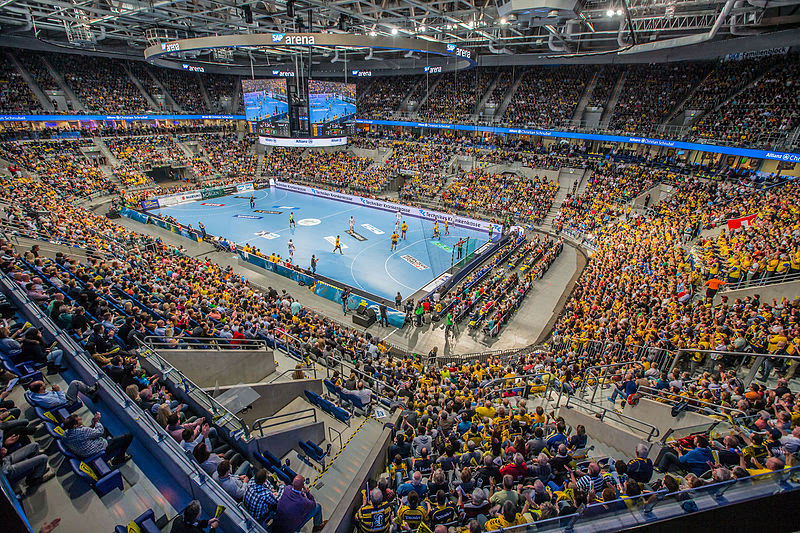
The playing court measures 40 m x 20 m (131 ft x 66 ft), with a safety zone of at least 1 m along the sidelines and 2 m behind each goal line. The court surface is typically hardwood, synthetic, or rubberised flooring and must be flat and non-slip (IHF Rule 1).
Goal area line (6 m arc): A quarter-circle arc drawn 6 m (19.7 ft) from each goal post, connected by a straight line 3 m from the goal line parallel to it. Only the goalkeeper may occupy this zone during active play (IHF Rule 1).; Free-throw line (9 m arc): A dashed arc 9 m (29.5 ft) from the goa...
Each team's bench area is positioned along the same sideline as the substitution area. The officials' table (timekeeper and scorekeeper) is at the centre of the sideline.
Amended effective 1 July 2025, the coaching zone (IHF Rule 1:11) was extended and now begins 3.5 m from the centre line and ends 8 m from the respective outer goal line, including, as far as possib...
Each team consists of up to 16 players; no more than 7 may be on the court at once. A player identified as a goalkeeper may become a court player at any time, and a court player may become a goalkeeper, so there is no fixed split between the two.
Goalkeeper (GK): Defends the goal within the 6 m area. May use any body part (including feet) to stop the ball. May leave the goal area but then becomes a regular court player subject to field-player rules.; Centre back (CB): The primary playmaker. Organises the attack from the centre of the 9 m ...
Substitutions are unlimited and occur as "flying substitutions" — the outgoing player must leave the court before the incoming player enters, both through the substitution zone. No stoppage of play is required.
Return possession after an injury stoppage
When play is halted for an injured player and the referee awards a free throw to the interrupting team, it is expected that the team with the ball voluntarily returns it to the side that held possession before the stoppage. Failing to do so draws strong disapproval from opponents, crowd, and often teammates.
Mirrors the same convention in football/soccer and is deeply embedded in European handball culture.
Give a genuine handshake after the final whistle
The post-match handshake line is treated as a solemn obligation in handball culture. Offering a limp hand, refusing eye contact, skipping the line, or using the moment to taunt is considered a serious breach of respect. Teams that lose composure in the handshake are remembered negatively long after the result is forgotten.
Especially prominent at youth and club levels in Scandinavia and Germany where formal sportsmanship is emphasised in federation development programs.
Avoid exaggerating contact — diving is disrespected
Despite handball being a highly physical sport where contact is legal and expected, deliberately exaggerating a foul or falling theatrically to draw a suspension card is culturally condemned. Players who flop habitually are labelled negatively by peers and opposing teams and lose credibility with referees over time.
The acceptance of physical contact in handball makes simulation stand out starkly compared to sports with stricter contact rules.
Ready to dive deeper?