






Section 1: Introduction
Sambo is a Russian/Soviet-developed martial art and combat sport ("Sambo" = "SAMozashchita Bez Oruzhiya" — "self-defense without weapons"), combining judo-style throws with groundwork and joint-locks. FIAS (International Sambo Federation) is the IOC-recognized international governing body since 2021 — a major milestone toward potential future Olympic medal-sport status. Sport Sambo is the throw-and-groundwork format (no strikes), structurally similar to judo + freestyle wrestling. See sibling Combat Sambo entry for the strikes-permitted variant.
This edition tracks the International Sambo Rules (Sport Sambo) together with the regulatory amendment round the FIAS Executive Committee approved on March 31, 2026, which updated the FIAS Regulations on SAMBO Referees, the FIAS Disciplinary Code, the procedures for Certification of SAMBO Athletes, Coaches and Accreditation of SAMBO Clubs, and the Classification Rules of SAMBO for the Blind and Visually Impaired. FIAS states the round's purpose as unifying competition practices, enhancing athlete safety, and supporting the continued development of international SAMBO. The core throw, groundwork, and submission scoring rules described in Sections 5 and 6 below are unchanged by this round.
Section 2: Equipment
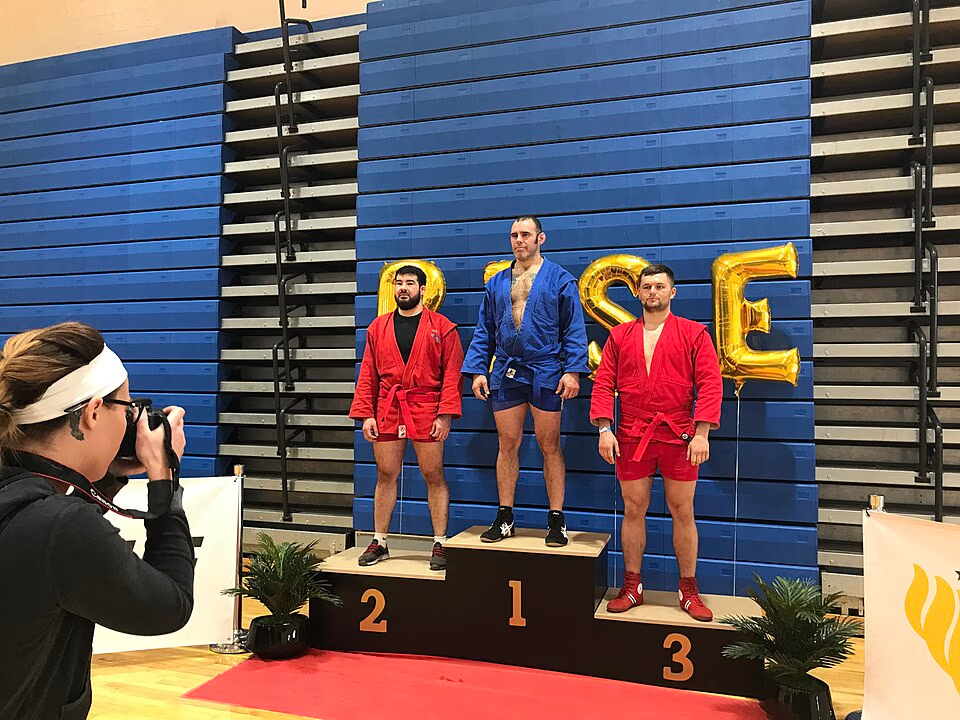
- Sambo jacket (Sambovka): distinctive jacket with belt loops + shoulder cinches — red or blue per competitor
- Sambo shorts: matching jacket color
- Sambo wrestling shoes (Sambovki): mandatory — soft, ankle-supportive
- Mouthguard recommended; protective cup permitted (men)
- No jewelry; nails trimmed; hair tied back
A distinct, separately classified division — SAMBO for the Blind and Visually Impaired — carries its own mandatory headgear specification; see Section 4 for the classification and equipment requirements that apply to that division only.
Section 3: Playing Area
- FIAS-spec mat: 11m × 11m total, with central 9m circle competition area
- Padded outer safety zone
- Mat colored to distinguish competition area from safety zone
Section 4: Players & Officials
- Two competitors per match (one red, one blue jacket)
- Weight classes (Adult Male, kg): -58, -64, -71, -79, -88, -98, +98
- Weight classes (Adult Female, kg): -50, -54, -59, -65, -72, -80, +80
- Age categories: Cadet, Junior, Senior, Veteran
- Officials: 1 mat referee + 2 corner judges + scoring official + timekeeper
Athlete, Coach & Club Certification
Following the FIAS Executive Committee's March 31, 2026 amendments to the procedures for Certification of SAMBO Athletes, Coaches and Accreditation of SAMBO Clubs, athletes and coaches must hold current FIAS certification and the club they represent must hold current FIAS accreditation to be eligible to enter FIAS-sanctioned Sport Sambo competition.
Match Officials
The FIAS Regulations on SAMBO Referees were likewise amended by the Executive Committee on March 31, 2026. FIAS describes the round as intended to unify officiating practices across FIAS-sanctioned events; mat referees, corner judges, and the scoring official listed above are appointed and credentialed under the amended regulation.
SAMBO for the Blind and Visually Impaired
FIAS separately sanctions Sambo for the Blind and Visually Impaired under its own Classification Rules of SAMBO for the Blind and Visually Impaired, which the Executive Committee revised on March 31, 2026 alongside a newly approved FIAS Specification Sheet for the Manufacturing of a Helmet for Blind SAMBO. Classification is based on the athlete's degree of visual impairment and ability to maintain balance, and assigns competitors to one of two classes:
- SVI1: includes totally blind athletes; competitors in this class must wear a helmet built to the FIAS specification, protecting the head and eye area and fitted with a black, non-light-transmitting eye patch and a curtain that seats snugly against the nose and cheekbones.
- SVI2: athletes with shaped/partial vision who can distinguish objects at a distance.
Section 5: Rules of Play
Match Length
- Two 4-minute periods (single 5-minute period for some events)
- Active wrestling required; passivity penalized
Throws
- 1 point: Takedown landing opponent on side (no full back exposure)
- 2 points: Throw landing opponent partially on back, throw to knees
- 4 points: Throw landing opponent fully on back from standing
Groundwork (par terre)
- 1 point: 5-second pin (sufficient to maintain control)
- 2 points: 10-second pin
- Joint locks legal on arms + legs (including kneebar, leg lock, ankle lock)
- Submission via tap = total victory
Total Victory
- 4-point throw + immediate dominant position = total victory (end of match)
- Submission = total victory
- 12-point differential = total victory (technical superiority)
Restrictions
- No chokes in Sport Sambo (key difference from BJJ/judo)
- No strikes
- Joint locks on knees and ankles legal at Senior level only
The Executive Committee's March 31, 2026 amendment round did not change throw, groundwork, submission, or total-victory scoring for Sport Sambo.
Section 6: Scoring
- Decision priority: total victory > technical superiority > points > last-scoring competitor
- Tournament: single-elimination + repechage for bronze
- Gold/Silver/two Bronze per weight + age + gender
Section 7: Violations & Penalties
- Passivity: verbal warning → caution → opponent awarded points
- Fleeing mat: caution
- Illegal techniques (chokes, prohibited joint locks, strikes): caution → DQ
- Slamming with intent to injure: DQ
- Unsportsmanlike conduct: warning → DQ
- Anti-doping: WADA Code; FIAS-administered testing
The FIAS Disciplinary Code was amended by the Executive Committee on March 31, 2026 to strengthen ethical standards and accountability. It applies alongside the in-competition penalties above, covering sanctions for anti-doping violations, competition manipulation, and athlete, coach, or official misconduct at FIAS-sanctioned events.
Section 8: Safety Considerations
Sport Sambo injury profile: shoulder/knee/elbow strain from throws + joint-lock applications. No chokes = lower asphyxiation risk vs judo. Mandatory Sambovki footwear reduces ankle/knee twist injuries during throws. On-site team physician + EMT + ambulance at FIAS championship level. AED on-site. Pre-match medical screening + age-appropriate cardiac screening. Concussion protocol: SCAT-5 assessment + multi-stage return-to-competition clearance. Skin-infection screening before mat use. Anti-doping testing in-competition + out-of-competition.
For SAMBO for the Blind and Visually Impaired, the FIAS-specification helmet required of SVI1 competitors (Section 4) is itself a safety measure, designed to protect the head and eye area of an athlete who cannot visually anticipate an incoming throw or strike. FIAS states its March 31, 2026 amendments to the referee regulations and athlete/coach/club certification procedures are likewise intended, in part, to enhance athlete safety across FIAS-sanctioned competition.