














Section 1: Introduction
1.1 History and Governance
Lacrosse is one of the oldest team sports in North America, originating with Indigenous peoples long before European contact. The modern international game is governed by World Lacrosse (formerly the Federation of International Lacrosse, FIL), the international federation recognized by the International Olympic Committee (IOC). World Lacrosse oversees multiple disciplines: Men's Field Lacrosse, Women's Field Lacrosse, Box (Indoor) Lacrosse, and Lacrosse Sixes — the format adopted for the 2028 Los Angeles Olympic Games.
1.2 Disciplines
World Lacrosse administers rules for four primary disciplines:
- Men's Field Lacrosse: Ten players per team on a large outdoor grass or turf field. Full-contact with protective equipment.
- Women's Field Lacrosse: Twelve players per team on an outdoor field. Limited contact with different protective requirements.
- Box Lacrosse: Six players per team played indoors on a hard surface within boards, similar in structure to ice hockey rinks.
- Lacrosse Sixes: Six players per team on a smaller field, designed as the Olympic format. Adopted for the 2028 LA Olympics following World Lacrosse's IOC recognition.
1.3 Objective of the Game
The object of lacrosse is to propel a small rubber ball into the opposing team's goal using a long-handled stick (the "crosse") that has a mesh pocket at one end. The team scoring the most goals by the end of regulation time wins the game. Players may carry, catch, and pass the ball using the crosse; the ball may not be touched by the hand (except by the goalkeeper within their crease in certain disciplines).
1.4 Official Rules Document
The rules contained in this reference are based on the World Lacrosse Men's Field Rules and World Lacrosse Women's Field Rules as published by World Lacrosse, effective for international competition. Member national associations (such as US Lacrosse and the Canadian Lacrosse Association) may adopt these rules with approved modifications for domestic play. For Lacrosse Sixes, refer to the World Lacrosse Sixes Rules adopted in preparation for the 2028 Olympic cycle.
Section 2: Equipment
2.1 The Ball
The official lacrosse ball must be solid rubber. Per World Lacrosse specifications:
- Circumference: Not less than 19.7 cm (7¾ inches) and not more than 20.3 cm (8 inches)
- Weight: Not less than 142 g (5 oz) and not more than 149 g (5¼ oz)
- Color: White, yellow, or orange for men's field; yellow or orange for women's field. Box lacrosse typically uses an orange ball.
- The ball must meet World Lacrosse certification standards and must be approved by the referee before play commences.
2.2 The Crosse (Stick)
The crosse is the primary implement used by players to carry, pass, and shoot the ball. It consists of a handle (shaft) and a head, which contains a mesh or leather pocket.
2.2.1 Men's Field Crosse Specifications
- Overall length (field players): Minimum 101.6 cm (40 inches), maximum 182.9 cm (72 inches)
- Overall length (goalkeeper): Minimum 101.6 cm (40 inches), maximum 182.9 cm (72 inches); goalkeeper may use a crosse up to 182.9 cm
- Head width (attack/midfield): Minimum 6.4 cm (2½ inches), maximum 10.2 cm (4 inches) at the widest point inside the head
- Head width (defense/goalkeeper): Minimum 6.4 cm (2½ inches), maximum 38.1 cm (15 inches) for goalkeepers
- The pocket depth must not allow the top of the ball to fall below the bottom edge of the sidewall when the crosse is held horizontally.
- Shooting strings are permitted; no more than two shooting strings may be used, each of uniform diameter.
2.2.2 Women's Field Crosse Specifications
- Overall length: Minimum 91.4 cm (36 inches), maximum 121.9 cm (48 inches) for field players; goalkeepers may use a longer crosse
- Head width: Minimum 17.8 cm (7 inches) at the widest point inside the head; maximum 22.9 cm (9 inches)
- The pocket must be shallow — the top of the ball must be above the sidewall when held horizontally in all planes.
- No shooting strings are permitted in women's lacrosse.
2.3 Protective Equipment — Men's Field Lacrosse
The following equipment is mandatory for all players in men's field lacrosse:
- Helmet: Must be a lacrosse-specific helmet meeting NOCSAE (National Operating Committee on Standards for Athletic Equipment) or equivalent World Lacrosse-approved standard. Must have a face mask and chin strap securely fastened.
- Gloves: Padded lacrosse gloves must be worn by all field players.
- Arm and elbow pads: Must be worn by all field players.
- Shoulder pads: Must be worn by all field players.
- Mouthguard: Mandatory; must be a color other than white or clear so officials can verify it is being worn.
- Athletic supporter/cup: Strongly recommended; may be required by national association rules.
- Goalkeeper additional equipment: Throat protector, chest protector, and leg pads are required. The goalkeeper's helmet must have additional throat protection.
2.4 Protective Equipment — Women's Field Lacrosse
- Eyewear/Goggles: Mandatory for all field players. Must meet ASTM F803 or equivalent standard.
- Mouthguard: Mandatory; must be a color other than white or clear.
- Gloves: Optional for field players.
- Soft headgear: Optional for field players.
- Goalkeeper: Must wear helmet with face mask, throat protector, chest protector, and leg pads. Gloves are required.
2.5 Uniforms
Each team must wear matching jerseys of a contrasting color to the opposing team. Jersey numbers are required and must be clearly visible. Numbers must be at least 20.3 cm (8 inches) high on the back and at least 10.2 cm (4 inches) high on the front. Teams may also wear matching shorts. The goalkeeper must wear a different colored jersey from both teams to be distinguished by officials.
Section 3: Playing Area
3.1 Men's Field Dimensions
The men's lacrosse field is a rectangular grass or artificial turf surface with the following official dimensions per World Lacrosse Men's Field Rules:
- Length: 100 yards (91.44 m) between end lines, with an additional 10–15 yards (9.14–13.72 m) of out-of-bounds space recommended at each end
- Width: 60 yards (54.86 m) between sidelines
- The field is divided into two halves by a center line running parallel to the end lines.
- A center circle of 9.1 m (10 yards) diameter is marked at the midfield center point.
3.2 Women's Field Dimensions
- Length: 110 yards (100.6 m) recommended; minimum 90 yards (82.3 m)
- Width: 60–70 yards (54.9–64.0 m)
- A center circle of 9.1 m (10 yards) diameter is marked at midfield.
- Women's field does not include a restraining line; instead, it uses a different positional structure.
3.3 Goal and Crease — Men's Field
- Goal posts: 1.83 m (6 feet) apart, inside measurement
- Crossbar height: 1.83 m (6 feet) from the ground to the underside of the crossbar
- The goal is positioned 15 yards (13.72 m) from the end line.
- Crease: A circular arc with a radius of 2.74 m (9 feet) from the center of the goal line, forming the goalkeeper's protected zone. No attacking player may enter the crease. Only the goalkeeper may stand within the crease.
- A rectangular area known as the goal area or crease box extends 18 feet (5.49 m) in front of and 9 feet (2.74 m) to each side of each goal post, encompassing the crease.
3.4 Goal and Crease — Women's Field
- Goal posts: 1.83 m (6 feet) apart, inside measurement
- Crossbar height: 1.83 m (6 feet) from the ground
- The goal is positioned 15 yards (13.72 m) from the end line.
- Crease: A circle with a radius of 2.6 m (8.5 feet) from the center of the goal line. No player other than the goalkeeper may enter the crease.
- An 11-metre (12-yard) arc is marked in front of the goal; this arc defines the area from which free-position shots are awarded for major fouls.
3.5 Restraining Lines (Men's Field)
Two restraining lines run the full width of the field, each located 20 yards (18.29 m) from the center line (i.e., 30 yards from each end line). These lines define the "attack area" and "defensive area." During a face-off, all players other than the two taking the face-off and the goalkeepers must remain in the wing areas or beyond the restraining line until possession is gained or the ball crosses the restraining line.
3.6 Wing Areas (Men's Field)
Wing areas are located at midfield, 10 yards (9.14 m) on each side of the center line. During a face-off, one player from each team (the wing midfielders) must remain in the wing areas until the ball is possessed or passes the restraining line.
3.7 Substitution Box
A designated substitution box is located along one sideline at midfield, typically 10 yards (9.14 m) on each side of the center line. Substitutions must be made within this area.
Section 4: Players & Officials
4.1 Team Composition — Men's Field
Each team consists of ten (10) players on the field at one time:
- 1 Goalkeeper (GK)
- 3 Defensemen — primarily positioned in the defensive half
- 3 Midfielders — free to play the full field
- 3 Attackmen — primarily positioned in the offensive half
A team must have at least seven (7) players on the field to begin or continue play. Rosters may include up to 23 players for international competition, with up to 13 on the bench at any time. Three midfielders, along with the goalkeeper, may move freely across the entire field.
4.2 Team Composition — Women's Field
Each team consists of twelve (12) players on the field at one time:
- 1 Goalkeeper (GK)
- 5 Defenders
- 3 Midfielders
- 3 Attackers
All players may move freely anywhere on the field in women's lacrosse; there are no positional restrictions by rule, though tactical positioning is conventional.
4.3 Offside Rule — Men's Field
At all times during play, each team must have a minimum of:
- Three (3) players — including the goalkeeper — in its defensive half of the field
- Three (3) players in its offensive half of the field
Violation of this requirement results in an offside foul. The penalty is a 30-second technical foul served by the offending team. The goalkeeper counts as one of the three required players in the defensive half.
4.4 Substitutions
Substitutions may be made at any time during play (on-the-fly). Substituting players must enter and exit through the substitution box on the sideline. A player leaving must be within 5 yards (4.57 m) of the substitution box before the substitute may enter. Substitutions may also be made during any stoppage in play without restriction as to location. Teams may make unlimited substitutions. In women's lacrosse, on-the-fly substitutions are permitted at midfield.
4.5 Officials
Men's and women's field lacrosse are officiated by a crew of officials:
- Men's Field (World Lacrosse international): Three officials — one referee and two umpires — work the game. Each official has jurisdiction over specific areas of the field. A table crew manages the scoreboard, shot clock, and substitution box.
- Women's Field: Three officials — one chief umpire and two umpires.
- Officials have authority to enforce rules from the time they arrive on the field until they leave after the game.
- A Alternate Official may be designated to replace any official who becomes incapacitated during the game.
4.6 Officials' Authority
Officials are empowered to call fouls, award possession, time penalties, eject players, and delay, suspend, or terminate a game due to weather, unruly conduct, or unsafe playing conditions. All decisions by officials on matters of fact are final. Only the head official (referee/chief umpire) communicates with team coaches regarding rules interpretations.
4.7 Coaches and Team Bench
Only credentialed team personnel (coaches, medical staff, team managers) are permitted in the team bench area. Coaches may stand in a designated coaches' box during play. Head coaches may request a time-out or address officials on rule interpretation. Only players listed on the official roster may participate.
Section 5: Rules of Play
5.1 Duration of Play — Men's Field
A standard men's field lacrosse game at the international level consists of four (4) quarters of fifteen (15) minutes each, for a total of sixty (60) minutes of playing time. Overtime procedures apply if the score is tied at the end of regulation. Each quarter begins with a face-off at the center circle.
- Half-time: A minimum of ten (10) minutes between the second and third quarters.
- Quarter breaks: Two (2) minutes between the first and second, and third and fourth quarters.
- Shot clock: A 60-second shot clock (or 80-second in some competitions) applies once a team gains possession in its offensive half. If no shot is taken within the allotted time, possession is awarded to the opposing team.
5.2 Duration of Play — Women's Field
International women's field lacrosse is played in two (2) halves of thirty (30) minutes each, for a total of sixty (60) minutes. A half-time of at least ten (10) minutes separates the two halves. A shot clock of 90 seconds applies once a team establishes possession in its offensive half in international play.
5.3 The Face-Off (Men's Field)
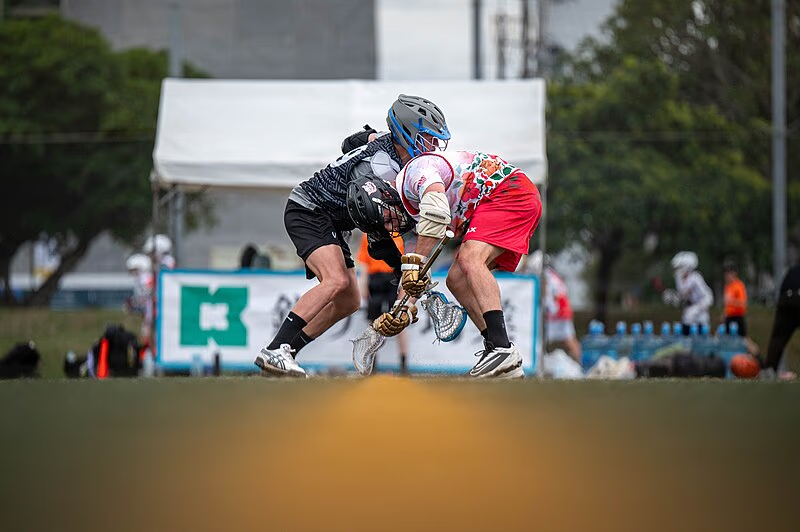
Play begins with a face-off at the center circle at the start of each quarter and after each goal. Two opposing players take the face-off:
- Both players crouch with their crosses on the ground, parallel to and on either side of the center line, with the ball between them.
- On the official's whistle, the players may use their crosses to control the ball. They may not touch the ball with their hands.
- All other players must remain in the wing areas or behind the restraining lines until a player gains possession or the ball crosses the restraining line.
- If neither player gains possession within the wing area after a contested face-off, play continues as the ball rolls free.
5.4 Draw — Women's Field
Women's lacrosse begins each half and restarts after each goal with a draw at the center circle. Two opposing players stand at the center circle with their crosses held at hip height. The ball is placed between the backs of the two crosses. On the official's whistle, both players draw their crosses up and away, propelling the ball into the air. All other players must stand outside the restraining circle (a circle of 9.1 m radius at center) until the draw is released.
5.5 Ball in Play
The ball is in play from the moment the official sounds the whistle to commence play. The ball becomes dead and play stops when:
- A goal is scored
- The ball goes out of bounds
- A foul is committed and the official sounds the whistle
- The official stops play for any other reason (injury, equipment failure, etc.)
5.6 Out of Bounds
When the ball goes out of bounds, possession is awarded to the team that did not touch the ball last before it went out (except after an unsuccessful shot on goal — see Section 6). On a shot that goes out of bounds, possession is awarded to the team whose player is closest to the ball at the point it crossed the boundary. If equidistant, a face-off/draw is conducted at the nearest restraining line.
5.7 Time-Outs
Each team is granted:
- Men's Field: Two (2) time-outs per game, each lasting 90 seconds. One additional time-out per overtime period.
- Women's Field: Two (2) time-outs per game, each lasting 90 seconds.
- Time-outs may only be requested by the head coach or a player in possession of the ball. Time-outs may only be called during a dead ball situation.
5.8 Overtime
If the score is tied at the end of regulation in men's field lacrosse, a sudden-victory overtime period is played. The first team to score wins. Overtime periods are typically four (4) minutes long in international competition, with a brief intermission and coin toss determining end choice and possession. In women's field, similar sudden-victory overtime rules apply. Additional overtime periods are played as necessary until a winner is determined.
5.9 Goalkeeper Privileges
The goalkeeper has special privileges within the crease:
- The goalkeeper may touch the ball with any part of the body (including hands) while within the crease.
- Opposing players may not enter the crease or make contact with the goalkeeper within the crease.
- In men's field, the goalkeeper has four (4) seconds to release the ball after gaining possession within the crease. Failure to do so results in a technical foul.
- In women's field, the goalkeeper has 10 seconds to release the ball from within the crease.
- The goalkeeper loses these privileges (including hand touching) when outside the crease.
5.10 Loose Ball and Possession
Players may contest possession of a loose ball using their crosses. A player who has possession of the ball may shield the ball with their body, but may not use their free hand to clamp or carry the ball. Players may run with the ball cradled in their crosse. Passing and catching are unrestricted in direction and distance.
Section 6: Scoring
6.1 Scoring a Goal
A goal is scored when the ball passes completely through the plane of the goal from front to back, between the goal posts and beneath the crossbar. The entire ball must cross the entire goal line for a goal to count. Goals are worth one (1) point each in standard field lacrosse.
6.2 Conditions for a Valid Goal
A goal is valid only if the following conditions are met:
- The goal was scored by an attacking player's crosse, body, or deflected off a defensive player — it may not be deliberately kicked or thrown with the hand by an attacking player.
- The attacking player who last touched the ball before it entered the goal was not in the crease at the time of the shot or in the act of scoring.
- The goalkeeper was not illegally displaced from the crease by an offensive player.
- The shot was taken before the expiration of the shot clock (where applicable).
- The goal was not scored after the official's whistle sounded to end a period.
6.3 Disallowed Goals
A goal will be disallowed if:
- An attacking player or any part of their body is in the crease at the moment of the shot or entry of the ball.
- The ball was propelled by a deliberate kick or thrown by hand by an attacking player immediately prior to entering the goal.
- The ball entered the goal after an official's whistle.
- The goal net was displaced from its proper position before the ball entered.
- A foul was committed by the scoring team on the play immediately leading to the goal.
6.4 Own Goals
If a defensive player causes the ball to enter their own goal, the goal is credited to the opposing team. If a goalkeeper accidentally puts the ball into their own net, the goal counts for the opposing team.
6.5 Out-of-Bounds After a Shot
When a shot on goal is taken and the ball goes out of bounds without entering the goal, possession is awarded as follows:
- The team whose player was closest to the ball when it went out of bounds is awarded possession at the spot where the ball crossed the boundary.
- If equidistant players from opposing teams are closest to the ball, a face-off (men's) or draw (women's) is conducted.
6.6 Winning the Game
The team with the greater number of goals at the end of regulation wins the game. In the event of a tie, overtime procedures (see Section 5.8) determine the winner. In tournament play, ties may stand in preliminary rounds per competition rules established by World Lacrosse or the host organizing committee.
6.7 Two-Point Goals (Lacrosse Sixes)
In the Lacrosse Sixes format (the Olympic discipline), a two-point goal line is marked on the field. A shot taken from behind this line that results in a goal counts as two (2) points. Standard goals scored from within the two-point line are worth one (1) point. This rule applies specifically to the Sixes format and not to standard men's or women's field lacrosse.
Section 7: Violations & Penalties
7.1 Overview of Foul Categories
World Lacrosse rules categorize fouls into two main types:
- Technical Fouls: Minor violations resulting in loss of possession or a 30-second suspension from the field (served in the penalty box) if the offending team had possession at the time of the foul.
- Personal Fouls: More serious violations resulting in a 1-minute or 3-minute suspension from the field (served in the penalty box). The offending team plays short-handed during the penalty time.
7.2 Technical Fouls — Men's Field
Technical fouls include (but are not limited to):
- Holding: A player uses their free hand, arm, or any part of their body to hold or pin an opponent's crosse or body.
- Pushing: A player pushes an opponent with the hands or arms from behind or in an unsafe manner.
- Withholding the ball from play: Deliberately trapping the ball against the ground or another player for an unreasonable period. Penalty: 30-second suspension or change of possession.
- Offside: A team does not maintain the required minimum number of players in each half of the field.
- Illegal crosse: Using a crosse that does not conform to specifications, including an illegal pocket depth.
- Stalling: A team in possession fails to advance the ball or make a genuine effort to attack the goal within the shot clock period.
- Goalkeeper crease violation: A goalkeeper holds the ball inside the crease for more than four (4) seconds.
- Interference: A player without the ball interferes with an opponent who does not have the ball and is not within 5 yards of the ball.
7.3 Personal Fouls — Men's Field
Personal fouls are more serious and result in a mandatory penalty suspension:
- Slashing: A player swings or strikes an opponent with the crosse in a reckless or uncontrolled manner — not in a legal check attempt. Penalty: 1-minute suspension.
- Tripping: A player obstructs an opponent below the knees with the crosse, feet, or legs. Penalty: 1-minute suspension.
- Cross-checking: A player uses the shaft of the crosse between the hands to check an opponent. Penalty: 1-minute suspension.
- Unnecessary roughness: Any excessively violent check or body contact beyond what is necessary in the normal flow of play. Penalty: 1- or 3-minute non-releasable suspension depending on severity.
- Unsportsmanlike conduct: Arguing with officials, taunting, using abusive language, or any conduct deemed detrimental to the game. Penalty: 1- or 3-minute non-releasable suspension; repeated offenses may result in ejection.
- Illegal body checking: A body check delivered from behind, to the head/neck area, or when the opponent does not have the ball or is more than 5 yards from a loose ball. Penalty: 1-minute suspension; more severe if flagrant.
- Illegal crosse (equipment): Using a crosse found to be intentionally altered to be illegal. Penalty: 3-minute non-releasable suspension.
7.4 Penalty Box and Man-Down Play
A player serving a personal foul penalty must leave the field and sit in the designated penalty area (penalty box). The offending team plays with fewer players for the duration of the penalty:
- Releasable penalty: The penalized player may return to the field if the opposing team scores a goal before the penalty time expires. (1-minute releasable penalties)
- Non-releasable penalty: The penalized player must serve the full penalty time regardless of goals scored. (3-minute penalties or flagrant fouls)
- Multiple simultaneous penalties may result in a team playing with as few as seven (7) field players.
- If equal numbers of players are penalized simultaneously from each team, the penalties offset and both teams remain at equal strength.
7.5 Free Positions — Women's Field
In women's lacrosse, fouls are adjudicated differently:
- Minor fouls: The fouled player is awarded a free position — unguarded possession at the spot of the foul. The fouling player must move four (4) meters away.
- Major fouls: The fouled player is awarded a free position at the spot of the foul or at the nearest point on the 11-metre arc if the foul occurred inside it. A free position inside the 11-metre arc places the fouled player at the arc with only the goalkeeper defending.
- Card system: Officials may issue yellow cards (2-minute suspension) and red cards (ejection) for serious misconduct. A player who receives two yellow cards in a game is ejected (red card).
7.6 Ejection
A player may be ejected from the game for:
- Five personal fouls in men's field lacrosse (fouling out)
- A flagrant foul — any act deemed by the official as deliberately violent or dangerous
- Receiving a red card in women's lacrosse
- Extreme unsportsmanlike conduct or refusing to comply with official instructions
An ejected player may be replaced by a substitute after the applicable penalty time is served, except where the ejection carries an additional non-releasable suspension period.
7.7 Crease Violations
- An attacking player entering the crease before, during, or after a shot nullifies any goal scored on that play. The ball is awarded to the defending team.
- A defensive player other than the goalkeeper who enters the crease to gain an advantage may be assessed a technical foul.
- An attacking player who is pushed or checked into the crease by a defender shall not be assessed a violation for that entry; the defender may be penalized instead.
Section 8: Safety Considerations
8.1 Mandatory Equipment Compliance
All players must wear the mandatory protective equipment specified in Section 2 before being permitted to take the field. Officials are required to inspect equipment prior to the start of each game. Any player found wearing non-compliant or damaged equipment must leave the field until the issue is corrected. Refusal to wear required equipment results in the player being barred from participation.
8.2 Head and Neck Injury Protocol
World Lacrosse follows international best practices regarding head injuries and concussion management:
- Any player who displays signs or symptoms of a concussion (loss of consciousness, confusion, unsteady gait, or reports of headache and dizziness following a blow to the head) must be immediately removed from play.
- A player removed for a suspected concussion may not return to play in the same game without written clearance from a qualified medical professional (team physician or certified athletic trainer).
- Officials are empowered to stop play and direct a player to the sideline if a head or neck injury is suspected, even without a formal medical staff request.
- Helmets must be properly fitted and the chin strap must be fastened before every play. Officials may stop play to require a player to replace a displaced or damaged helmet.
8.3 Illegal Contact Rules for Player Safety
Certain contact is explicitly prohibited to protect player safety:
- No contact to the head or neck: Any hit, check, or contact directed at a player's head or neck is a personal foul regardless of whether it was intentional.
- No checks from behind: Checks delivered to the back of a player who is unaware of the incoming contact are illegal and penalized as personal fouls.
- No hits on a player without the ball: Body checks are only legal against a player who has the ball or is within 5 yards of a loose ball in men's lacrosse.
- No late hits: A player may not be checked after releasing the ball if the check is not part of a continuous motion that began before the release.
8.4 Weather and Environmental Safety
Officials and event organizers are empowered and obligated to address unsafe weather and environmental conditions:
- Lightning: Play must be immediately suspended upon any observed lightning within 8 miles (approximately 13 km) of the playing venue. Play may resume no sooner than 30 minutes after the last observed lightning strike. This is a mandatory World Lacrosse and national association guideline.
- Extreme heat: Officials may grant additional water breaks or suspend play during periods of extreme heat. Teams should have water and electrolytes available at the bench at all times.
- Playing surface: If the playing surface becomes dangerous (waterlogged, icy, or excessively torn), the official may suspend or relocate the game at their discretion.
- Darkness: Outdoor games without adequate lighting must be suspended if visibility falls to an unsafe level.
8.5 Medical Personnel Requirements
World Lacrosse international competitions require:
- At least one qualified medical professional (sports medicine physician or certified athletic trainer) present at the venue for all games.
- Emergency medical services (EMS) on-call or on-site at the venue.
- Each team must have a designated medical contact or team trainer for communication with officials regarding player injuries.
- A first aid kit and automated external defibrillator (AED) must be accessible at or near the playing venue.
8.6 Equipment Inspection and Crosse Legality
Officials may inspect any player's equipment at any time during the game, including the crosse pocket depth:
- The pocket test is conducted by placing the ball in the pocket of the crosse and holding the head horizontal. If the top of the ball falls entirely below the bottom edge of the sidewall, the pocket is deemed too deep and is illegal.
- For women's field, the ball must sit above the sidewall in all horizontal planes.
- An illegal crosse discovered during a game results in a technical foul (first offense) or personal foul (if deemed intentionally altered). The player may correct the equipment or use a replacement crosse.
- Pre-game equipment inspections may be requested by either team's head coach, with final determination made by the referee.
8.7 Dangerous Play and Officials' Discretion
Officials retain broad discretion to penalize any act that they deem dangerous or likely to cause injury, even if not explicitly enumerated in the rules. The guiding principle is player safety. Any act — including legal body-checking techniques — that results in particularly dangerous contact may be penalized at the official's discretion as unnecessary roughness or flagrant misconduct. Player welfare takes precedence over strict application of technical rules in all safety-related decisions.