


🏛️Official — FIVB
Loading OpenSourceSports…
Team Sports
6 players
indoor
volleyball, net, post
10 essential rules
Volleyball was invented in 1895 by William G. Morgan at the YMCA in Holyoke, Massachusetts, USA. Originally called "Mintonette," the sport was designed as a less physically demanding alternative to basketball. The Fédération Internationale de Volleyball (FIVB) was founded on April 18, 1947, in Pa...
All balls used in a match must have the same characteristics regarding circumference, weight, pressure, type, and color (Rule 3.3). In FIVB World and Official Competitions, three balls are used.
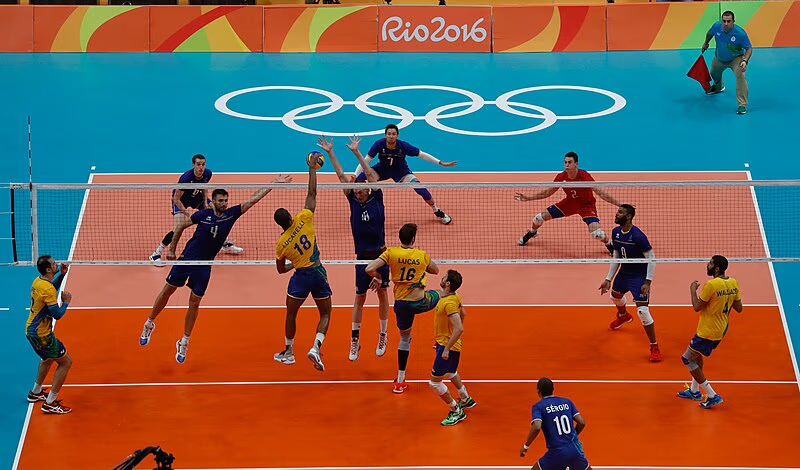
The net is placed vertically over the centre line. Its dimensions and specifications are as follows (Rule 2.1): Length: 9.50–10.00 m (31.2–32.8 ft); Width: 1.00 m (3.28 ft); Mesh: 10 cm × 10 cm (3.94 × 3.94 in) square mesh
The net height is measured from the centre of the playing court (Rule 2.1): Men: 2.43 m (7 ft 11⅝ in); Women: 2.24 m (7 ft 4⅛ in); Mixed (men and women together): 2.43 m
Shoes must be flexible and lightweight with rubber or leather soles, without heels (Rule 4.3.3). Players are not permitted to wear objects that may cause injury or give artificial advantage; smooth and/or protective braces may be worn (Rule 4.3.5).
The playing court is a rectangle measuring 18 m × 9 m (59.06 ft × 29.53 ft), surrounded by a free zone which is a minimum of 3 m (9.84 ft) wide on all sides. The free playing space is the space above the playing area which is free from any obstruction.
The playing surface must be flat, horizontal, and uniform. Indoor surfaces must be of wood or synthetic material.
All lines are 5 cm (1.97 in) wide. Lines must be a light color, different from the color of the floor and from any other lines.
In each court, an attack line is drawn 3 m (9.84 ft) from the axis of the centre line to delimit the front zone. The attack line is extended beyond the sideline by 5 short lines, each 15 cm (5.91 in) long, 5 cm wide, and spaced 20 cm (7.87 in) apa...
Front Zone: Bounded by the axis of the centre line and the edge of the attack line nearest to the net (Rule 1.4.1).; Back Zone: Bounded by the back edge of the attack line and the inside edge of the end line (Rule 1.4.2).; Service Zone: 9 m (29.53 ft) wide area behind each end line. The server mu...
For FIVB World and Official Competitions, the minimum temperature is 16°C (61°F) and the maximum is 25°C (77°F). The illumination level on the playing surface must be 1,000–1,500 lux (Rule 1.2 notes).
Self-call own violations in non-officiated play
In games without referees, players are culturally expected to call their own net touches, double contacts, lifts, and carries immediately. Failing to call an obvious personal violation is treated as cheating and severely damages trust within the playing community.
This norm extends to recreational beach volleyball where line calls are also player-managed.
Beach volleyball: self-call block touches honestly
In beach volleyball, the blocker is culturally and practically expected to immediately acknowledge when they touched a ball during a block attempt, because that contact counts as the team's first of three and changes the tactical situation. Deliberately concealing a felt touch is considered dishonest and violates the sport's strong self-officiating culture.
Applies specifically to beach volleyball where there are no line judges and minimal officiating; indoor volleyball has full referees who make this call.
Restrained celebration after opponent unforced errors
When an opponent commits an unforced error—service fault, ball hit out of bounds without a defensive play—excessive directed celebration is taboo. Quiet acknowledgment of the point is expected; pointing, taunting gestures, or directed dancing toward the opponent violates the code at all competitive levels including FIVB.
Contrast with celebrating a hard-earned defensive play or block, which is fully accepted.
Ready to dive deeper?
Honest out-of-bounds line calls benefit the doubt to opponent
In self-officiated matches, players call balls in or out honestly. The longstanding convention—borrowed from tennis and observed in recreational volleyball worldwide—is that a ball that genuinely could go either way is called in favor of the opponent.
Post-match handshake line at the net
After the final point of a match, both teams immediately line up and pass through the net handshaking or slapping hands with every opponent. Refusing to participate, dragging feet, or walking away before the line completes is considered a serious sign of disrespect toward the opponent.