









Section 1: Introduction
1.1 Governing Body & Official Rules Document
Squash is governed internationally by the World Squash Federation (WSF), headquartered in Hastings, United Kingdom. The official rules governing competition are published in the WSF Rules of Squash, with the current edition effective from 2020 and incorporating subsequent amendments. All WSF-sanctioned events, PSA World Tour events, and national federation competitions are conducted under these rules.
1.2 History of the Sport
Squash originated at Harrow School in London around 1830, when students discovered that a punctured racketball that "squashed" on impact created a more interesting game than a solid ball. The first purpose-built squash court was constructed at Harrow in 1864. The Squash Rackets Association (SRA) was founded in England in 1928, and the World Squash Federation was established in 1967 to govern the sport globally. Today WSF comprises over 150 national member federations.
1.3 Object of the Game
Squash is played by two players (singles) or four players (doubles) in an enclosed court. Each player uses a strung racket to alternately strike a hollow rubber ball against the front wall of the court. The object is to play the ball in such a way that the opponent is unable to make a good return, thereby winning a rally and, ultimately, the game and match. The ball must strike the front wall above the tin (the lower boundary board) and below the out line on each shot.
1.4 Scope of Rules
These rules apply to singles squash. Separate WSF rules govern doubles squash. Where a Referee is not appointed, players must apply the rules in a spirit of fair play and call lets or strokes as appropriate. In WSF-sanctioned events, a Referee and Marker are appointed to officiate matches.
Section 2: Equipment
2.1 The Ball (WSF Rules of Squash, Rule 2)
The ball used in official play must conform to WSF specifications and carry WSF approval. The ball is hollow and made of rubber compound.
- Diameter: 40.0–44.0 mm (1.57–1.73 inches)
- Weight: 23.0–25.0 grams (0.81–0.88 ounces)
- Stiffness: 3.2–4.5 kg at 20°C (68°F)
- Seam type: The ball may be seamless or have a seam, provided all other specifications are met
Balls are colour-coded by dot to indicate speed/bounce characteristics. The double yellow dot (extra slow) is the standard ball used in professional and elite competition. The single yellow dot (slow) is used in cooler courts or at recreational level. Orange and red dot balls are faster and used by beginners.
A ball must be replaced if it breaks during play. Either player may request a ball change if the ball becomes damaged or excessively worn. The Referee determines whether a change is warranted.
2.2 The Racket (WSF Rules of Squash, Rule 1)
Rackets must comply with WSF specifications. Only WSF-approved rackets may be used in sanctioned competition.
- Maximum overall length: 686 mm (27.0 inches)
- Maximum overall width: 215 mm (8.46 inches)
- Maximum strung area: 500 cm² (77.5 sq inches)
- Frame material: Any material, provided all other specifications are met
- Strings: Must be uniform; strings may not be arranged to provide extra catching or throwing effect. No attached objects may affect the flight of the ball
The frame and strings must be of uniform colour or combination of colours. A player whose racket is found to be non-compliant during a match may be required to change rackets. Failure to do so constitutes Conduct.
2.3 Player Attire
Players must wear appropriate squash attire. In WSF-sanctioned events, players must wear predominantly white or light-coloured clothing on glass show courts unless a special colour exception is granted by the event organisers. Footwear must be non-marking and suitable for squash court surfaces. Eye protection is mandatory in doubles and strongly recommended for all players at all levels.
Section 3: Playing Area
3.1 Court Dimensions (WSF Rules of Squash, Rule 1 – Court Specifications)
A singles squash court is a rectangular enclosed space with the following official dimensions:
- Length (front wall to back wall): 9.750 m (32 feet 0 inches)
- Width (side wall to side wall): 6.400 m (21 feet 0 inches)
- Diagonal (floor): 11.665 m (38 feet 3 inches)
3.2 Front Wall Markings
- Out Line (top boundary): 4.570 m (15 feet 0 inches) above the floor — a horizontal line across the full width of the front wall. Any ball striking the out line or above is out.
- Service Line: 1.830 m (6 feet 0 inches) above the floor — a horizontal line across the front wall. Service must strike the front wall above this line.
- Tin (lower boundary board): The bottom 0.480 m (19 inches) of the front wall is marked by the tin (or board). Any ball striking the tin or below is out. The tin produces a distinctive sound when struck to assist the Marker.
3.3 Side Wall Markings
The out line continues from the front wall top (4.570 m) along each side wall, sloping downward to the back wall at a height of 2.130 m (7 feet 0 inches). This sloping line on each side wall marks the upper boundary. Any ball striking the side wall on or above the out line is out.
3.4 Back Wall
The back wall minimum height is 2.130 m (7 feet 0 inches). The out line on the back wall is at 2.130 m. Any ball striking above 2.130 m on the back wall (or above the out line) is out.
3.5 Floor Markings
- Short Line: A line drawn across the full width of the floor, parallel to the front and back walls, at 5.490 m (18 feet 0 inches) from the front wall (equivalently, 4.260 m / 14 feet from the back wall). The short line divides the court into the front court (service courts) and the back court.
- Half-Court Line: A line drawn from the middle of the short line to the middle of the back wall, dividing the back court into left and right service boxes.
- Service Boxes: Two boxes, each 1.600 m (5 feet 3 inches) square, formed by the short line, the half-court line, and each side wall respectively. The server must stand with at least one foot in the service box when serving.
3.6 Court Construction
Court walls are typically constructed of plaster, plywood, or glass panels. The floor is typically made of sprung hardwood (e.g., maple). All lines on the court shall be 50 mm (2 inches) wide. Lines are part of the boundary they define — a ball contacting a line is considered to have struck the boundary itself (i.e., it is out or down).
Section 4: Players & Officials
4.1 Players
A singles match is contested between two players. Each player is responsible for knowing and applying the rules of the game. In the absence of a Referee, players must conduct play under the rules in a spirit of fair play, calling lets and strokes as required. Players may request a let or call for a stroke when appropriate interference occurs.
A player may not receive coaching or instruction during a match except during the interval between games. Communication from coaches or spectators during a rally is not permitted. Violation of this rule may result in a Conduct Warning.
4.2 The Marker (WSF Rules of Squash, Rule 16)
The Marker calls the score and announces decisions. Specific duties include:
- Calling "Fault," "Foot fault," "Not up," "Down," or "Out" for incorrect play
- Repeating the Referee's decisions and calling the score after each rally
- Calling "Hand out" to indicate a change of service
- Announcing "Match ball" or "Game ball" when applicable
If a Marker is unsure whether a ball was down or out, the Marker shall not make a call and shall allow the rally to continue. The Marker's call of "Not up" or "Down" ends the rally immediately.
4.3 The Referee (WSF Rules of Squash, Rule 17)
The Referee is responsible for the conduct of the match and has final authority over all decisions. Specific duties include:
- Deciding all appeals by players against the Marker's calls (Rule 17.1)
- Awarding lets and strokes when interference occurs (Rule 12)
- Applying Conduct regulations (Rule 15)
- Stopping play for injury, bleeding, or dangerous conditions
- Awarding games or the match in cases of Conduct
The Referee's decision on all matters of fact is final and cannot be appealed. A player may ask the Referee to review a Marker's call; the Referee's ruling on such an appeal is also final.
4.4 Video Replay (VAR/Hawk-Eye)
At WSF World Championships and major PSA events where video replay technology is available, the Referee may use video review to assist in determining whether a ball was in or out, or for other factual decisions at the Referee's discretion.
4.5 Match Officials for Self-Officiated Play
When no officials are appointed (recreational or club play), both players act as joint referees. Either player may call a let. Any dispute about whether a ball was good should result in a let being played. Players are expected to make fair and honest decisions.
Section 5: Rules of Play
5.1 Spin (WSF Rules of Squash, Rule 3)
Before the first game, a spin of the racket or other fair method determines which player has the choice of serving first or which side of the court to serve from first. The winner of the spin has the choice.
5.2 Warming Up (WSF Rules of Squash, Rule 4)
Players are entitled to a warm-up period on court before the match commences. At WSF-sanctioned events the warm-up is 5 minutes. Players shall share the use of the ball equitably during the warm-up. If a player is not ready to begin play at the end of the warm-up period, the Referee may apply Conduct regulations.
5.3 Service (WSF Rules of Squash, Rules 7 & 8)
At the start of each game and following each hand-out, the server must serve from one of the two service boxes. The server may choose which box to serve from at the start of a game; thereafter, the server alternates boxes with each successful rally won while serving — unless the Referee awards a stroke to the server, in which case the server serves from the same box again.
Requirements for a good service (Rule 7):
- The server must stand with at least one foot within the service box and no part of either foot touching the service box line (Rule 7.1).
- The server must drop or toss the ball and strike it before it bounces on the floor (Rule 7.2).
- The ball must strike the front wall above the service line and below the out line (Rule 7.3).
- The ball must land in the opposite back quarter of the court on its first bounce — specifically in the area beyond the short line and between the half-court line and the far side wall (Rule 7.4).
- Only one service attempt is permitted per rally (no second serve) (Rule 7.5).
If service is not good for any reason, it is a fault and a hand-out is declared. The receiver becomes the new server. A foot fault is declared if the server fails to have at least one foot inside the service box at the moment of striking the ball.
5.4 The Return of Service and Rally Play (WSF Rules of Squash, Rules 9 & 10)
After a good service, players alternate hitting the ball. Each shot must strike the front wall above the tin and below the out line before touching the floor. The ball may strike any number of side walls or the back wall before reaching the front wall, provided it does not touch the floor first (Rule 9.1).
A player may also play the ball onto a side wall or the back wall first, provided the ball then strikes the front wall above the tin and below the out line (these are called "boast" or "angle" shots).
The ball is NOT good (a player loses the rally) in the following circumstances (Rule 10):
- Down: The ball strikes the tin or the floor below the tin on the front wall (Rule 10.1)
- Out: The ball strikes the out line or above, on any wall (Rule 10.2)
- Not up / Double bounce: The player fails to strike the ball before it bounces twice on the floor (Rule 10.3)
- Carry or Sling: The player deliberately causes the ball to travel along the racket face (Rule 10.4)
- Striking the ball twice: The player strikes the ball more than once in a single attempt (Rule 10.5)
- Body contact before front wall: The ball touches the player's clothing or body before striking the front wall (Rule 10.6)
- Not attempting: The player does not attempt a shot before the ball bounces twice (implicit in Rule 10.3)
5.5 Interference (WSF Rules of Squash, Rule 12)
Interference is one of the most complex aspects of squash rules. Interference occurs when a player's access to the ball, their swing, or their movement toward the ball is obstructed by their opponent.
Obligations of the player who last struck the ball (Rule 12.1):
- Make every effort to provide the opponent with unobstructed direct access to the ball
- Allow the opponent a fair view of the ball
- Allow the opponent freedom to play the ball to any part of the front wall and to either side wall to the back wall
- Avoid creating crowding, causing the opponent to be unable to swing the racket freely
When interference occurs, the Referee may award (Rule 12.4):
- A Let: Replay the rally — awarded when interference occurred but the player could not have made a winning shot and did not clearly have a clear path to the ball; or when the player stops play due to reasonable fear of hitting the opponent with the racket or ball
- A Stroke: Point awarded to the player who was interfered with — awarded when the player would have made a good return had interference not occurred AND the player would have won the rally; or when the player refrains from hitting due to reasonable belief the ball would have struck the opponent
- No let: Denied — awarded when there was no interference, the player created the interference themselves, or the player made no attempt to play the ball despite being able to do so
Turning (Rule 12.6): If a player turns to play the ball behind them (the ball has passed the player and they turn to strike it going back the other direction), the Referee shall stop play and award a let, unless the striker would clearly have won the rally, in which case a stroke is awarded. Play shall not continue where a turning situation has occurred and the risk of striking the opponent is high.
5.6 Lets (WSF Rules of Squash, Rule 13)
A let is the replaying of a rally. Lets are awarded in addition to interference situations in the following circumstances:
- The ball breaks during play (Rule 13.1.1)
- The ball strikes any object that has fallen onto the court (Rule 13.1.2)
- The Referee is unable to make a decision on an interference call (Rule 13.1.3)
- The striker refrains from completing a shot due to reasonable fear of striking the opponent, even if the interference was accidental (Rule 13.1.4)
- A rally is interrupted by an unexpected distraction outside the court
A player must stop play and appeal immediately upon interference. A player who continues to play after interference has occurred is deemed to have accepted the situation and forfeits the right to claim a let or stroke.
5.7 Intervals & Rest Periods (WSF Rules of Squash, Rule 6)
- Between games: 90 seconds maximum (Rule 6.1)
- Prior to the fifth game (if applicable): 120 seconds maximum (Rule 6.2)
- Intervals begin when the previous game ends. Players must be ready to resume at the expiration of the interval. Failure to be ready may result in a Conduct Warning.
Section 6: Scoring
6.1 Scoring System — Point-a-Rally (PAR) (WSF Rules of Squash, Rule 5)
The WSF uses Point-a-Rally (PAR) scoring, also referred to as PARS-11. Under this system, a point is scored on every rally regardless of which player served. This replaced the earlier hand-in/hand-out (HIHO) scoring system for international competition.
6.2 Games
A game is won by the first player to reach 11 points, provided that player leads by at least 2 points (Rule 5.1). If the score reaches 10-10, play continues until one player leads by 2 points. There is no upper cap — a game at 10-10 could theoretically continue indefinitely until a 2-point lead is established (e.g., 15-13, 22-20, etc.).
6.3 Match Format
A standard match is the best of five games (first to win three games wins the match) (Rule 5.3). At the WSF World Championships and most major PSA World Tour events, the best-of-five format is used. Some lower-tier events may use a best-of-three format, at the discretion of the event organisers.
6.4 Serving Order
The server is determined at the start of the match by spin. At the start of each subsequent game, the player who won the previous game serves first. During a game, service changes hands (hand-out) whenever the server loses a rally. The server continues to serve until losing a rally, at which point the receiver becomes the new server (Rule 5.2).
6.5 Calling the Score
The Marker calls the score after each rally, announcing the server's score first. For example, "3-2" means the server has 3 points and the non-server has 2 points. When a hand-out occurs, the Marker announces "Hand out" before calling the new score. The Marker announces "Match ball" when the server requires one more point to win the match, and "Game ball" when the server requires one more point to win the current game.
6.6 Awarding Points for Conduct
Under the Conduct regulations (Rule 15), the Referee may award a Conduct Stroke (one point to the opponent), a Conduct Game (the current or next game to the opponent), or a Conduct Match. These are counted in the score as if played. See Section 7 for details.
Section 7: Violations & Penalties
7.1 Fault on Service (WSF Rules of Squash, Rule 8)
A service is a fault (resulting in a hand-out — the opponent becomes the new server) when:
- The server fails to keep at least one foot inside the service box at the moment of striking the ball (foot fault) (Rule 8.1)
- The served ball strikes the front wall on or below the service line, or on or above the out line (Rule 8.2)
- The served ball, after striking the front wall correctly, does not land on the floor in the opposite back quarter (i.e., it lands in the front court, or in the server's back quarter) (Rule 8.3)
- The served ball touches the side wall, back wall, or ceiling before landing on the floor in the required area (Rule 8.4)
- The server drops or tosses the ball to serve, and the ball touches the floor (Rule 8.5)
- The server fails to hit the ball on the drop/toss (an "air ball") — this is not a fault per se but the serve is void and replayed only with Referee's discretion; generally it is called a fault
Unlike tennis, squash allows only one service attempt per rally. A fault results immediately in a hand-out; there is no second serve.
7.2 Ball Not Up (Down) (WSF Rules of Squash, Rule 10)
A player loses the rally when the ball is "not up" — meaning the player failed to return the ball before it bounced twice, or struck it after two bounces. The Marker calls "Not up" to end the rally.
7.3 Ball Hitting the Tin or Going Out
A rally is lost immediately when the ball strikes the tin (the board at the base of the front wall), strikes the front wall below the tin level, strikes the floor before reaching the front wall, or strikes on or above the out line on any wall. The Marker calls "Down" for tin strikes and "Out" for balls above the out line.
7.4 Deliberate or Excessive Interference (WSF Rules of Squash, Rule 12)
If a player deliberately impedes the opponent, the Referee shall award a Stroke to the opponent and may also award a Conduct Warning or Conduct Stroke (Rule 12.5). Excessive or repeated accidental interference that suggests a pattern of deliberate obstruction may also be treated as a Conduct matter.
7.5 Conduct Regulations (WSF Rules of Squash, Rule 15)
The Referee has authority to enforce Conduct regulations to prevent behaviour detrimental to the game. The progressive scale of sanctions is:
- Conduct Warning (yellow card): A formal caution. No point is deducted. The Referee announces "Conduct Warning [player name] for [reason]." (Rule 15.1)
- Conduct Stroke (red card): One point is awarded to the opponent. The Referee announces "Conduct Stroke [player name] for [reason]." (Rule 15.2)
- Conduct Game: The current game (or the next game, if a game has just ended) is awarded to the opponent. (Rule 15.3)
- Conduct Match: The match is awarded to the opponent. (Rule 15.4)
Sanctionable conduct includes (but is not limited to): deliberate time-wasting; audible or visible obscenity; ball or racket abuse; verbal abuse of the opponent or officials; not being ready to play at the end of an interval; excessive appeals or disputing decisions; leaving the court without permission; and physical contact with or threatening behaviour toward the opponent.
The Referee may skip earlier stages of the progression if the offence warrants it (e.g., going directly to Conduct Game or Conduct Match for serious misconduct).
7.6 Injury and Bleeding (WSF Rules of Squash, Rule 14)
If a player is injured during play, the Referee shall stop the match. If the injury is caused by the opponent's action, the injured player is allowed reasonable time to recover (Rule 14.1). If the injury is self-inflicted or the result of the player's own action, the player is allowed a maximum of three minutes to recover, after which the Referee shall award the match to the opponent if the player is unable to continue (Rule 14.2).
If a player is bleeding, play must be stopped immediately. The player must have the wound treated and covered before play resumes. A bleeding stoppage is treated as a self-inflicted injury for time purposes (Rule 14.3).
7.7 Broken Ball During a Rally
If the ball breaks during a rally, a let is played. The broken ball must be replaced. If it is unclear at what point during the rally the ball broke, the let covers the entire rally.
Section 8: Safety Considerations
8.1 Eye Protection
Eye injuries represent the most serious safety risk in squash due to the enclosed court, small ball, and high swing speeds. The WSF and all national federations strongly recommend that all players wear WSF-approved protective eyewear at all times during play and warm-up. Eye protection is mandatory in doubles squash at all levels. Many national federations and junior competitions now mandate eye protection for all players. WSF-approved eyewear must meet the relevant national standards (e.g., ASTM F803 in the United States, CSA Z262.2 in Canada).
8.2 Interference and Physical Contact (WSF Rules of Squash, Rule 12)
A core safety principle in squash is that players must not strike their opponent with the racket or ball. A player is expected to stop playing and appeal for a let or stroke rather than risk striking the opponent. The Referee shall award a let or stroke to any player who, in the Referee's judgment, stopped play because of a reasonable fear of striking the opponent with the racket or ball — even if actual interference by the opponent was minimal (Rule 12.4.3).
If a player's racket or the ball actually strikes the opponent during a rally:
- If the striker could have made a good return, and the opponent was in the line of a reasonable swing, a let is generally awarded (Rule 12)
- If the striker turned and struck the opponent while the opponent was behind the striker, the Referee shall stop play and award a let (or stroke if clear winner) due to the inherent safety risk of turning shots (Rule 12.6)
8.3 Dangerous Play
Players must not play recklessly or in a manner likely to cause injury. Excessive backswings that endanger the opponent are considered dangerous play. The Referee may call a let and issue a Conduct Warning if a player's swing is unreasonably large or reckless given the proximity of the opponent. Repeated dangerous play shall result in escalating Conduct sanctions.
8.4 Court Safety Standards
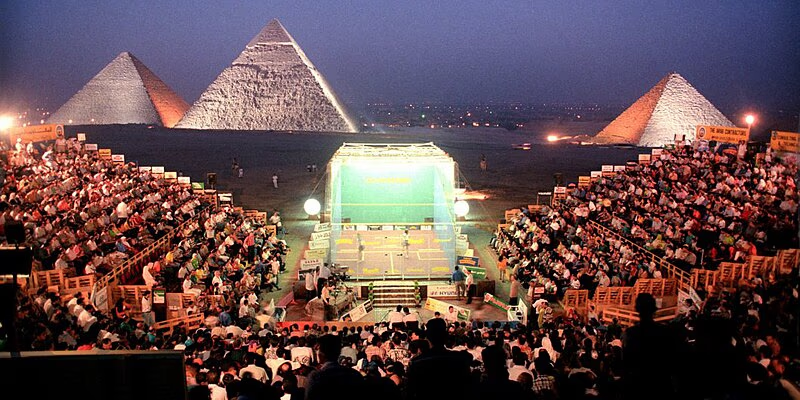
The WSF publishes standards for court construction to ensure player safety. Glass courts used for show court matches must meet WSF glass court specifications, including the use of toughened or laminated safety glass. All doors must open outward and be flush with the court walls when closed. Any equipment, lights, or camera housings within or near the court must be padded if within range of player contact.
8.5 Wet or Dangerous Court Conditions
If the court floor becomes wet (due to sweat, a leaking roof, or condensation on a glass court) or dangerous in any way, the Referee must stop play. The match may not resume until the hazard has been eliminated. Players may request that a court be assessed for safety. The Referee's decision on whether conditions are safe is final.
8.6 Medical Emergencies
If a player collapses, loses consciousness, or suffers a medical emergency, the Referee must immediately stop the match and summon medical assistance. The match result is determined in accordance with WSF rules for injury where necessary, but player welfare takes absolute priority over any competitive consideration.
8.7 Heat and Hydration
Squash is an extremely high-intensity sport. Players are permitted to bring water to the court and may take brief drinks between games and during injury time-outs. Players experiencing serious heat-related illness (dizziness, confusion, cramping) should stop play immediately and seek medical attention. Tournament organisers are responsible for ensuring adequate ventilation in enclosed courts.