


🏛️Official — WSF
Loading OpenSourceSports…
Racquet Sports
1–2 players
indoor
squash ball, racket, court
10 essential rules
Squash is governed internationally by the World Squash Federation (WSF), headquartered in Hastings, United Kingdom. The official rules governing competition are published in the WSF Rules of Squash, with the current edition effective from 2020 and incorporating subsequent amendments. All WSF-sanc...
The ball used in official play must conform to WSF specifications and carry WSF approval. The ball is hollow and made of rubber compound.
The frame and strings must be of uniform colour or combination of colours. A player whose racket is found to be non-compliant during a match may be required to change rackets.
Players must wear appropriate squash attire. In WSF-sanctioned events, players must wear predominantly white or light-coloured clothing on glass show courts unless a special colour exception is granted by the event organisers.
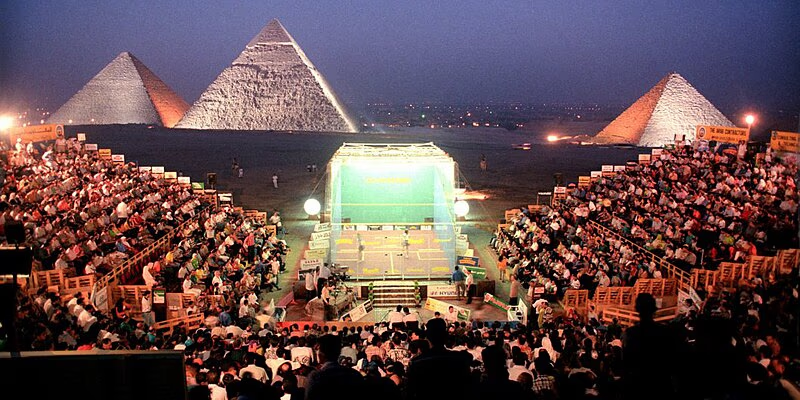
A singles squash court is a rectangular enclosed space with the following official dimensions: Length (front wall to back wall): 9.750 m (32 feet 0 inches); Width (side wall to side wall): 6.400 m (21 feet 0 inches); Diagonal (floor): 11.665 m (38 feet 3 inches)
Out Line (top boundary): 4.570 m (15 feet 0 inches) above the floor — a horizontal line across the full width of the front wall. Any ball striking the out line or above is out.; Service Line: 1.830 m (6 feet 0 inches) above the floor — a horizontal line across the front wall. Service must strike ...
The out line continues from the front wall top (4.570 m) along each side wall, sloping downward to the back wall at a height of 2.130 m (7 feet 0 inches). This sloping line on each side wall marks the upper boundary.
The back wall minimum height is 2.130 m (7 feet 0 inches). The out line on the back wall is at 2.130 m.
Short Line: A line drawn across the full width of the floor, parallel to the front and back walls, at 5.490 m (18 feet 0 inches) from the front wall (equivalently, 4.260 m / 14 feet from the back wall). The short line divides the court into the front court (service courts) and the back court.; Ha...
Court walls are typically constructed of plaster, plywood, or glass panels. , maple).
A singles match is contested between two players. Each player is responsible for knowing and applying the rules of the game.
Call your own tin and double-bounce honestly
In self-refereed squash — the norm at amateur and recreational levels — players are expected to call their own down balls (tin hits) and double-bounces without waiting to be challenged. Failing to do so is a serious breach of the code; squash's culture prizes self-honesty above almost all else.
At the professional level, referees and video replay handle these calls, but honest self-refereeing is foundational to squash culture at every other level.
Do not deliberately target the opponent with the ball
When an opponent is obstructing your shot and you could claim a let, deliberately blasting the ball directly at their body instead is considered dangerous and unsporting. The enclosed glass-and-plaster court makes a hard ball at close range genuinely hazardous; taking the let is always the expected choice.
Accidental body contact during normal play is part of the sport; deliberate targeting is a different matter entirely.
Volunteer the let or stroke when you've clearly obstructed
If you know you impeded your opponent — blocking their swing path or cutting off their line to the ball — good sportsmanship dictates conceding the let, or even the stroke, before they ask. Waiting for your opponent to appeal when you know you obstructed them is considered poor form.
Ready to dive deeper?
Accept referee decisions without prolonged dissent
At the professional and elite level, disputing a referee's let or stroke decision beyond a brief query is strongly frowned upon. Players may politely ask for clarification but extended argument, visible frustration directed at officials, or repeated challenges to rulings is considered conduct unbecoming.
The PSA World Tour has formal conduct rules, but the cultural norm against dissent predates and underlies them.
Do not overclaim lets
Requesting a let when you clearly had no genuine shot at the ball — because you were out of position, hit a poor shot, or the interference was trivial — is widely condemned as gamesmanship. The let system exists for genuine interference, not as a tactical reset.
Chronic let-fishing is one of the most criticized behaviors in club and amateur squash.
Call a let — don't swing — when you've turned on the ball
When a ball passes behind you and you consider turning to play it with your opponent in the swing arc, the strong cultural expectation is to stop and call a let rather than swing. The closed court makes a turning swing genuinely dangerous. Even if you could have hit a winner, a stroke should never be claimed after turning.
The WSF rules address turning in Rule 8 but the cultural norm goes further: proactively calling a let rather than waiting for the opponent to object is expected.