


🏛️Official — ISSF
Loading OpenSourceSports…
Individual Sports
1 players
both
firearm, target face, jacket
10 essential rules
Shooting has been part of every modern Olympic Games since 1896 (absent only in 1904 and 1928), making it one of the original Olympic sports. The International Shooting Sport Federation (ISSF), founded in 1907 and headquartered in Munich, Germany, governs the sport under the ISSF Official Statute...
Calibre: 4.5 mm (.177 cal) only (ISSF Section 7); Maximum weight: 5.5 kg (12.1 lb) including all accessories; Power source: Pre-charged pneumatic (PCP) or spring-piston; CO2 and gas-powered rifles are prohibited (ISSF Section 7)
Calibre: 5.6 mm (.22 LR) rimfire only (ISSF Section 7); Maximum weight: 8.0 kg (17.6 lb) including all accessories; Sights: Aperture sights only (same as 10 m); no telescopic or optical sights (ISSF Section 7)
Calibre: 4.5 mm (.177 cal), single-shot (ISSF Section 8); Maximum weight: 1.5 kg (3.3 lb); Grip: Must not extend above the wrist (no wrist support); the angle between the grip and barrel axis is regulated (ISSF Section 8)
Rapid Fire Pistol (men): .22 Short calibre, semi-automatic, 5-round magazine. Maximum weight 1.26 kg (2.78 lb). Trigger minimum 1000 g (2.2 lb).; Sport Pistol (women): .22 LR calibre, semi-automatic, 5-round magazine. Maximum weight 1.4 kg (3.1 lb). Trigger minimum 1000 g (2.2 lb).; Both: grip mu...
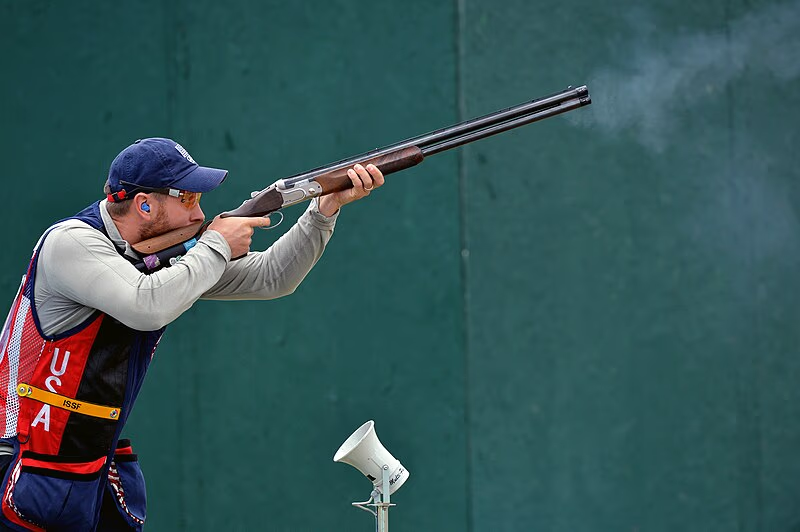
Gauge: 12-gauge maximum (most common); smaller gauges permitted but not competitive at elite level (ISSF Section 9); Action types: Over-under (most common), semi-automatic, or side-by-side (ISSF Section 9); Ammunition: Maximum load 24 g (0.85 oz) of shot. Maximum shot size 2.5 mm (No. 7½). Lead s...
Shooting jacket (rifle/pistol): Maximum material thickness regulated by ISSF (measured by stiffness gauge). Provides stabilization for standing and kneeling positions. Must not be so rigid as to constitute a brace or external support (ISSF Section 6).; Shooting trousers: Maximum stiffness regulat...
Distance: 10 m (32.8 ft) from firing line to target face; Indoor facility: Temperature-controlled, enclosed, with consistent lighting (minimum 1500 lux at the target) (ISSF Section 6); Firing points: Minimum 1.0 m (3.3 ft) wide per athlete. Separated by partitions to prevent visual distraction.
Distance: 50 m (164 ft) from firing line to target (ISSF Section 6); Outdoor or indoor: Outdoor ranges typical; covered firing points to protect athletes from weather (ISSF Section 6); Firing points: Minimum 1.25 m (4.1 ft) wide. Shooting mats provided for prone position.
Distance: 25 m (82 ft) from firing line to targets (ISSF Section 6); Rapid Fire Pistol: 5 targets in a row, 0.75 m (2.5 ft) apart (center to center). Targets turn to face the shooter for timed series (electronic turning mechanism).; Sport Pistol: Single target per firing point; precision and rapi...
Trench: 15 target-throwing machines arranged in 5 groups of 3 (left, center, right) in a trench 15 m (49 ft) in front of the shooting stations (ISSF Section 9); Shooting stations: 5 stations in a line, 3 m (9.8 ft) apart. Athletes rotate through all 5 stations during a round.; Targets (clays): St...
Absolute silence during a relay
Spectators, coaches, and non-competing shooters are expected to maintain complete silence while a relay is in progress. Even quiet conversation near the firing line is considered a serious breach of etiquette that could disturb a competitor's concentration during a shot.
Applies in all ISSF disciplines — rifle, pistol, and shotgun preparation phases. Some ranges post written rules, but the cultural expectation goes far beyond any posted sign.
No coaching from the stands during individual competition
In ISSF individual events, coaches and team staff are expected to stay silent and not call out advice, technical cues, or score updates while the athlete is on the firing line. Verbal coaching mid-relay is seen as a form of outside assistance that undermines the individual nature of the discipline.
ISSF rules restrict formal coaching in finals; the unwritten norm extends this expectation to qualification rounds where the written rule is less explicit.
Do not disturb a shooter in their preparation routine
Approaching, speaking to, or physically passing close behind a competitor who is in their pre-shot routine or dry-firing preparation is considered a serious lapse of etiquette. Each shooter's pre-relay mental preparation is treated as inviolable personal space.
Particularly relevant in 10m and 50m events where mental focus is paramount; even well-meaning words can break concentration built over hours.
Lend equipment to a competitor in need
If a fellow competitor suffers an equipment failure before or during competition and you have a spare part or compatible item, it is expected you offer it — even if that person is your direct rival. Refusing to help when you easily could is considered deeply unsporting.
Particularly observed at major championships where replacement equipment is difficult to source quickly. The spirit of individual sport solidarity is strong in shooting culture.
Ready to dive deeper?