












Section 1: Introduction
1.1 Overview and Governing Body
Nordic combined has been part of the Olympic program since the inaugural Winter Games at Chamonix in 1924, making it one of the oldest winter Olympic disciplines. Governed by FIS under ICR Book III (Ski Jumping) and Book II (Cross-Country Skiing) with combined-specific regulations in the Nordic Combined section, the sport uniquely demands that athletes excel in two fundamentally different physical disciplines: the explosive power and aerial technique of ski jumping, and the sustained aerobic endurance of cross-country skiing.
1.2 History and Olympic Evolution
Originally a single event (18 km cross-country + jumping), Nordic combined has expanded over the decades. The Individual Normal Hill/10 km was joined by the Team event (1988) and the Individual Large Hill/10 km (2002, replacing the original Sprint format). The Gundersen method, introduced in the 1980s, revolutionized the sport by converting jumping points into time gaps, creating dramatic pursuit-style cross-country finishes where the first athlete across the line wins.
1.3 Women's Nordic Combined
Women’s Nordic combined has been contested at FIS World Championships since 2021 and is scheduled for its Olympic debut at the 2026 Milano-Cortina Games. The women’s program features the Individual Normal Hill/5 km event. The growth of women’s ski jumping (Olympic since 2014) provided the foundation for expanding combined disciplines to women.
1.4 Olympic Events
- Individual Normal Hill / 10 km: One competition jump from the Normal Hill (HS 98–109), followed by a 10 km cross-country race
- Individual Large Hill / 10 km: One competition jump from the Large Hill (HS 127–145), followed by a 10 km cross-country race
- Team Large Hill / 4×5 km Relay: 4 athletes per team each jump once, then race a 4×5 km cross-country relay
- Women’s Individual Normal Hill / 5 km (debuting 2026): One jump, followed by a 5 km cross-country race
Section 2: Equipment
2.1 Ski Jumping Equipment
- Jumping skis: Maximum length 145% of body height, adjusted by BMI (lower BMI = shorter maximum ski length, per FIS BMI-to-ski-length table). Minimum ski width 95 mm at the binding. Maximum weight per ski not to exceed half the ski length in grams (e.g., max 1350 g for a 270 cm ski).
- Jumping suit: Maximum material thickness 6 mm (0.24 in). Air permeability minimum 40 l/m²/s (tested by FIS gauge). No inflation or aerodynamic aids. Suit must be measured and stamped by FIS equipment controllers before competition.
- Jumping boots: Maximum sole height 45 mm at the heel; boot must be compatible with the approved binding system
- Helmet: FIS-approved helmet mandatory for the jumping phase; must meet EN 1077 or equivalent certification
- Goggles: Recommended during the jumping phase; must not provide aerodynamic advantage
2.2 Cross-Country Equipment
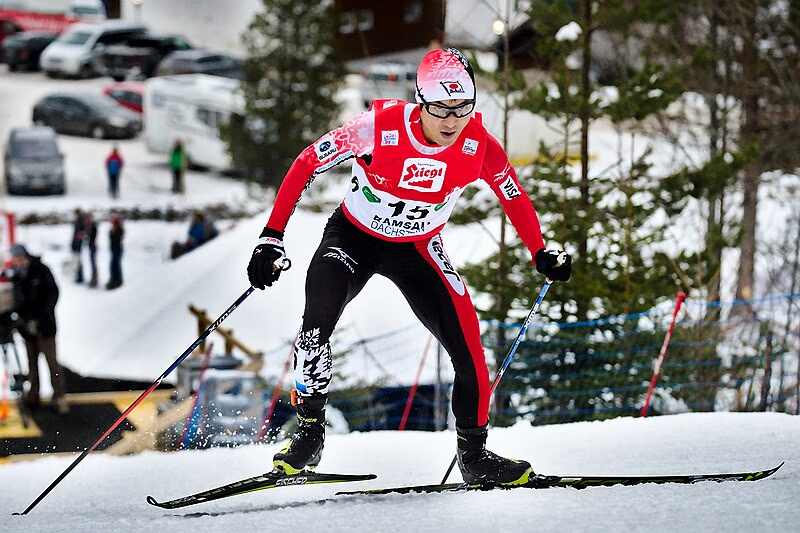
- Skating skis: Free technique is standard for the cross-country phase. Minimum length = athlete’s height minus 10 cm. Skis must comply with all FIS cross-country equipment rules.
- Skating poles: Maximum length 100% of body height. Pole baskets maximum 100 cm².
- Skating boots: High-cuff design with ankle support; must be commercially available and FIS-approved
- Wax: Glide wax only (no kick wax for skating). Fluorocarbon wax prohibited since 2023–2024 season.
- Race suit: Standard cross-country race suit; bib number worn during the cross-country phase
2.3 Equipment Transition
- Athletes carry or transport two complete sets of equipment: jumping gear and cross-country gear
- Equipment is pre-positioned in the transition area before the jumping phase begins
- Rapid transition between jumping and skiing equipment is essential; teams practice transition to minimize time
- Equipment controllers may inspect cross-country skis for fluorocarbon wax during the transition period
Section 3: Playing Area
3.1 Ski Jumping Hill
- Normal Hill: Hill Size (HS) 98–109 m. K-point (construction point) approximately 90–100 m. In-run length, takeoff table angle, and landing slope profile must meet FIS homologation standards.
- Large Hill: HS 127–145 m. K-point approximately 120–130 m. Full FIS homologation certificate required.
- Wind screens: netting or barriers along the in-run and landing hill to reduce crosswind effects
- Judges’ tower: positioned at the K-point level, perpendicular to the landing slope, housing 5 style judges with clear sightlines
- Speed measurement at the takeoff edge and distance measurement (video-based or manual)
3.2 Cross-Country Course
- 10 km course: 2.5 km or 5 km laps; total climb 250–420 m. Course terrain one-third uphill, one-third downhill, one-third flat.
- 5 km course (team relay / women): 2.5 km laps; total climb 125–210 m
- Minimum course width 6 m for free technique (skating)
- Course must be FIS-homologated with a valid certificate
- Course marked with directional arrows, distance markers every 1 km, and competitor information boards
3.3 Transition and Stadium Area
- Transition area between jumping hill and cross-country start: athletes change from jumping to skiing equipment. Minimum size to accommodate all competitors simultaneously.
- Stadium area includes: cross-country start zone (staggered start positions), finish straight (minimum 100 m), exchange zone (30 m for relay), electronic timing mats, and spectator viewing areas
- Results display board visible from the stadium showing jumping scores and cross-country time gaps
- Warm-up area adjacent to the cross-country start with groomed snow lanes
Section 4: Players & Officials
4.1 Athlete Qualifications
- Athletes must hold a valid FIS license and be registered by their national federation
- Olympic quotas: maximum 5 athletes per nation for individual events; 1 team per nation for the team event
- Athletes must meet minimum FIS points requirements in both ski jumping and cross-country to qualify
- Minimum age: 16 for Continental Cup; 18 for World Cup and Olympic competition
- The same athlete must compete in both the jumping and cross-country phases — no substitutions between phases
4.2 Team Composition
- Individual events: Each athlete competes alone in both phases
- Team event: 4 athletes per team; all 4 jump in the jumping phase, then race a 4×5 km relay in the cross-country phase
- Team jumping order and relay leg order are declared by the team coach before competition
- If an athlete is injured between phases, they may not be replaced; the team is either withdrawn or competes with fewer members (in team event, the team is disqualified)
4.3 Officials and Jury
- Competition jury: FIS Technical Delegate, Chief of Competition, Assistant TD; oversees both phases
- Jumping officials: 5 style judges, distance measurers, equipment controllers, wind/gate compensation committee
- Cross-country officials: Timekeepers, technique controllers (not typically needed as free technique is used), course controllers, exchange zone judges (relay)
- Equipment controllers: Inspect jumping suits, ski lengths, boot heights, and BMI compliance before the jumping phase; inspect cross-country skis for fluorocarbon before/after the skiing phase
- Separate timing systems for jumping (distance/style) and cross-country (elapsed time); electronic transponders on athletes’ ankles
Section 5: Rules of Play
5.1 Competition Sequence
All Nordic combined events follow the same fundamental sequence: ski jumping first, then cross-country skiing. The jumping phase determines the start time gaps for the cross-country phase using the Gundersen method. This creates a pursuit-style cross-country race where the first athlete across the finish line wins, making the result immediately clear to spectators.
5.2 The Gundersen Method
- Jumping results (total points from distance + style + wind/gate compensation) are converted into time differences relative to the leader
- Conversion factor (Individual): Each point difference = 4 seconds in cross-country start time gap (e.g., an athlete 10 points behind the jumping leader starts 40 seconds behind)
- Conversion factor (Team): Each point difference = 1.33 seconds per point (since the relay amplifies time differences)
- The jumping leader starts the cross-country at time 0:00; all other athletes start at their calculated time gaps
- This system rewards consistency across both disciplines; a strong jumper who is a weak skier can be caught, and vice versa
5.3 Jumping Phase Rules
- Typically one competition round (one jump per athlete); a provisional/trial round may precede it
- Scored identically to standalone ski jumping: distance points + 5 style judges (highest and lowest dropped, 3 remaining scores summed) + wind/gate compensation
- Athletes jump in reverse order of FIS points ranking (best athletes jump last for optimal conditions)
- Gate and wind compensation: points added or subtracted based on in-run gate position and wind conditions to ensure fairness
- Telemark landing (one foot ahead of the other) is essential for full style marks; a two-footed landing results in deductions
5.4 Cross-Country Phase Rules
- Free technique (skating) used exclusively in Nordic combined cross-country
- Individual: 10 km race (2.5 or 5 km laps through the stadium)
- Team relay: 4×5 km with body-contact exchange in the 30 m exchange zone
- Athletes may be lapped; lapped athletes must yield the preferred line
- Feed zones at approximately 5 km intervals for drinks (no solid food typically needed for 10 km)
5.5 Compact Format (World Cup)
FIS has introduced compact formats for World Cup events to increase spectator appeal. The Compact Individual format features a shorter cross-country distance (e.g., 7.5 km) with a tighter point-to-time conversion, compressing the field for closer finishes. Mass Start events reverse the order, with cross-country first and jumping second, using a time-to-points conversion. These formats are used at select World Cup events but not yet at the Olympics.
Section 6: Scoring
6.1 Jumping Score Calculation
- Distance points: Each meter beyond or short of the K-point = a fixed number of points (1.8 points/m on Normal Hill, 1.2 points/m on Large Hill). Landing at the K-point = 60 points.
- Style points: 5 judges each award 0–20 points based on flight form, body position, landing technique, and outrun. Highest and lowest scores are discarded; remaining 3 are summed (maximum 60 style points).
- Wind compensation: Points added for headwind (disadvantage), subtracted for tailwind (advantage). Calculated from real-time anemometer data on the hill.
- Gate compensation: Points added if the in-run gate is lowered (shorter in-run = less speed), subtracted if raised. Jury adjusts the gate for safety based on conditions.
- Total jumping score: Distance + Style + Wind/Gate compensation
6.2 Final Results
- Final ranking is determined by cross-country finish order, not by total points
- The first athlete to cross the finish line wins, regardless of their jumping score
- Jumping scores serve solely to determine the cross-country start time gaps via the Gundersen method
- In case of a tie at the finish line: photo-finish determines the winner (times recorded to 1/100th second)
6.3 World Cup Points
- World Cup points awarded for top 30 finishers: 100-80-60-50-45-40-36-32-29-26-24-22-20-18-16-15-14-13-12-11, then 10 through 1 for places 21–30
- Overall World Cup standings determine the season champion; separate standings for individual and team events
- Nations Cup standings determine team quotas for the following season’s World Cup
Section 7: Violations & Penalties
7.1 Jumping Phase Violations
- Equipment non-compliance: Suit thickness, air permeability, ski length, or boot height outside FIS limits — DSQ from the entire competition (both phases)
- BMI manipulation: If an athlete’s BMI is found to be artificially altered (e.g., wearing weights), DSQ and potential FIS disciplinary action
- Improper landing: Two-footed, hand-touch, or fall landings incur style deductions but are not violations per se; falls may trigger safety holds
- False start: Leaving the start gate before the signal; athlete must return and restart (time penalty may apply if delay affects wind conditions)
7.2 Cross-Country Phase Violations
- Obstruction: Deliberate blocking of an overtaking athlete — time penalty or DSQ depending on severity and whether it influenced the final result
- Unauthorized assistance: Receiving pushing, pacing, or physical aid from team personnel or spectators — DSQ
- Course cutting: Deviating from the marked course to gain an advantage — DSQ
- Fluorocarbon wax detection: DSQ from the competition, confiscation of skis, potential further sanctions
7.3 General Violations
- Unsportsmanlike conduct in either phase: warning, time penalty, or DSQ at the jury’s discretion
- Missing mandatory equipment control checks: athlete may not start the respective phase
- Late arrival at the start: in jumping, the athlete forfeits their jump; in cross-country, the athlete starts at their designated time regardless
- Doping violations: handled per WADA code; immediate provisional suspension and results invalidation
Section 8: Safety Considerations
8.1 Jumping Phase Safety
- FIS-approved helmet mandatory for all jumps; chin strap must be fastened
- Competition jury monitors wind conditions continuously; jumping halted if crosswind exceeds safe thresholds (typically >3 m/s sustained crosswind)
- In-run gate adjusted by the jury based on wind, snow, and athlete safety; athletes cannot request gate changes
- Landing area maintained with groomed and shaped snow; minimum snow depth requirements enforced
- Medical team with stretcher positioned at the base of the landing hill; ambulance on standby
- Fall protocol: if an athlete falls during landing, competition is paused to clear the outrun before the next jumper
8.2 Cross-Country Phase Safety
- Temperature limits apply: competition cancelled or shortened if ambient temperature drops below -20 °C (-4 °F) or wind chill below -25 °C (-13 °F)
- Course controllers stationed every 500 m with radio communication to race control
- Emergency snowmobile access to all course sections within 3 minutes
- Athletes showing signs of hypothermia, exhaustion, or collapse are removed by medical personnel
8.3 Transition Area Safety
- Transition area must be fenced and controlled to prevent unauthorized access
- Non-slip surfaces or mats at the equipment change area to prevent falls
- Team support personnel limited to designated areas; no more than 2 team staff per athlete in the transition zone
- Equipment laid out in pre-assigned positions to avoid collisions between athletes during simultaneous transitions
8.4 General Safety Provisions
- Competition may be cancelled, postponed, or shortened at any time if conditions become unsafe for either discipline
- If the jumping phase is completed but the cross-country cannot be held (e.g., extreme weather), the competition may be rescheduled or the jumping results may stand as provisional (jury decision)
- All venues must have an emergency action plan reviewed by local emergency services before competition
- Anti-doping controls conducted per WADA and FIS Anti-Doping Rules; selected athletes tested after competition