




Section 1: Introduction
Overview
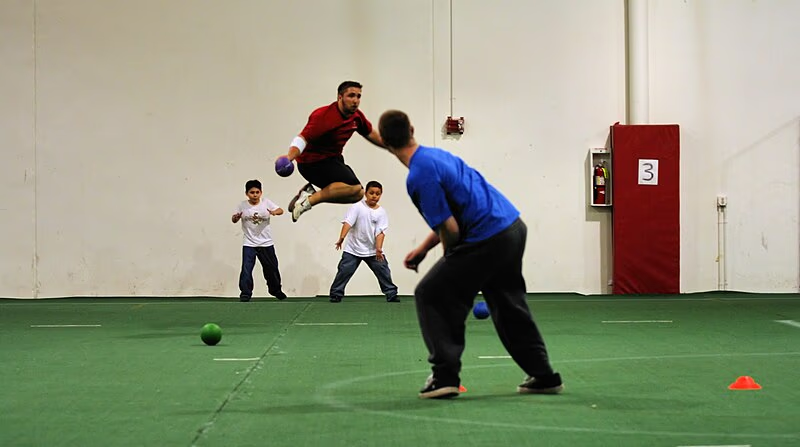
Dodgeball is a fast-paced team sport in which players attempt to eliminate opponents by hitting them with thrown balls while simultaneously avoiding being hit themselves. The game is widely played in schools, recreation leagues, and organized competitions around the world. Its combination of athleticism, strategy, and teamwork makes it one of the most popular gymnasium and playground games.
History
Dodgeball has roots dating back hundreds of years, with variations played across many cultures. The modern version of the game became a staple of physical education programs in North America during the 20th century. In recent decades, organized adult dodgeball leagues and tournaments have grown in popularity, with governing bodies such as the World Dodgeball Federation (WDF) and the National Dodgeball League (NDL) establishing standardized competitive rules.
Spirit of the Game
Dodgeball is meant to be an inclusive, high-energy activity that emphasizes fair play, sportsmanship, and fun. Players are expected to call themselves out honestly, respect opponents, and prioritize safety at all times. The game rewards agility, throwing accuracy, catching ability, and team coordination.
Section 2: Equipment
Balls
- Standard balls: 6 foam or rubber balls per game (the most common setup)
- Size: Approximately 7 inches (18 cm) in diameter for standard play; smaller balls (5-6 inches) may be used for younger players
- Material: Soft foam, rubber-coated foam, or cloth-covered foam. Hard rubber balls are discouraged for safety reasons
- Weight: Lightweight enough to be thrown comfortably but heavy enough to travel accurately across the court
Player Attire
- Athletic clothing suitable for running, jumping, and dodging
- Non-marking athletic shoes with good grip (indoor courts)
- Team jerseys, pinnies, or matching shirts for organized play
- No jewelry, watches, or accessories that could cause injury
Optional Equipment
- Knee pads for players who prefer to dive or slide
- Scoreboard or score sheet for tournaments
- Whistle for referees and officials
- Boundary markers (cones, tape, or painted lines)
- Timer or game clock for timed matches
Section 3: Playing Area
Court Dimensions
- Standard court: Rectangular, approximately 60 feet (18 m) long by 30 feet (9 m) wide
- Center line: Divides the court into two equal halves; players may not cross this line during play
- Attack line: Located approximately 10 feet (3 m) from the center line on each side; some rulesets require players to be behind this line before the opening rush
- End lines: Mark the back boundary of each team's half
- Side lines: Mark the lateral boundaries of the court
Ball Placement
- At the start of each game, all 6 balls are placed evenly along the center line
- Typically, 3 balls are placed on the right side and 3 on the left side of the center line
- Teams line up on their respective end lines before the opening rush
Indoor vs. Outdoor Play
- Indoor: Gymnasiums with hardwood or rubber flooring are the most common setting. Walls may or may not be in play depending on house rules
- Outdoor: Grass fields, asphalt courts, or sand courts. Boundaries should be clearly marked with cones or chalk. Wind conditions may affect ball flight
- Adapted spaces: Smaller courts (such as half-gym setups) can be used for fewer players; adjust ball count accordingly
Section 4: Players & Officials
Team Composition
- Standard team size: 6 players per team on the court at a time
- Recreational play: Teams of 6 to 10 players are common; larger groups can be accommodated by increasing court size
- Substitutes: In organized leagues, teams may carry additional players who rotate in between games or sets
- Mixed teams: Dodgeball is commonly played as a co-ed sport with no restrictions on team gender composition
Player Roles
- Throwers: Players who focus on eliminating opponents with accurate throws
- Catchers: Players who specialize in catching incoming balls to eliminate throwers and revive teammates
- Dodgers: Agile players who prioritize evasion and survival
- Distributors: Players who gather loose balls and quickly pass them to teammates in better throwing positions
In practice, most players perform all of these roles throughout a game depending on the situation.
Officials
- Head referee: Controls the game, signals the start and end of play, and makes final rulings on disputed calls
- Line judges (optional): Positioned along the sidelines and end lines to call boundary violations and close plays
- Scorekeeper (optional): Tracks eliminated and active players, game scores, and time remaining
- Casual play: Self-officiated; players are expected to honestly call themselves out when hit
Section 5: Rules of Play
Opening Rush
- Both teams line up behind their respective end lines
- On the referee's signal (whistle or verbal "Go!"), players sprint toward the center line to retrieve balls
- Players may only initially retrieve balls placed on their right side of the court
- All balls retrieved during the opening rush must be taken behind the attack line before they can be thrown at opponents
Eliminating Opponents
A player is eliminated (out) when any of the following occurs:
- Hit by a thrown ball: A thrown ball strikes the player anywhere on their body or clothing before touching the ground, a wall, or another object. Hits must be below the shoulders to count (see Headshot Rule below)
- Ball is caught: An opponent catches a ball the player has thrown before it touches the ground or any other surface. The thrower is out, and one eliminated teammate of the catching team returns to play
- Crossing the center line: A player steps over or beyond the center line onto the opponent's side
- Stepping out of bounds: A player steps outside the side lines or end lines of their half
The Headshot Rule
Hits to the head and face are treated differently for safety:
- If a player is hit in the head while standing upright, the throw does not count and the target player remains in the game
- If a player deliberately ducks or dives into a low position and is then hit in the head, the hit does count and the target is out (they put themselves in that position)
- If a thrower is deemed to have intentionally targeted the head, the thrower is eliminated instead of the target
- The referee's judgment is final on all headshot calls
Catching
- A clean catch (ball does not touch the ground or any other surface) eliminates the thrower
- Upon a successful catch, one previously eliminated teammate from the catching team re-enters the game, returning in the order they were eliminated (first out, first back in)
- If a player attempts a catch and drops the ball, that player is eliminated
- A ball that deflects off one player and is caught by a teammate before touching the ground counts as a valid catch; the thrower is out and a teammate returns
Deflections and Blocking
- Players may use a held ball to deflect or block an incoming thrown ball
- If the blocking ball is knocked out of the defender's hands by the impact, the defender is eliminated
- If the deflected ball hits another player before touching the ground, that player is eliminated
- A deflected ball that is caught before touching the ground still counts as a valid catch
Dead Balls
A ball is considered "dead" and cannot eliminate a player when:
- It has touched the ground, a wall, the ceiling, or any other surface
- It has already hit a player (the ball is dead after the first contact)
- It was kicked rather than thrown
- It was thrown by a player who was already out at the time of the throw
Ball Possession and Stalling
- Players may hold a maximum of one ball at a time (some rulesets allow holding two)
- A player may not hold a ball for longer than 10 seconds; after 10 seconds they must throw it or roll it to the opposing side
- If a team holds all available balls and does not throw within 5 seconds, the balls are forfeited to the opposing team
Popular Variations
Prison Ball (Jailbreak)
- Eliminated players go to a "prison" area behind the opposing team's end line
- Prisoners can re-enter the game if they catch a ball thrown to them by a teammate or if they retrieve a loose ball and hit an opponent from behind
- The game ends when all members of one team are in prison
Doctor Dodgeball
- Each team secretly designates one player as the "Doctor" before the game begins
- The Doctor can revive eliminated teammates by tagging them (without being seen by the opposing team)
- If the Doctor is eliminated, no further revivals are possible for that team
- Teams must guard and protect their Doctor's identity
Trampoline Dodgeball
- Played on a court with interconnected trampolines
- Players can bounce and perform aerial maneuvers to dodge or throw
- Standard dodgeball elimination rules apply
- Additional safety rules are enforced due to the elevated risk of injury
Medic Dodgeball
- Similar to Doctor Dodgeball, but the medic is publicly known
- The medic can revive teammates by touching them and escorting them to the back wall
- Once the medic is eliminated, the team loses revival ability
King's Court
- One player is designated as the "King" on each team
- When the King is eliminated, the entire team loses regardless of remaining players
- The King's identity may be secret or publicly known depending on house rules
Section 6: Scoring
Elimination Victory
The primary win condition in dodgeball is elimination: the last team with one or more players remaining on the court wins the game. A team wins the round the moment all opposing players have been eliminated.
Timed Games
- In organized and tournament play, games may have a time limit (commonly 5 to 10 minutes per round)
- If time expires before one team is fully eliminated, the team with more active players remaining on the court wins that round
- If both teams have the same number of active players when time expires, the round is declared a draw (or a sudden-death overtime ball is used)
Match Format
- Best-of series: Matches are typically played as a best-of-3, best-of-5, or best-of-7 series of rounds
- Point-based: Some leagues award 1 point per round won. The team with the most points at the end of the match wins
- Swiss or bracket: In tournaments, teams advance through Swiss-system pairings or single/double-elimination brackets
Tiebreakers
- If a match is tied after all rounds, a sudden-death round is played with fewer balls and a shorter time limit
- Some leagues use "last ball" tiebreakers: one ball, one player per team, winner takes the match
Section 7: Violations & Penalties
Common Violations
- Crossing the center line: Stepping onto or beyond the center line during play. The offending player is immediately eliminated
- Out of bounds: Stepping outside the court boundaries. The offending player is immediately eliminated
- Stalling: Holding a ball for longer than the allowed time (typically 10 seconds). The ball is forfeited to the opposing team
- Intentional headshot: Deliberately throwing at an opponent's head or face. The thrower is eliminated
- Kicking the ball: Players may not kick balls at opponents. A kicked ball is dead and cannot eliminate anyone
- Illegal opening rush: Crossing the end line before the start signal or retrieving a ball from the wrong side. The player must return the ball and retreat to the end line
- Hiding the ball: Concealing the ball under clothing or behind the body to deceive opponents. The ball is forfeited
Unsportsmanlike Conduct
- Refusing to call oneself out: Deliberately staying in the game after being clearly hit. Warning on first offense; ejection on repeated offenses
- Excessive force: Throwing with intent to injure rather than eliminate. Warning or ejection at the referee's discretion
- Verbal abuse: Taunting, threatening, or using offensive language toward opponents, teammates, or officials. Warning, then ejection
- Physical contact: Intentionally pushing, tripping, or otherwise making physical contact with another player. Immediate ejection
Penalty Enforcement
- Warning: Issued for minor or first-time violations. Player remains in the game
- Elimination: The standard penalty for most rule violations. Player is removed for the remainder of the round
- Ejection: For serious or repeated violations. Player is removed from the match entirely and may not return
- Forfeiture: A team that cannot field the minimum number of players (due to ejections or other reasons) forfeits the match
Section 8: Safety Considerations
Ball Safety
- Use only approved foam or rubber-coated balls. Hard rubber, leather, or weighted balls are prohibited
- Inspect balls before each game for damage, deflation, or excessive wear
- Replace balls that have become too firm, cracked, or irregularly shaped
Physical Preparation
- Players should warm up with dynamic stretching and light cardio before playing
- Focus warm-up exercises on shoulders, legs, and core muscles used in throwing, dodging, and catching
- Cool down with static stretching after play to reduce muscle soreness and injury risk
Court Safety
- Ensure the playing surface is clean, dry, and free of debris or obstructions
- Maintain adequate clearance around the court boundaries to prevent collisions with walls, bleachers, or equipment
- In outdoor settings, check the surface for holes, rocks, or uneven terrain before play
- Ensure adequate lighting for visibility, especially in indoor gymnasiums
Injury Prevention
- Enforce the headshot rule strictly to protect players' faces and heads
- Players should not dive headfirst on hard surfaces; sliding on knees is safer on gym floors
- Encourage players to be aware of their surroundings to avoid collisions with teammates or walls
- Remove all jewelry, watches, and loose accessories before playing
- Players with glasses should consider wearing sports straps or protective eyewear
Age and Skill Adaptations
- Young children (under 8): Use softer, lighter balls and smaller courts. Emphasize fun over competition. Consider allowing unlimited catches without elimination
- Elementary school (8-12): Standard foam balls with slightly reduced court size. Focus on fair play and inclusion
- Teens and adults: Standard rules and equipment. Competitive play with full enforcement of all rules
- Adult supervision is recommended for all players under 13 years of age
First Aid
- A basic first aid kit should be available at the playing venue
- Common dodgeball injuries include jammed fingers, minor bruises, and ankle sprains
- Any player who sustains a head injury, feels dizzy, or shows signs of concussion should be immediately removed from play and evaluated
- Players should stay hydrated, especially during extended tournament play





