



Section 1: Introduction
Overview
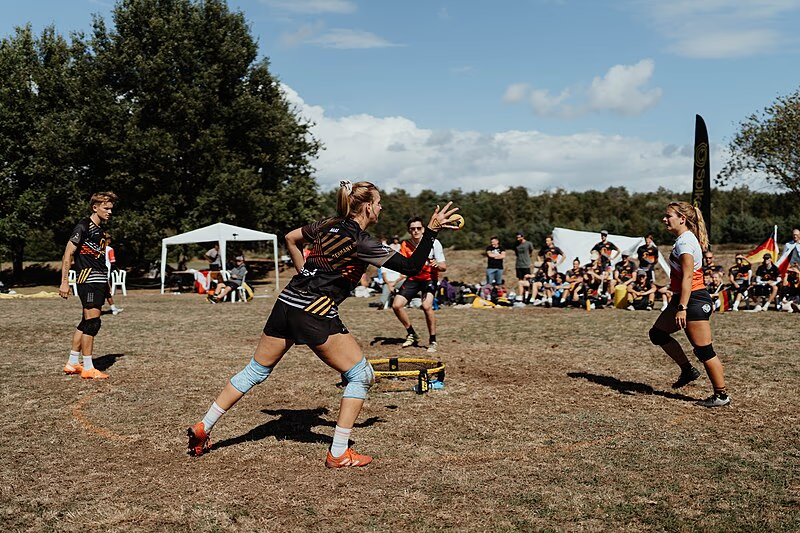
Spikeball, also known as roundnet, is a fast-paced ball sport played by two teams of two players. A small trampoline-like net is placed at ankle height between the teams, and players hit a small ball down onto the net so that it bounces up toward their opponents. The opposing team then has up to three touches among themselves to control the ball and spike it back onto the net. Play is 360 degrees around the net with no fixed sides or boundaries, making positioning, communication, and athleticism essential to the game.
History and Origins
Spikeball was invented by Jeff Knurek in 1989, who designed the original roundnet set as a backyard game. The concept drew loose inspiration from volleyball but reimagined it around a circular net with no boundaries. The game remained relatively obscure for nearly two decades until Chris Ruder discovered it in 2008 and founded Spikeball Inc. to revive and commercialize the sport. Ruder redesigned the equipment for durability and portability, making it easy to set up on any surface.
Growth and Popularity
The sport experienced explosive growth after Chris Ruder appeared on the television show Shark Tank in 2015, securing an investment from Daymond John. This national exposure propelled Spikeball from a niche backyard game to a mainstream recreational and competitive sport. College campuses, parks, and beaches became hotspots for play, and organized tournament circuits emerged across North America and internationally.
Competitive Scene
The Roundnet World Championship (formerly the Spikeball Roundnet Association Tour) is the premier competitive circuit for the sport. Tournaments feature divisions for men's, women's, and mixed teams at various skill levels. The sport has been recognized by USA Roundnet and the International Roundnet Federation, with national federations forming in dozens of countries. Competitive play follows standardized rules with certified referees and structured brackets.
Spirit of the Game
Spikeball is celebrated for its accessibility and social nature. The game requires minimal equipment, can be played almost anywhere, and is easy to learn at a basic level. Whether played casually at a family gathering or intensely at a tournament, the spirit of the game emphasizes fun, sportsmanship, and fair play. Players are expected to resolve close calls honestly and respectfully, particularly in recreational settings where referees are not present.
Section 2: Equipment
The Net
- Type: Circular trampoline-style net stretched across a collapsible frame
- Diameter: Approximately 36 inches (91.4 cm) across the playing surface
- Net Material: Tightly woven nylon or polyester mesh designed to produce a consistent bounce
- Frame: Five collapsible legs that fold out from a central hub, typically made of plastic or lightweight metal
- Height: The net surface should sit approximately 8 inches (20 cm) above the ground at the rim when assembled
- Tension: The net should be taut enough that the ball bounces cleanly and consistently. For competitive play, the ball should bounce approximately 12 inches when dropped from a height of 3 feet onto the center of the net
The Ball
- Circumference: 12 inches (30.5 cm)
- Material: Soft, lightweight plastic or rubber
- Weight: Approximately 1.6 ounces (45 grams)
- Color: Traditionally yellow, though any high-visibility color is acceptable for recreational play
- Pressure: The ball should have enough give that it can be gripped and controlled with one hand but firm enough to bounce consistently off the net
Ball Pressure Guidelines
- Casual Play: Slightly softer inflation makes the ball easier to control and rallies longer, ideal for beginners
- Competitive Play: Firmer inflation produces faster play and sharper angles; tournament balls are typically at maximum inflation
- Testing: Squeeze the ball between thumb and forefinger. For standard play, you should be able to press in roughly half an inch with moderate pressure
Adjustable Legs
- Purpose: The legs elevate the net to ankle height and provide stability on uneven surfaces
- Adjustment: Some sets feature adjustable-length legs to accommodate different surfaces (grass, sand, indoor floors)
- Stability: Legs should be firmly seated and locked before play begins. On soft surfaces like sand, legs may need to be pressed deeper for stability
Optional Equipment
- Carrying bag: Most sets include a drawstring or zippered bag for portability
- Extra balls: Recommended for continuous play and to replace worn or damaged balls
- Ball pump: A small hand pump or needle pump for adjusting ball pressure
- Sunglasses: Recommended for outdoor play to track the ball against bright skies
Section 3: Playing Area
General Setup
Spikeball is played in an open area with the net placed at the center. Unlike most net sports, there are no court boundaries or fixed sides. Play occurs in a full 360 degrees around the net, and players are free to move anywhere during a rally. This open-field design is one of the sport's most distinctive features.
Net Placement
- Position: The net is placed on the ground at the center of the playing area
- Height: The net rim should be at approximately ankle height (8 inches / 20 cm above the ground)
- Level surface: The net should be placed on the flattest area available. If the surface is uneven, adjust the legs so the net is as level as possible
- Anchoring: On windy days or soft surfaces, ensure the net is stable and will not shift during play
Recommended Clear Space
- Minimum radius: At least 20 feet (6 meters) of clear space in all directions from the net
- Ideal radius: 30 feet (9 meters) or more for competitive play, as rallies can extend far from the net
- Hazard clearance: Remove or mark any obstacles within the playing radius, including rocks, holes, sprinkler heads, tree roots, and sharp objects
Surface Types
- Grass: The most common playing surface. Provides good footing and cushioning for dives. Ensure the grass is not wet or slippery
- Sand: Popular for beach play. Provides excellent cushioning for dives but requires more effort to move quickly. Press net legs deeper for stability
- Indoor floors: Gymnasium floors or other hard indoor surfaces work well. Use non-marking shoes and ensure the net legs have rubber tips to prevent sliding
- Turf: Artificial turf fields provide consistent footing and are commonly used for organized tournaments
- Concrete/asphalt: Playable but not recommended due to injury risk from dives and falls
Indoor vs. Outdoor Considerations
- Indoor play: Ensure adequate ceiling height (at least 12 feet / 3.6 meters). Be aware of walls, pillars, and other obstacles. Ball behavior is more consistent without wind
- Outdoor play: Wind can significantly affect ball trajectory. On windy days, consider using a slightly deflated ball for better control. Sun position can create visibility challenges — rotate starting positions if needed
Section 4: Players & Officials
Team Composition
- Standard format: 2 players per team (2v2), for a total of 4 players
- Casual variations: 1v1 (singles) and 3v3 formats are popular in recreational settings but are not used in official tournament play
- Mixed teams: Teams may be composed of any combination of players regardless of gender
Starting Positions
- Serving team: The server stands at least 6 feet (1.8 meters) from the net. The server's teammate may stand anywhere
- Receiving team: The designated receiver stands across the net from the server, at any distance. The receiver's teammate may stand anywhere but must not interfere with the serve
- After the serve: Once the ball is in play, all four players may move freely in any direction around the net. There are no fixed positions or zones
Serving Rotation
- Alternating servers: The serving team must alternate which player serves with each new service possession
- Receiving rotation: At the start of each new service possession, the receiving team may choose which player receives the serve
- Tracking rotation: In casual play, players should verbally confirm whose turn it is to serve to avoid confusion
Substitutions
- Casual play: Substitutions may be made freely between points or games by mutual agreement
- Tournament play: Substitution rules vary by tournament. Some events allow one substitute per match; others do not allow substitutions after a match has begun
Tournament Referees
- Role: In competitive tournaments, referees observe play and make calls on disputed points, faults, and rule violations
- Positioning: Referees typically stand several feet from the net with a clear sightline to the net surface and all players
- Authority: The referee's call is final on all disputed points. Players may request clarification but may not argue or delay play
- Self-officiation: In recreational and many tournament pool-play settings, teams self-officiate using an honor system. Disputed points are typically replayed
Player Conduct
- Players are expected to call their own faults honestly (double hits, carries, rim shots)
- If players on opposing teams disagree on a call, the point is replayed
- Excessive arguing, taunting, or unsportsmanlike behavior may result in a point penalty or disqualification in tournament play
Section 5: Rules of Play
Objective
The objective of Spikeball is to hit the ball onto the net in such a way that the opposing team cannot successfully return it. Teams alternate hitting the ball onto the net until one team fails to make a legal return, resulting in a point for the opposing team.
Basic Flow of Play
- The serving team begins by serving the ball onto the net toward the receiving team
- The receiving team has up to three touches among its two players to control the ball and spike it back onto the net
- Teams continue alternating net hits until a team fails to return the ball legally
- The team that wins the rally scores a point (rally scoring)
Serving
- Distance: The server must stand at least 6 feet (1.8 meters) from the edge of the net at the moment of contact
- Motion: The serve must be an underhand hit. The server tosses the ball upward (at least 4 inches) and strikes it with one open hand toward the net
- Trajectory: The served ball must travel downward onto the net. It must bounce off the net and travel upward toward the receiver
- Net clearance: The ball must not strike the rim of the net on the serve. A serve that hits the rim is a fault (see Let Serves below)
- Receiver position: The designated receiver must be given a fair opportunity to play the ball. The serve should not be aimed directly at the receiver's body from an unreasonably close distance
- Pivot foot: The server may take a single step during the serve but must not cross the 6-foot line before making contact with the ball
Rally Play
Once the serve is successfully returned, the rally phase begins. During a rally:
- Teams alternate hitting the ball onto the net. After one team hits the ball onto the net, the other team has possession
- There are no assigned sides or zones. Players move freely around the net in 360 degrees
- Each team has up to three touches to return the ball to the net
- The ball must be hit, not caught, carried, or thrown
- Players may use any part of their body to hit the ball (hands, arms, head, chest, legs, feet)
Touch Limit
- Maximum touches: Each team is allowed a maximum of three touches before the ball must be played onto the net
- No consecutive touches: The same player may not hit the ball twice in a row. Touches must alternate between the two teammates
- Minimum touches: A team is not required to use all three touches. A player may spike the ball onto the net on the first or second touch
- Counting touches: Any intentional or unintentional contact with the ball counts as a touch, including deflections off the body
Net Shots
- Clean bounce: The ball must bounce cleanly off the net surface. A clean bounce means the ball contacts the net mesh and rebounds upward in a predictable trajectory
- Multiple bounces: If the ball bounces on the net more than once (a "double bounce" on the net), the hitting team loses the point
- Near-net play: Players may reach over the net to play the ball, provided they do not touch the net or interfere with the opposing team
Rim Shots
- Definition: A rim shot occurs when the ball strikes the plastic rim (frame) of the net rather than the mesh surface
- Consequence: If the ball hits the rim at any point during play (including on the serve), the hitting team loses the rally and the opposing team is awarded the point
- Rim and net: If the ball hits both the rim and the net simultaneously, it is considered a rim shot and the point is awarded to the opposing team
Pocket Shots
- Definition: A pocket shot occurs when the ball hits the net near the rim and rolls along or "pockets" into the junction between the net and the rim, producing an unpredictable bounce
- Ruling: Pocket shots that produce an unplayable or drastically altered trajectory are replayed (called a "let")
- Judgment call: In self-officiated games, both teams should agree whether a bounce was a pocket. If they disagree, the point is replayed
Let Serves
- Rim on serve: If the served ball strikes the rim, it is a let and the serve is retaken. The server gets one additional attempt
- Consecutive lets: If the server hits the rim on the retaken serve, the receiving team is awarded the point (fault)
- Near-rim serves: If the ball lands very close to the rim but bounces off the net cleanly, it is a legal serve regardless of how close it came to the rim
Hinder Rules
- Definition: A hinder occurs when a player's position or movement prevents an opponent from making a play on the ball
- Defensive hinder: If a player on the team that just hit the ball onto the net impedes an opponent's ability to reach or play the ball, a hinder is called and the point is replayed
- Offensive hinder: If the receiving team's own movement causes them to run into an opponent, it is not a hinder — they must play around the obstacle
- Responsibility: Both teams share responsibility to avoid collisions. The team that just hit the net must make a reasonable effort to move out of the opposing team's path
- Calling hinders: Either team may call a hinder. If both teams agree, the point is replayed. If they disagree, a referee decides (in tournaments) or the point is replayed (in casual play)
Body Shots
- Legal contact: The ball may be played with any part of the body, including hands, fists, arms, head, chest, legs, and feet
- Unintentional contact: If the ball strikes a player unintentionally (e.g., a deflection off the body), it counts as a touch for that player's team
- Below the net: If a player is positioned very close to the net and the ball hits them directly off the net before they can react, it counts as a touch. If the contact makes the ball unplayable, the team that was hit loses the point
Faults
A fault results in the loss of the rally. The following are faults:
- The ball hits the rim at any point during play
- The ball bounces more than once on the net
- A team uses more than three touches before returning the ball to the net
- The same player touches the ball twice in a row
- The ball is caught, carried, or thrown rather than hit
- The ball hits the ground before being returned to the net
- The server steps closer than 6 feet to the net before contacting the ball
- The served ball is not struck underhand
- A player touches the net or net frame during play in a way that affects the rally
- The ball does not make contact with the net on a team's return
Switch Serves
- Alternating servers: When a team regains service (wins a rally on the opponent's serve), the next server on that team must serve. Teams must alternate servers with each new service possession
- Tracking the rotation: Each team should track which player served last. In tournament play, referees may track the rotation
- Wrong server: If the wrong player serves and the error is caught before the rally ends, the serve is retaken by the correct server. If the rally is completed before the error is noticed, the result stands
Possession Changes
After each net hit, possession transfers to the opposing team. The team that did not hit the ball onto the net is now on offense and has up to three touches to return it. There is no concept of "sides" — both teams share the same 360-degree playing area and possession alternates with each net contact.
Out-of-Play Situations
- If the ball becomes lodged in the net, the point is replayed
- If an external object or person interferes with play (e.g., a dog runs through the playing area), the point is replayed
- If the net shifts or collapses during a rally, the point is replayed and the net is reset
Section 6: Scoring
Rally Scoring
Spikeball uses rally scoring, meaning a point is awarded on every rally regardless of which team served. The team that wins the rally scores a point, whether they were serving or receiving.
Standard Game
- Points to win: The first team to reach 21 points wins the game
- Win by two: A team must win by at least 2 points. If the score reaches 20-20, play continues until one team leads by 2 (e.g., 22-20, 23-21)
- Point cap: In some recreational settings, a point cap of 25 is used — the first team to 25 wins regardless of the margin
Tournament Game Format
- Games to 11: Many tournaments play games to 11 points (win by 2) for faster round-robin play
- Games to 15: Some tournament formats use games to 15 points (win by 2) for bracket play
- Games to 21: Championship and elimination matches are typically played to 21 points
- Best-of format: Tournament matches are often best-of-three games
Switching Sides
- Midpoint switch: In games to 21, teams switch starting sides when the first team reaches 11 points. In games to 11, teams switch at 6 points
- Purpose: Switching compensates for environmental factors such as sun position, wind direction, or uneven terrain
- Indoor play: Switching is still recommended indoors to maintain fairness, as lighting and proximity to walls may differ
Timeouts
- Casual play: Players may take breaks between points by mutual agreement
- Tournament play: Each team is typically allowed one timeout per game, lasting 30 to 60 seconds depending on tournament rules
Winning a Point
A team scores a point when the opposing team:
- Fails to return the ball to the net within three touches
- Hits the ball into the rim
- Hits the ball onto the ground
- Commits a double hit (same player touching the ball twice consecutively)
- Catches, carries, or throws the ball
- Commits a service fault (after any allowed let serves)
- Touches the net or frame in a way that affects the rally
Section 7: Violations & Penalties
Double Hits
- Definition: A double hit occurs when the same player contacts the ball twice in succession without a teammate touching it in between
- Ruling: The opposing team is awarded the point
- Self-calling: In self-officiated games, players are expected to call their own double hits honestly. If a player is unsure, they should call it on themselves
Carrying
- Definition: A carry occurs when the ball visibly rests in a player's hand or on their body rather than being struck cleanly. The ball must be hit with a single, distinct contact
- Ruling: The opposing team is awarded the point
- Judgment: Carries can be subjective. In tournament play, the referee makes the final determination. In casual play, the hitting player should call obvious carries on themselves
Server Foot Faults
- Definition: A foot fault occurs when the server steps closer than 6 feet (1.8 meters) to the net before contacting the ball on the serve
- Ruling: The serve is a fault. If it is the first fault, the serve is retaken. If it is the second consecutive fault, the receiving team is awarded the point
- Measurement: In casual play, the 6-foot distance is estimated. In tournament play, a line or marker may be placed to define the serving distance
Net Interference
- Touching the net: If a player touches the net or frame during a rally in a way that visibly moves the net or affects the ball's trajectory, the opposing team is awarded the point
- Incidental contact: Brief, incidental contact with the net that does not affect play (e.g., a foot barely brushing a leg of the frame) is generally not penalized in casual play but may be called in tournament settings
- Kicking the net: Intentionally kicking or striking the net frame is a violation and results in a point for the opposing team
Illegal Serves
- Overhand serve: Serving the ball with an overhand motion is illegal. All serves must be underhand
- No toss: Dropping the ball directly onto one's hand without an upward toss of at least 4 inches is a fault
- Deceptive serving: The server may not deliberately fake or abort a serve to gain an advantage. A service motion once started must be completed
Excessive Contact with Opponents
- Incidental contact: Minor, unavoidable contact during play is expected in a 360-degree sport. No penalty is assessed for incidental contact
- Aggressive contact: Pushing, grabbing, tripping, or intentionally running into an opponent is a violation. The opposing team is awarded the point
- Repeated offenses: In tournament play, repeated aggressive contact may result in a match forfeit or disqualification
Unsportsmanlike Conduct
- Examples: Taunting, excessive celebration directed at opponents, throwing equipment, profanity, intentionally delaying play, or refusing to acknowledge legitimate calls
- First offense: Verbal warning from the referee (in tournaments) or from the opposing team (in casual play)
- Second offense: Point awarded to the opposing team
- Third offense: Game forfeit or disqualification from the tournament
Disputed Calls
- Self-officiated games: If teams cannot agree on a call (rim shot, pocket, hinder, carry, double hit), the point is replayed
- Refereed games: The referee's decision is final. Players may request a brief explanation but may not argue or delay the match
- Video review: Some top-level tournaments allow video review for critical points in elimination rounds
Section 8: Safety Considerations
Collision Avoidance
The 360-degree nature of Spikeball means all four players frequently move through the same space. Collision avoidance is one of the most important safety considerations:
- Communication: Teammates should call "mine" or "yours" on every play to avoid collisions with each other
- Spatial awareness: All players should maintain awareness of where opponents are at all times, especially when moving backward or sideways
- Right of way: The team whose turn it is to play the ball generally has the right of way. The team that just hit the ball onto the net should make a reasonable effort to move out of the way
- Calling hinders: If a collision seems imminent, any player should immediately call a hinder to stop play rather than risking injury
Surface Selection
- Grass: Recommended as the safest surface. Provides natural cushioning for dives, falls, and quick directional changes
- Sand: Excellent for cushioning but can be unstable for quick lateral movements. Watch for hidden shells, rocks, or debris
- Indoor courts: Safe for play but hard surfaces increase the risk of impact injuries from falls. Knee pads are recommended for aggressive players
- Avoid hard surfaces: Concrete, asphalt, and packed dirt should be avoided as playing surfaces due to the high risk of abrasion and impact injuries from the dynamic movements required in Spikeball
Net Tension Safety
- Assembly: Assemble the net carefully. The legs snap into place under spring tension and can pinch fingers if not handled properly
- Tension check: Before play, verify that the net is evenly tensioned and that no legs are loose or at risk of collapsing
- During play: If the net shifts, becomes uneven, or a leg comes loose, stop play immediately and reset the equipment
- Disassembly: When taking the net apart, release tension gradually. Do not let the legs snap closed quickly
Sun and Wind Considerations
- Sun glare: The ball can be difficult to track when looking directly into the sun. Rotate starting positions or switch sides to minimize the impact on one team
- Sunscreen: Apply sunscreen before extended outdoor play sessions, especially on exposed arms, legs, and face
- Hydration: Keep water bottles readily accessible. Spikeball is physically demanding and dehydration risk increases in direct sun
- Wind: Strong wind significantly alters ball flight. Consider moving to a sheltered location or adjusting ball inflation on very windy days
- Heat: In high temperatures, take regular breaks, seek shade between games, and watch for signs of heat exhaustion
Warm-Up and Stretching
- Dynamic warm-up: Light jogging, lateral shuffles, arm circles, and leg swings prepare the body for the quick, multidirectional movements required in Spikeball
- Common injury areas: Ankles, knees, shoulders, and lower back are the most common injury sites. Stretching and strengthening these areas reduces risk
- Diving: Players who dive for balls should practice proper diving technique (arms extended, landing on the torso, sliding forward) to minimize impact
Equipment Inspection
- Before each session: Inspect the net for tears, loose legs, or damaged frame components. Replace any worn or damaged parts
- Ball condition: Discard balls that are cracked, deflated, or have developed an irregular shape, as they may bounce unpredictably
- Playing area sweep: Walk the playing area before starting to identify and remove any hazards (broken glass, sharp rocks, holes, sprinkler heads)