









Section 1: Introduction
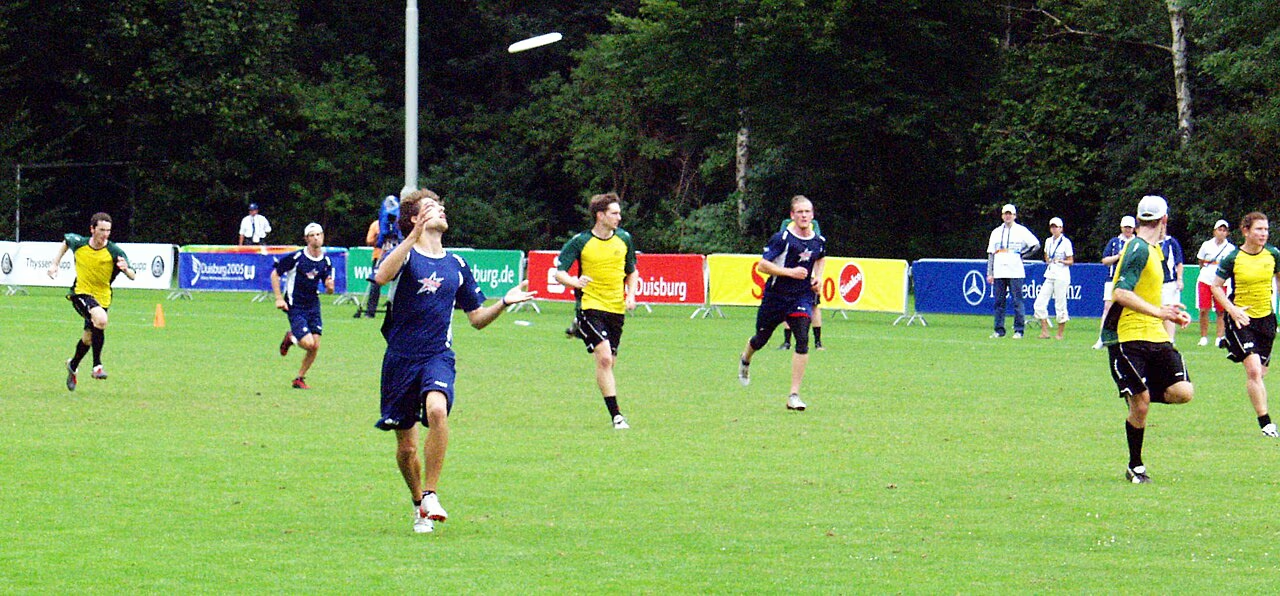
Ultimate (often colloquially "Ultimate Frisbee") is a non-contact, self-officiated team sport played with a flying disc. USA Ultimate (USAU) is the recognized national governing body in the United States; the World Flying Disc Federation (WFDF) governs internationally and is recognized by the International Olympic Committee. The current standard ruleset is the 2026-27 Official Rules of Ultimate, USA Ultimate's 12th edition, which took effect January 1, 2026 and supersedes the prior 2024-2026 (11th edition) rules. USA Ultimate has characterized this cycle's revisions as largely clerical and clarifying rather than structural — there is no change on the scale of the offsides or soft-cap overhauls introduced in the 2020-2021 rules — but several substantive updates around dangerous play, misconduct cards, observer authority, and stall counts are new for this cycle and are detailed in the relevant sections below.
Ultimate's defining principle remains the Spirit of the Game: players self-officiate, call their own fouls, and resolve disputes peer-to-peer — even at the highest competitive levels of college and club championship play.
Section 2: Equipment
- Disc: 175-gram flying disc; USAU-approved manufacturers (Discraft Ultra-Star is standard)
- Cleats: rubber/molded only (no metal)
- Jerseys: numbered, contrasting colors per team
- Mouthguards optional but recommended
- No pads, helmets, or other contact-protective equipment (non-contact sport)
Section 3: Playing Area
- Field: 70 yards (64 m) × 40 yards (37 m) playing field, plus two 20-yard (18 m) end zones
- Total: 110 yards × 40 yards
- Marked sidelines and end-zone lines
- "Brick" mark 20 yards into end zone (for pulls landing out-of-bounds)
- Field marshal stations at each sideline at championship level
Section 4: Players & Officials
- 7 players per side on the field (standard outdoor format)
- Roster: typically 14-25 per team; unlimited substitutions between points
- New for the 2026-27 rules: deliberately mis-designating a group of players at an event (e.g., misrepresenting who is rostered to a given team or division) is itself codified as a roster violation, distinct from and in addition to any resulting eligibility penalty
- Self-officiated at most levels: players call own fouls, infractions, and out-of-bounds; disputes resolved by discussion + re-do
- "Observers" (USAU-trained, non-binding consultative role) at championships. Under the 2026-27 rules, Observers have expanded authority to assist with stall-count disputes and may offer input on foul calls; the final call on a foul still rests with the players involved
- WFDF / USAU "Game Advisors" may be assigned to active officiating at international championship level
- Spirit Captain designated on each team — promotes fair play, mediates disputes
Section 5: Rules of Play
Starting Play
- "Pull": defensive team throws disc to offensive team to start each point (like a kickoff)
- After scoring, scoring team pulls next
Disc Movement
- Disc is advanced only by passing — no running with the disc
- Receiver must establish a pivot foot upon catching (basketball-style)
- 10-second "stall count" by the defender (marker) — thrower must release disc before count reaches 10. The 2026-27 rules tightened marker conduct here: the count must be delivered at a steady, consistent pace, and the marker must be ready to begin counting from the moment defensive marking position is established, closing prior ambiguity around delayed or uneven counts
- If disc hits ground, is intercepted, or goes out-of-bounds → turnover
Scoring
- Score when a receiver catches the disc in the opposing end zone with full possession + in-bounds
Spirit of the Game
- All players responsible for fair play, knowledge of rules, mutual respect
- Even at elite level, players make their own foul/contest calls
- "Contest" → re-do throw; "no contest" → call stands
Section 6: Scoring
- 1 point per score (in-bounds catch in opposing end zone)
- Game-to-15 standard for outdoor 7-on-7 (cap at 19, win by 2 if reached)
- Hard cap (time): typically 90 minutes total game-time; soft cap notifies of approaching end
- Half-time at 8 points (or time-equivalent)
- Champions decided by knockout bracket at USAU Nationals (College, Club, Masters divisions)
Section 7: Violations & Penalties
- Foul: any non-incidental contact between players; called by the affected player → "contest" or "no contest"; if contested, disc returns to thrower
- Travel: moving the pivot foot after catching; disc returns to thrower
- Pick: defender obstructed; defender call → play stops + resume at point of obstruction
- Stalling: stall reaches 10 → turnover
- Strip: defender knocks disc from established catch → foul + disc returns
- Dangerous Play (Rule 20.B.1): under the 2026-27 rules, a dangerous play call generally may only be made if at least some amount of contact between the involved players occurred. The no-contact exception survives but was narrowed for this cycle: it now applies only where there is "near certainty" that significant contact would have occurred had a player not taken last-moment evasive steps — a higher bar than the prior edition's "reasonable certainty" standard, signaling that no-contact dangerous-play calls are expected to be rare and are unlikely to be upheld by an Observer absent contact
- Misconduct system (revised for 2026-27): the prior "Team Misconduct Foul" / "Personal Misconduct Foul" terminology is now codified directly as a three-color card system. Blue cards address repeated infractions, invalid calls, and mild taunting; Yellow cards address dangerous plays and intentional fouls, and aggressive taunting; Red cards address very dangerous plays and acts such as punching, kicking, spitting, or spiking the disc at an opponent. A Red card additionally assigns two Blue cards toward a team's Team Misconduct Penalty (a yardage penalty), which is triggered once a team accumulates its third Blue card. Accumulating personal misconduct cards can still lead to game suspension at championship level
Section 8: Safety Considerations
Ultimate is non-contact by design — incidental contact happens but intentional contact is penalized. Common injuries: ankle sprains (sudden cuts), hamstring strains (sprinting), shoulder/wrist (diving layouts). USAU recommends mandatory athletic trainer presence at championship-level events. Concussion protocol: USAU adopted comprehensive head-injury protocol mirroring USA Football / NFHS — removal-for-evaluation, multi-stage return-to-play, mandatory rest period. Heat safety: USAU enforces heat-index protocols at summer tournaments (water breaks, mandatory cooling periods, potential weather stops). Lightning protocol: 30-minute clear-sky resume window. AED on-site at all sanctioned championship play. The 2026-27 rules' narrowed Dangerous Play standard (Rule 20.B.1, Section 7) is itself a safety-adjacent change: by generally requiring contact before a dangerous-play call, it aims to reduce disputed no-contact stoppages while still preserving a narrow near-certainty exception for plays that would otherwise result in significant contact.