











Section 1: Introduction
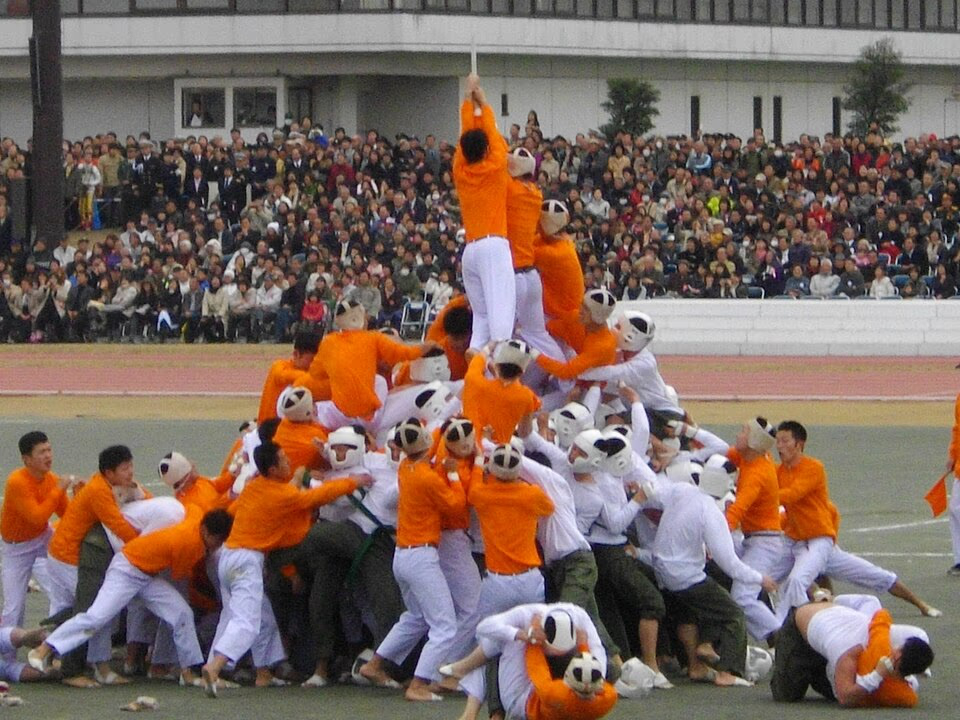
Bo-taoshi (棒倒し, literally "pole toppling") is a large-scale Japanese team sport played annually at the National Defense Academy (NDA) of Japan in Yokosuka, Kanagawa. It is contested as the centerpiece of the Academy's annual Kiryu-sai (桐葉祭) festival, which has run continuously since the NDA's founding in 1954.
The format is radical in scale: two teams of 150 players each — 300 players simultaneously on the field — compete to topple the opposing team's pole while defending their own. Each team is divided into an attacking contingent and a defending contingent, and both sides attack and defend at the same time. A match lasts two minutes; victory is awarded to the team whose attackers tilt the opponent's pole to 30 degrees or more from vertical within the time limit. If neither team achieves the 30-degree threshold, judges assess which pole is at the greater angle, and that team loses (angle-judgment decision).
Bo-taoshi is not contested under an international or national sports federation. The authoritative ruleset is the NDA event regulation as described on the official NDA festival page and event materials. The rules summarized here reflect the NDA's published festival standards. Secondary sources (academic and journalistic) consistently describe the same 150v150 format, 2-minute duration, and 30-degree victory condition; historical accounts note the current 30-degree standard replaced an earlier 45-degree threshold at some point in the NDA's competition history, though no NDA archive document has been publicly cited to date that threshold change.
Section 2: Equipment
The Pole
Each team defends a single tall wooden pole (the "bo") erected vertically at its end of the field. The pole is set into the ground or braced at the base and is tall enough to accommodate a rider on top and a cluster of defenders clinging to its length. The exact dimensions are set by the NDA for each competition year.
Player Attire
- NDA cadet uniform or athletic kit consistent with the player's team assignment
- Sturdy footwear suitable for grass or dirt surface
- No protective padding required beyond standard athletic wear; the sport's nature produces incidental contact, and players are expected to be physically conditioned accordingly
No Special Equipment
No bats, balls, projectiles, or scoring instruments are used. The pole itself is the only apparatus. Players compete using body weight, positioning, grip, and coordinated team movement exclusively.
Section 3: Playing Area
Bo-taoshi is played on the NDA's outdoor grounds at its Yokosuka campus. Two poles are erected at opposite ends of the playing field, one for each team. Both poles and their surrounding zones are active simultaneously — there is no halfway boundary preventing either team from crossing to the opponent's pole zone.
- Pole zones: each pole's base is the focal point of that team's defense; no fixed perimeter is marked, as the defense is formed by the bodies of the defending players themselves
- Surface: natural grass or compacted earth; the NDA grounds are used as-is for the festival
- Crowd clearance: spectators are kept behind a perimeter; the active field accommodates 300 players in motion simultaneously and requires substantial clearance for safety
Section 4: Players & Officials
Team Composition (150 players per team)
Each team of 150 is divided into two groups at the start of the match: an attacking contingent that advances toward the opponent's pole, and a defending contingent that protects their own pole. Roles within each contingent are assigned by team leadership in advance and executed from the opening whistle.
Attacking Roles
- Tukko (突攻, lead attackers): the frontline rush unit; the first wave to make contact with the defensive ring around the opponent's pole. Their task is to break through or displace defenders to expose the pole.
- Scrum unit: a wedge of attackers who drive together in a coordinated push to create a gap through the defending circle and allow deeper attackers to reach the pole.
- Mole (shinobikomi, infiltrators): attackers who attempt to slip through or under the defensive mass, reaching the pole from unexpected angles or through gaps created by the scrum. Their low profile and mobility allow them to grab or pull the pole when others cannot.
- Support/outer attackers: players who occupy the outer defenders and interference players, reducing the number of defenders available to reinforce the inner ring or the pole itself.
Defending Roles
- Pole holders: players who physically cling to the pole — gripping it, adding body weight against the direction of tilt, or bracing at the base. Their mass and grip are the pole's primary resistance to toppling.
- Defensive circle (ring defenders): a ring of players who surround the pole base and actively repel attackers. They form a human barrier between the pole and the incoming scrum.
- Interference players (妨害役, obstructors): mobile defenders positioned outside the defensive circle who stop attackers before they reach the ring — blocking, tackling, and redirecting the incoming rush.
- Rider (天辺, top rider): one defender who climbs to the top of the pole and sits or stands on it, adding weight and shifting the pole's center of gravity against the direction attackers are pushing. The rider's presence significantly increases the force required to tilt the pole to the 30-degree threshold.
Officials
- A panel of judges monitors the angle of each pole throughout the 2-minute match and makes the final determination on angle-judgment decisions when neither pole reaches 30 degrees by time expiry
- NDA event staff manage time, safety intervention, and match officiating
Section 5: Rules of Play
Match Start
At the starting signal, both teams begin simultaneously: attackers advance toward the opponent's pole while defenders take up their assigned positions around their own pole. There is no phase delay between attack and defense — both happen from the first second.
Victory Condition
- A team wins if its attacking players tilt the opposing team's pole to 30 degrees or more from vertical before the 2-minute time limit expires
- The tilt is judged visually by the officiating panel; no mechanical sensor is used
- Once the pole reaches 30 degrees and officials confirm the condition, the match ends immediately in favor of the attacking team that achieved the tilt
Simultaneous Action
Both teams attack and defend at the same time on the same field. There is no concept of a separate offensive or defensive phase; a team can win while simultaneously under attack on its own pole. Strategy involves both the efficiency of the attacking contingent and the holding ability of the defending contingent.
Match Duration
- Duration: 2 minutes from the starting signal
- If neither team has tilted the opponent's pole to 30 degrees when time expires, the match continues to an angle-judgment decision (see Scoring)
Tournament Format
At the NDA Kiryu-sai festival, bo-taoshi is organized as a class-bracket competition among the NDA's cadet classes. Individual class units compete in elimination rounds, with the bracket structure determined by the Academy's event committee for each festival year.
Section 6: Scoring
Bo-taoshi does not use a points system. Each match has a single decisive outcome.
- Win by pole tilt: the team whose attackers first tilt the opponent's pole to 30 degrees or more from vertical within 2 minutes wins the match outright
- Win by angle judgment: if the 2-minute limit expires with neither pole at 30 degrees, officials measure and compare the angle of each pole from vertical. The team whose pole is closer to vertical (i.e., whose defenders held better) wins; the team whose pole is at a greater angle from vertical loses. In the event both poles are at exactly equal angles, the match may be declared a draw or decided by a secondary criterion at the NDA officials' discretion
Section 7: Violations & Penalties
Bo-taoshi involves intensive full-body contact as a normal part of play — blocking, gripping, shoving, and piling on are all expected within the attacking and defending roles. Prohibited conduct is limited to actions considered excessively dangerous beyond the sport's inherent physicality.
- Dangerous physical techniques: strikes intended to injure (punching, kicking, eye-gouging, choking), or deliberate use of technique designed to cause serious harm rather than simply move or hold a player, are prohibited
- Targeting the head or neck: actions that place extreme force on a player's head, neck, or cervical spine are prohibited
- Equipment interference: sabotaging the opposing team's pole, its anchoring, or the event apparatus before the starting signal is prohibited
- Refusal of official authority: ignoring a stop-play signal from NDA officials results in immediate disqualification of the offending player and may result in a match penalty against the team
The NDA event committee has authority to issue warnings, remove players from the field, or award the match to the opposing team in cases of egregious rule violation. Officials may stop play at any time for a safety emergency.
Section 8: Safety Considerations
Bo-taoshi involves 300 players in close-quarter physical contact simultaneously, making it one of the most physically intense team-sport formats in terms of participant density. The NDA manages the sport's inherent risks through cadet conditioning, medical staff presence, and officiating authority to halt play.
- Physical conditioning requirement: all participants are NDA cadets who undergo rigorous physical conditioning as part of their military academy training. No untrained participants compete in the official NDA format
- Medical staff: NDA medical personnel are present at the festival grounds; the Academy's medical facilities are on-campus and immediately accessible
- Common injury types: sprains, contusions, abrasions, and occasional fractures consistent with high-density contact sport; the NDA manages these through on-site medical response and post-match care
- Spectator separation: the active field is cleared of all non-participants; spectator barriers prevent crowd encroachment during matches
- Rider safety: the top-rider role carries fall risk if the pole is toppled rapidly; riders are trained to dismount safely when a tilt becomes uncontrollable
- Stop-play authority: officials can and do halt matches immediately for serious injury assessment; play does not resume until the medical situation is resolved
Note on adaptation for non-NDA contexts: the NDA format as described here is specific to trained military cadets in a controlled institutional environment. Informal or recreational attempts to replicate bo-taoshi at reduced scale are documented in Japan, but the safety profile changes significantly with untrained participants. This entry describes the authoritative NDA competition format only.