


🏛️Official — National Defense Academy
Loading OpenSourceSports…
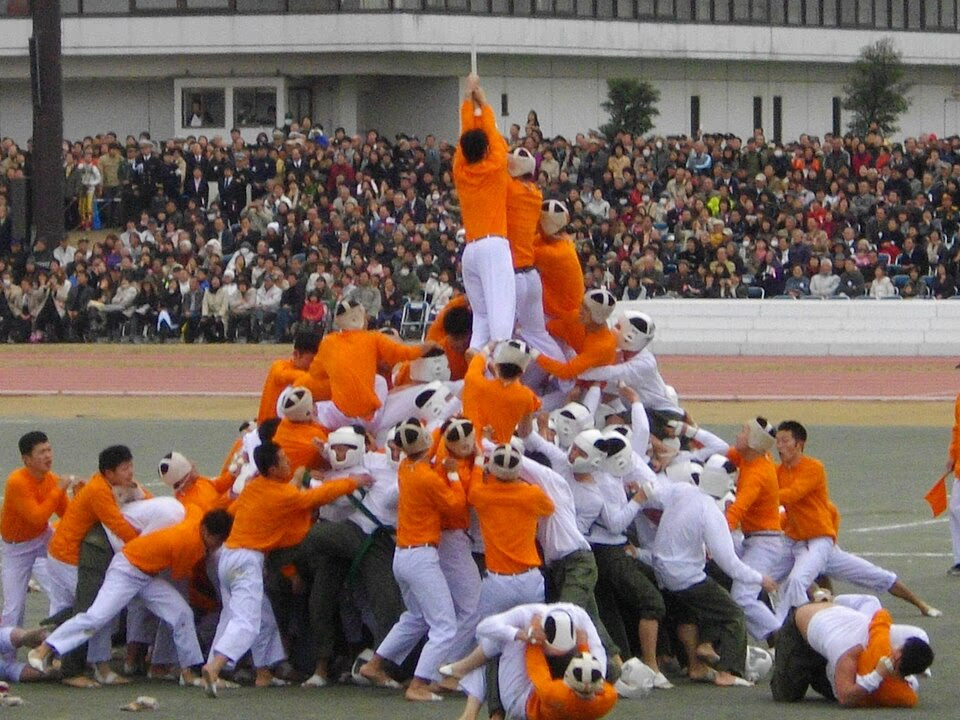
The ninja must hold until the pole is called down
The defender assigned to ride atop the pole (the 'ninja') is expected to stay in position and resist at all costs — abandoning the pole prematurely or surrendering the top position without a fight is considered a serious failure of duty to the team. The role carries prestige and an unspoken obligation to endure.
Tukko (突攻, lead attackers): the frontline rush unit; the first wave to make contact with the defensive ring around the opponent's pole. Their task is to break through or displace defenders to expose the pole.; Scrum unit: a wedge of attackers who drive together in a coordinated push to create a g...
Why people argue about this
People often think that the Scrum unit is just a group of players pushing together without strategy, but in fact, they are supposed to coordinate their pushes like a well-timed wave to create space for the Tukko to break through or displace defenders and expose the pole. They misunderstand the need for strategic teamwork within this unit rather than seeing it as a simple mass push.
Pole holders: players who physically cling to the pole — gripping it, adding body weight against the direction of tilt, or bracing at the base. Their mass and grip are the pole's primary resistance to toppling.; Defensive circle (ring defenders): a ring of players who surround the pole base and a...
Why people argue about this
People often assume that only pole holders are allowed to physically support the pole against a tilt, forgetting that defensive circle players can also brace at the base of the pole, adding their weight for stability too. This leads to arguments about who exactly is permitted to contribute to maintaining balance in case of a toppling attempt.
Duration: 2 minutes from the starting signal; If neither team has tilted the opponent's pole to 30 degrees when time expires, the match continues to an angle-judgment decision (see Scoring)
Why people argue about this
People often assume that if a match doesn't end after 2 minutes due to neither team reaching the angle-judgment decision, it's simply extended for another 2 minutes until one side tilts their opponent's pole. But actually, the rule states the game continues in an angle-judgment decision format beyond the initial 2-minute period if no winner is declared within that time frame.
At the starting signal, both teams begin simultaneously: attackers advance toward the opponent's pole while defenders take up their assigned positions around their own pole. There is no phase delay between attack and defense — both happen from the first second.
Why people argue about this
People often assume that there's a phase delay where attackers start before defenders do, which leads them to believe they have time to prepare for the attack. But in reality, the rule states both teams begin at the same instant with no such delay, so defenders must immediately take up their positions as soon as the signal is given.
No bats, balls, projectiles, or scoring instruments are used. The pole itself is the only apparatus.
Why people argue about this
People often assume that since only a pole is allowed as an apparatus, they can use their own bat from home for hitting the pole. But actually, the rule explicitly states no bats or scoring instruments are used, so using anything like a bat would be a clear violation of the "No Special Equipment" stipulation in Bo-taoshi.
A panel of judges monitors the angle of each pole throughout the 2-minute match and makes the final determination on angle-judgment decisions when neither pole reaches 30 degrees by time expiry; NDA event staff manage time, safety intervention, and match officiating
Why people argue about this
People often assume that only the judges decide when a pole doesn't reach 30 degrees by time expiry, forgetting that NDA event staff are in charge of managing time and safety interventions, which can lead to confusion about who ultimately makes the final call on angle judgments.
NDA cadet uniform or athletic kit consistent with the player's team assignment; Sturdy footwear suitable for grass or dirt surface; No protective padding required beyond standard athletic wear; the sport's nature produces incidental contact, and players are expected to be physically conditioned a...
Why people argue about this
People often assume that protective padding is mandatory in Bo-taoshi due to its physical nature, forgetting that the official rule explicitly states no additional protection beyond standard athletic wear is required—despite incidental contact occurring, players are expected to be physically prepared for the sport's demands.
Each team defends a single tall wooden pole (the "bo") erected vertically at its end of the field. The pole is set into the ground or braced at the base and is tall enough to accommodate a rider on top and a cluster of defenders clinging to its length.
Why people argue about this
People often assume that the bo-taoshi pole must be a standard wooden stick, forgetting about its height requirement for accommodating riders and defenders. They also misunderstand that it's set into the ground or braced at the base, not just left in place as they might expect from seeing similar poles in other sports.
Bo-taoshi is played on the NDA's outdoor grounds at its Yokosuka campus. Two poles are erected at opposite ends of the playing field, one for each team.
Why people argue about this
People often assume that Bo-taoshi is played in a specially designed indoor arena when they first hear about it, but the official rule clearly states it's played on outdoor grounds at NDA’s Yokosuka campus, with poles for each team placed at opposite ends of the field. This discrepancy leads to misunderstandings and arguments about where exactly the game takes place.
Each team of 150 is divided into two groups at the start of the match: an attacking contingent that advances toward the opponent's pole, and a defending contingent that protects their own pole. Roles within each contingent are assigned by team lea...
Why people argue about this
People often assume that players are randomly assigned roles within their teams without considering team dynamics, forgetting that each contingent's composition is decided by the team leaders based on their strategic preferences rather than chance.
At the starting signal, both teams begin simultaneously: attackers advance toward the opponent's pole while defenders take up their assigned positions around their own pole. There is no phase delay between attack and defense — both happen from the first second.
Why people argue about this
People often assume that there's a brief pause between when one team starts their play and the other begins theirs, thinking it gives an unfair advantage. But actually, the rule states both teams start immediately at the same time from the very first second, eliminating any such delay for clarity on equal footing.
Bo-taoshi does not use a points system. Each match has a single decisive outcome.
Why people argue about this
People often assume that Bo-taoshi uses a points system like other sports where players accumulate scores over time, forgetting entirely about its unique structure of having only one decisive outcome per match, which leads to confusion when they expect multiple point exchanges or tiebreakers.
Bo-taoshi involves intensive full-body contact as a normal part of play — blocking, gripping, shoving, and piling on are all expected within the attacking and defending roles. Prohibited conduct is limited to actions considered excessively dangerous beyond the sport's inherent physicality.
Why people argue about this
People often assume that Bo-taoshi's physicality means it's completely unregulated, leading them to argue about what exactly constitutes "excessively dangerous" conduct. In reality, the confusion arises because they misinterpret the rule’s intent to mean any contact is off-limits, when in fact, only actions that go beyond the sport's inherent full-body contact are prohibited.
Bo-taoshi involves 300 players in close-quarter physical contact simultaneously, making it one of the most physically intense team-sport formats in terms of participant density. The NDA manages the sport's inherent risks through cadet conditioning...
Why people argue about this
People often assume that the high player density in Bo-taoshi means it's inherently unsafe, leading them to argue for more stringent safety measures or even a ban on the sport. However, the NDA manages these risks through rigorous cadet conditioning and proper training protocols, which is actually what mitigates the misunderstanding about its inherent danger.
Both teams attack and defend at the same time on the same field. There is no concept of a separate offensive or defensive phase; a team can win while simultaneously under attack on its own pole.
Why people argue about this
People often assume that simultaneous action means a team can only win if they're under attack on their own pole, which leads them to miss the broader interpretation: a team can indeed win by outperforming defensively while also being on the offensive at the same time in different areas of the field.
Each team of 150 is divided into two groups at the start of the match: an attacking contingent that advances toward the opponent's pole, and a defending contingent that protects their own pole. Roles within each contingent are assigned by team lea...
Why people argue about this
People often assume that in Bo-taoshi, each team of 150 players is split into two groups of 75 each, with one group attacking and the other defending simultaneously. However, the official verdict clarifies this is not how it works; instead, at the start, teams are divided into two separate contingents of 75 each, advancing in a turn-based system to simulate real battlefield dynamics.
Each team defends a single tall wooden pole (the "bo") erected vertically at its end of the field. The pole is set into the ground or braced at the base and is tall enough to accommodate a rider on top and a cluster of defenders clinging to its length.
Why people argue about this
People often assume that defenders can simply hang onto the pole like a ladder, which they believe makes it easier for their team to score by knocking over the pole. However, the actual rule states that only one rider per team can be atop the pole at any time, and defenders must use their hands to grab the pole, not just hang from it like a climbing apparatus.
At the NDA Kiryu-sai festival, bo-taoshi is organized as a class-bracket competition among the NDA's cadet classes. Individual class units compete in elimination rounds, with the bracket structure determined by the Academy's event committee for each festival year.
Why people argue about this
People often assume that all cadet classes compete against each other in a single-elimination bracket right from the start, but actually, the event committee decides the initial bracket structure for each festival year, creating different rounds and seeding based on their strategic planning to ensure fairness and competitiveness across all levels of NDA Kiryu-sai.
A team wins if its attacking players tilt the opposing team's pole to 30 degrees or more from vertical before the 2-minute time limit expires; The tilt is judged visually by the officiating panel; no mechanical sensor is used; Once the pole reaches 30 degrees and officials confirm the condition, ...
Why people argue about this
People often argue that if they can just get the pole slightly over 30 degrees before time runs out, it's enough to win - but actually, the officials must visually confirm the pole is tilted at least 30 degrees and not leaning back towards vertical; otherwise, it’s a judgment call that could go either way.