


🏛️Official — Nihon Sumo Kyokai
Loading OpenSourceSports…
Combat Sports
1 players
indoor
ring, belt
10 essential rules
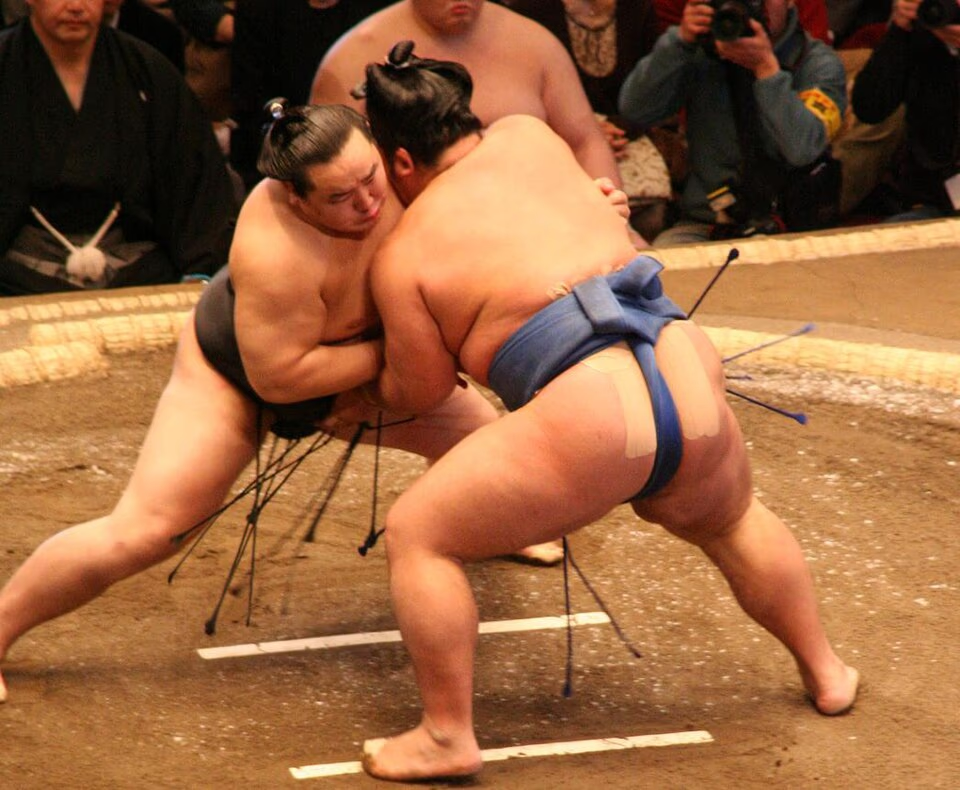
Professional Sumo (大相撲, ōzumō) is Japan's national sport, governed by the Nihon Sumo Kyokai (Japan Sumo Association, founded 1925) as the sole professional sumo authority worldwide. Sumo wrestlers (rikishi) compete in six annual 15-day tournaments (basho): January (Tokyo), March (Osaka), May (Tok...
No closed-fist punches (open-hand slaps permitted); No kicking; No grabbing hair
82 officially recognized winning techniques (kimarite) — including yorikiri (force-out grip), oshidashi (push-out), uwatenage (overarm throw), shitatenage (underarm throw), various trips + lifts + slap-downs; Each match victory recorded with the kimarite used — kimarite history is preserved as pa...
No fixed time limit — matches typically last 5-30 seconds; most are over within 10 seconds; Pre-match ritual (shikiri) takes 4+ minutes; salt-throwing + facing-off; the actual bout is brief
Mawashi (silk belt loincloth): the rikishi's only attire during competition; ~9-13 m long, folded + wrapped around the waist + crotch; color varies by rank (Makuuchi: vibrant colored; lower divisions: black cotton); Chonmage (topknot hair-style): traditional samurai-style hair worn by all profess...
Dohyo (土俵): elevated clay-and-sand ring, raised ~50 cm above the floor; Inner ring diameter: 4.55 m bounded by a circular rope (tawara) embedded in the clay; Outer dohyo platform extends an additional ~2 m beyond the rope
Two rikishi per match (1-on-1); No weight classes — all rikishi within a division compete open-weight; Divisions (highest to lowest): Makuuchi, Juryo, Makushita, Sandanme, Jonidan, Jonokuchi, Maezumo
No fixed time limit — matches typically last 5-30 seconds; most are over within 10 seconds; Pre-match ritual (shikiri) takes 4+ minutes; salt-throwing + facing-off; the actual bout is brief; Force opponent out of the dohyo (any part of body steps outside the rope), OR
Each match: 1 win or 1 loss recorded per rikishi (no scoring beyond W/L); Each basho: 15 days × 1 match per rikishi = up to 15 wins; Kachi-koshi: 8 or more wins in a 15-day basho = winning record (promotion + bonus)
Banned technique (kinjite): immediate loss + potential commission discipline; Mawashi failure (belt comes off during match): immediate loss (rare, considered dishonorable); Premature start (henka jump): tactical move (not technically illegal) but heavily frowned upon at Yokozuna rank
Professional sumo's injury profile: severe limb fractures (especially knees), neck injuries from being thrown, shoulder + back strain from grappling at high body weights (rikishi often 130-200+ kg)...
Never celebrate or show emotion after winning
A rikishi who wins must exit the dohyo without any display of joy, triumph, or relief—no raised fists, shouting, or gestures to the crowd. The winner bows, collects any prize envelope, and departs composedly. Exuberant post-win behavior is considered a serious breach of the dignity the sport demands of its participants.
Foreign rikishi from cultures where victory celebrations are normal have been publicly criticized for violations. Yokozuna Hakuho's raised-arm gestures and verbal exclamations after wins drew sustained, documented criticism from traditionalists and the Yokozuna Deliberation Council.
A Yokozuna must retire rather than accept demotion
A Yokozuna who performs poorly cannot be formally stripped of rank—the JSA has no demotion mechanism for the title. Instead, cultural and institutional pressure requires voluntary retirement. When the Yokozuna Deliberation Council issues public statements 'encouraging retirement,' this functions as a near-mandatory demand; ignoring it repeatedly is viewed as deeply dishonorable.
Yokozuna Kisenosato (retired 2019), Kakuryu (2021), and Hakuho (2021) all faced this pressure. Kakuryu's extended absence from honbasho while nominally holding the title was a particular flashpoint.
Lose quietly—no protest, no lingering on the dohyo
After a loss, the rikishi must exit immediately and in complete silence. Challenging a gyoji's call before a mono-ii (judges' review) is requested, visibly showing frustration, or lingering near the dohyo is considered disrespectful to the sport and opponent alike. A composed exit is expected regardless of the circumstances of the loss.
Ready to dive deeper?
Absolute deference to the oyakata (stablemaster) within the stable
Within the heya (stable), the oyakata's authority over training, scheduling, diet, and career decisions is not publicly questioned by rikishi. A wrestler who openly challenges or criticizes their stablemaster violates the foundational iemoto (master-apprentice) social contract that structures sumo stable life.
Public dissent is so rare that the few documented cases became major news stories in Japanese sports media and typically ended careers.
A Yokozuna unable to perform dohyo-iri is expected to consider retirement
The dohyo-iri ring-entering ceremony at each honbasho is both privilege and obligation for a Yokozuna. Repeatedly missing or being physically unable to complete this ceremony is understood culturally as a signal that the wrestler can no longer fulfill the rank's duties and should retire. There is no written rule—the pressure is entirely social and institutional.
Yokozuna Kakuryu's repeated tournament absences (kyujo) while retaining the rank were the central driver of sustained retirement pressure culminating in 2021.