

🏛️Official — AJP
Loading OpenSourceSports…
Release immediately when opponent taps
The most sacred rule in all of jiu-jitsu: the instant an opponent taps (hand, foot, or verbally) you release the submission completely, no exceptions. Continuing even a fraction of a second after the tap is considered a grave violation of trust and the foundational safety compact of the sport.
Never sandbag — compete at your true skill level
Deliberately competing in a division below your actual ability — whether by manipulating weight, belt classification, or age bracket — is one of the most socially condemned acts in competitive BJJ. Community policing is strong; known sandbaggers face public criticism and are informally shunned at gyms.
Maintain rigorous hygiene before training and competition
Arriving to train or compete with an unwashed gi, untrimmed nails, or skin infections is considered a serious breach of etiquette. The close-contact nature of the sport makes hygiene both a courtesy and a safety issue; competitors known for poor hygiene are informally avoided as training partners.
Don't 'dojo storm' — respect visiting gym etiquette
Visiting another academy and immediately attempting to impose dominance on the resident training partners — especially without invitation from the instructor — is a serious breach of community etiquette. Visitors are expected to introduce themselves, receive permission to train, and roll with appropriate respect.
Seek the submission — stalling is a disgrace
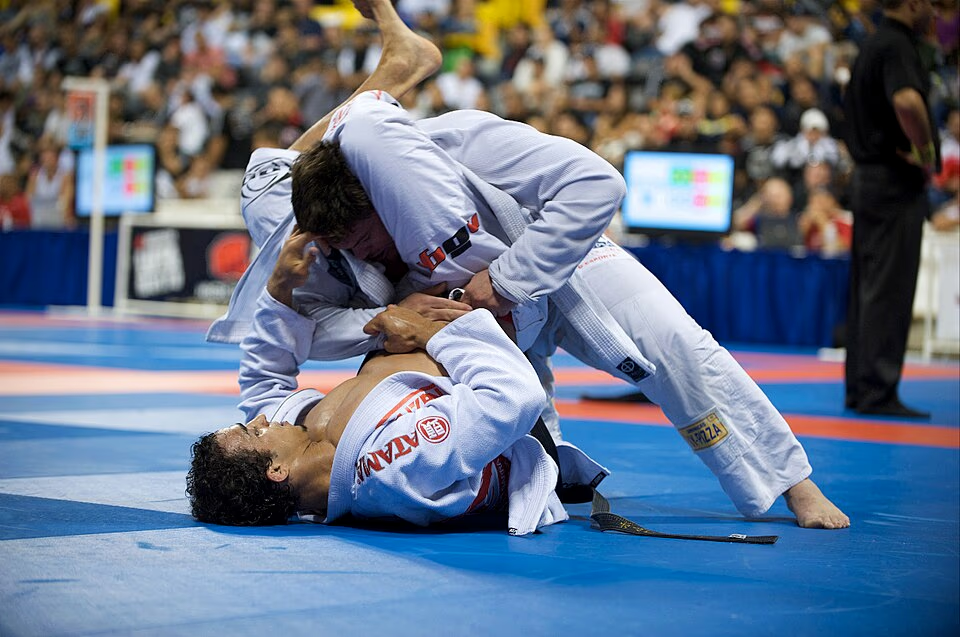
BJJ culture holds that the goal of a match is a submission, not a points victory. A competitor who wins purely by stalling, avoiding engagement, or running the clock on a slim advantage is widely criticized even if the result is legal. This norm is especially sharp at AJP, which structures scoring to reward submission attempts.
No taunting or excessive celebration after a finish
Demonstrative taunting — standing over a downed opponent, pointing, or prolonged flexing directed at the opponent rather than the crowd — violates BJJ's martial arts etiquette. A brief acknowledgment of emotion is accepted; humiliating an opponent who just tapped is not.
Higher belts control their intensity with lower-ranked partners in training
A black or brown belt rolling with a white or blue belt is expected to calibrate intensity — using technique rather than strength and athleticism to dominate. Going full force against a much lower-ranked partner and injuring them is widely viewed as an abuse of rank.
2 points: Takedown, Sweep, Knee-on-Belly; 3 points: Guard Pass; 4 points: Mount, Back Mount
Why people argue about this
People often think that takedowns and sweeps are worth 4 points each because they assume all submissions are scored at 4 points, but actually, a mount or back mount is what gets those higher scores, leading to confusion about why other moves aren't getting the same high point value.
White Belt: 4 min; Blue: 5 min; Purple: 6 min; Brown: 7 min; Black: 8 min (10 min for major tournaments); If tied: referee decision based on points, advantages, penalties
Why people argue about this
People often assume that the longer match times for higher belts mean they're automatically better fighters, which is a misunderstanding of how these rules are intended to work—instead, it's meant to account for the increased skill level and endurance typically found in more experienced practitioners.
Stalling, fleeing match, illegal grip → penalties; 4 penalties = DQ; Advantage awarded for near-completion of scoring moves; tiebreaker only
Why people argue about this
People often assume that stalling or using an illegal grip only results in a penalty, forgetting that four instances of these penalties lead to Disqualification, which can be confusing because it means minor infractions escalate quickly and significantly.
Gi (Kimono): AJP-approved gi; colored belt indicating rank; No-Gi: rashguard + shorts/grappling pants; Gi colors: white, blue, or black
Why people argue about this
People often assume that all AJP-approved colored belts must wear a rashguard under their gi top during competitions, which leads to misunderstandings about what is required for different belt levels in no-gi matches where cups are recommended instead of rashguards.
Standard 8m × 8m AJP-approved tatami; multiple mats at Grand Slam events; Center match area with marked outer safety zone; Mat material: at least 4 cm tatami-style thickness
Why people argue about this
People often assume that the 8m x 8m area is just a square on the mat where they can practice without restrictions, but actually, it's delineated by lines within the tatami mats and includes an outer safety zone with at least 4 cm of tatami material for added stability and cushioning. This oversight leads to misunderstandings about what constitutes the playing area during matches.
Two competitors per match; Weight classes (Adult Male, kg): -56, -62, -69, -77, -85, -94, -120; Belt classification: White, Blue, Purple, Brown, Black (recognized via UAEJJF + IBJJF cross-recognition)
Why people argue about this
People often assume that all AJP Jiu-Jitsu matches are head-to-head competitions without realizing that in specified weight classes from -56 kg to -120 kg, each match does indeed have two competitors simultaneously grappling for a decision. The confusion arises because they might not fully grasp the concept of simultaneous competition within these weight categories.
White Belt: 4 min; Blue: 5 min; Purple: 6 min; Brown: 7 min; Black: 8 min (10 min for major tournaments); If tied: referee decision based on points, advantages, penalties; 2 points: Takedown, Sweep, Knee-on-Belly
Why people argue about this
People often assume that a 4-10 minute match in Jiu-Jitsu (AJP) means exactly what it sounds like—four to ten full minutes of grappling without breaks—but actually, these time limits are per belt level and can be broken up into rounds or periods with breaks for rest. The confusion arises because the verbatim rule doesn't specify how the total time is divided among matches.
Decision priority: submission > points > advantages > penalties > referee decision; AJP Tour points: each Grand Slam round contributes ranking points; year-end championship tour standings; World Pro Championship: highest annual purse in BJJ (~$50K+ for gold)
Why people argue about this
People often assume that in AJP Jiu-Jitsu, points are given more importance than submissions, leading to arguments about which decision criteria are most crucial for winning matches. However, the official verdict clarifies that scoring decisions indeed prioritize submission over points and other factors, highlighting how understanding the specific hierarchy can resolve these misunderstandings.
Stalling: verbal warning → penalty; repeated = DQ; Fleeing: exiting match area without tactical reason = penalty; Illegal submissions for belt/age: immediate DQ if applied
Why people argue about this
People often assume that a verbal warning for stalling in Jiu-Jitsu means it's just a minor infraction they can get away with, but actually, the rule is quite strict: repeated instances of stalling are what warrants a disqualification (DQ), not just one or two warnings.
Same injury profile as BJJ generally: joint injuries (shoulder, elbow, knee), occasional concussion. AJP belt-graded submission restrictions enforced; high-risk submissions (heel hooks, knee reaps, twisters) only legal at higher belt levels in specific no-gi categories.
Why people argue about this
People often assume that AJP's safety considerations are identical to BJJ, forgetting that AJP has belt-graded submission restrictions enforced in high-risk moves like heel hooks and knee reaps, which can lead to confusion about its risk profile compared to other no-gi submissions.
Joint locks + chokes legal subject to belt + age restrictions; Heel hooks legal in no-gi at adult Brown/Black at some AJP events (more permissive than IBJJF); Knee reaps legal in some no-gi categories
Why people argue about this
People often assume that heel hooks are universally illegal in Jiu-Jitsu competitions, forgetting that they're permitted at some events with proper age restrictions and belt level requirements, leading to confusion about where and when this move is allowed.