

🏛️Official — AJP
Loading OpenSourceSports…
Combat Sports
1 players
indoor
mat, gi, belt
10 essential rules
Abu Dhabi Jiu-Jitsu Pro (AJP) is the professional jiu-jitsu circuit operated by the UAE Jiu-Jitsu Federation (UAEJJF). AJP rose to prominence by operating the Abu Dhabi World Professional Championship (the highest-prize-purse BJJ tournament in the world) and an extensive Grand Slam circuit with s...
2 points: Takedown, Sweep, Knee-on-Belly; 3 points: Guard Pass; 4 points: Mount, Back Mount
White Belt: 4 min; Blue: 5 min; Purple: 6 min; Brown: 7 min; Black: 8 min (10 min for major tournaments); If tied: referee decision based on points, advantages, penalties
Stalling, fleeing match, illegal grip → penalties; 4 penalties = DQ; Advantage awarded for near-completion of scoring moves; tiebreaker only
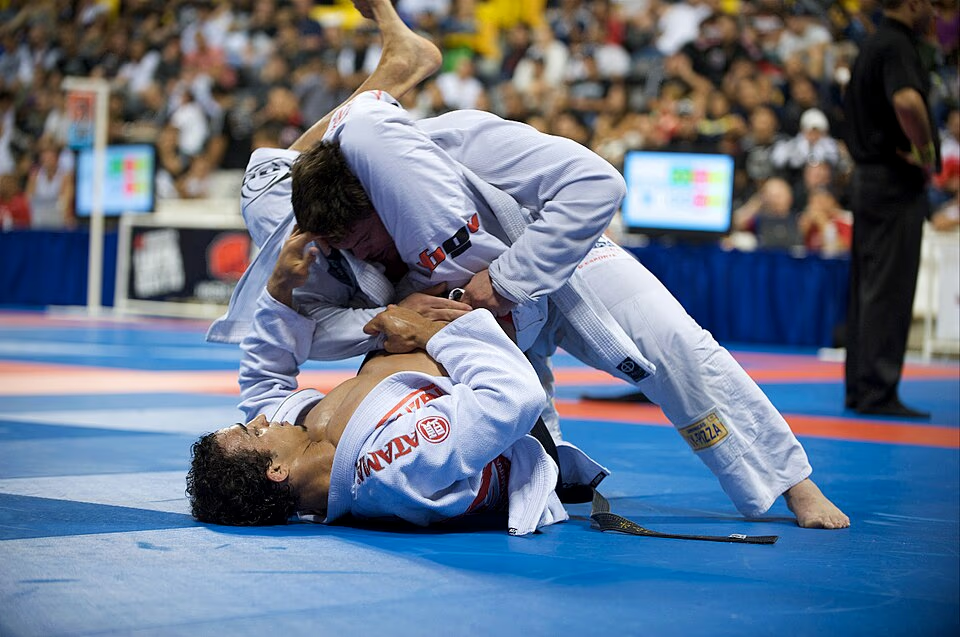
Gi (Kimono): AJP-approved gi; colored belt indicating rank; No-Gi: rashguard + shorts/grappling pants; Gi colors: white, blue, or black
Standard 8m × 8m AJP-approved tatami; multiple mats at Grand Slam events; Center match area with marked outer safety zone; Mat material: at least 4 cm tatami-style thickness
Two competitors per match; Weight classes (Adult Male, kg): -56, -62, -69, -77, -85, -94, -120; Belt classification: White, Blue, Purple, Brown, Black (recognized via UAEJJF + IBJJF cross-recognition)
White Belt: 4 min; Blue: 5 min; Purple: 6 min; Brown: 7 min; Black: 8 min (10 min for major tournaments); If tied: referee decision based on points, advantages, penalties; 2 points: Takedown, Sweep, Knee-on-Belly
Decision priority: submission > points > advantages > penalties > referee decision; AJP Tour points: each Grand Slam round contributes ranking points; year-end championship tour standings; World Pro Championship: highest annual purse in BJJ (~$50K+ for gold)
Stalling: verbal warning → penalty; repeated = DQ; Fleeing: exiting match area without tactical reason = penalty; Illegal submissions for belt/age: immediate DQ if applied
Same injury profile as BJJ generally: joint injuries (shoulder, elbow, knee), occasional concussion. AJP belt-graded submission restrictions enforced; high-risk submissions (heel hooks, knee reaps, twisters) only legal at higher belt levels in specific no-gi categories.
Release immediately when opponent taps
The most sacred rule in all of jiu-jitsu: the instant an opponent taps (hand, foot, or verbally) you release the submission completely, no exceptions. Continuing even a fraction of a second after the tap is considered a grave violation of trust and the foundational safety compact of the sport.
Applies equally in competition and training. Referees enforce this, but competitors are expected to self-police even when the referee does not see a tap.
Never sandbag — compete at your true skill level
Deliberately competing in a division below your actual ability — whether by manipulating weight, belt classification, or age bracket — is one of the most socially condemned acts in competitive BJJ. Community policing is strong; known sandbaggers face public criticism and are informally shunned at gyms.
AJP and IBJJF both have technical rules against it, but the cultural stigma operates independently and often precedes formal sanctions.
Maintain rigorous hygiene before training and competition
Arriving to train or compete with an unwashed gi, untrimmed nails, or skin infections is considered a serious breach of etiquette. The close-contact nature of the sport makes hygiene both a courtesy and a safety issue; competitors known for poor hygiene are informally avoided as training partners.
Skin infections (ringworm, staph) are an occupational hazard; hygiene norms are enforced socially even when not explicitly written in event rules.
Ready to dive deeper?
Don't 'dojo storm' — respect visiting gym etiquette
Visiting another academy and immediately attempting to impose dominance on the resident training partners — especially without invitation from the instructor — is a serious breach of community etiquette. Visitors are expected to introduce themselves, receive permission to train, and roll with appropriate respect.
The practice has historical roots in early Brazilian vale tudo culture and remains a touchstone for community trust.
Seek the submission — stalling is a disgrace
BJJ culture holds that the goal of a match is a submission, not a points victory. A competitor who wins purely by stalling, avoiding engagement, or running the clock on a slim advantage is widely criticized even if the result is legal. This norm is especially sharp at AJP, which structures scoring to reward submission attempts.
The AJP's own ruleset reflects this cultural expectation through its submission-bonus and activity provisions, but the social norm predates and exceeds the written rules.
No taunting or excessive celebration after a finish
Demonstrative taunting — standing over a downed opponent, pointing, or prolonged flexing directed at the opponent rather than the crowd — violates BJJ's martial arts etiquette. A brief acknowledgment of emotion is accepted; humiliating an opponent who just tapped is not.
The expectation traces directly to the sport's martial arts lineage. Violations occasionally draw public criticism from community figures.
Higher belts control their intensity with lower-ranked partners in training
A black or brown belt rolling with a white or blue belt is expected to calibrate intensity — using technique rather than strength and athleticism to dominate. Going full force against a much lower-ranked partner and injuring them is widely viewed as an abuse of rank.
Training room norm with direct competitive implications — athletes who injure training partners through recklessness carry a reputation that follows them in the community.