
🏛️Official — IWF
Loading OpenSourceSports…
Individual Sports
1 players
indoor
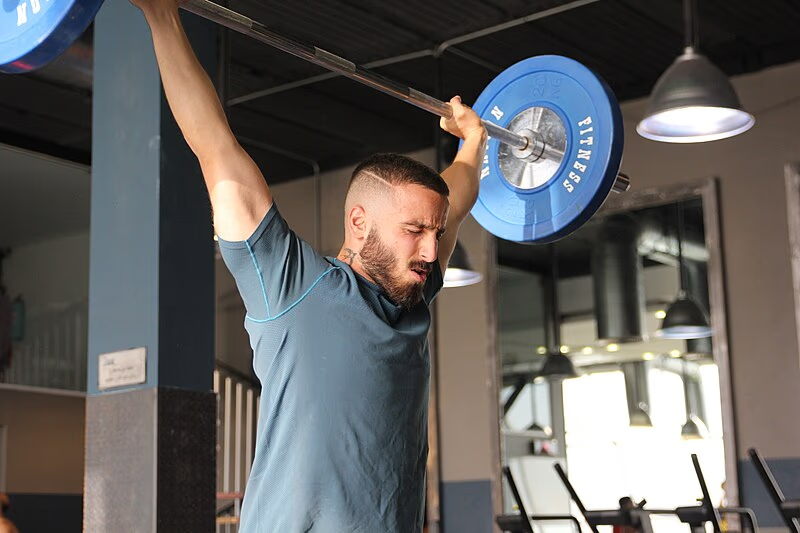
barbell, weight plate, singlet
10 essential rules
Olympic weightlifting is governed by the International Weightlifting Federation (IWF), founded in 1905 and headquartered in Lausanne, Switzerland. The sport operates under the IWF Technical and Competition Rules and Regulations (TCRR), updated before each Olympic cycle. With over 190 member feder...
Men's bar: Weight 20 kg (44.1 lb). Total length 220 cm (86.6 in). Shaft diameter 28 mm (1.1 in). Sleeve (collar) diameter 50 mm. Rotating sleeves with needle bearings to allow plates to spin freely during the lift.; Women's bar: Weight 15 kg (33.1 lb). Total length 201 cm (79.1 in). Shaft diamete...
Competition plates are rubber-coated (bumper plates) designed for safe dropping from overhead.
Weightlifting shoes: Raised heel (maximum sole height 130 mm / 5.1 in from floor, minimum 3 mm). Rigid sole for stability. Strap or lace closure.; Singlet: One-piece competition singlet. Must not cover the elbows or extend below the knees. Team or national federation colours.; Belt: Maximum width...
The competition platform is the defined lifting area: Dimensions: 4 m x 4 m (13.1 ft x 13.1 ft); Surface: Wooden or composite non-slip material, designed to absorb impact from dropped barbells. The surface must be flat, level, and free of debris.; Elevation: At major competitions, the platform is...
A separate warm-up room must be provided adjacent to the competition venue. It must contain a minimum of one warm-up platform per 3–4 athletes in the session, each equipped with a competition-standard barbell and full set of plates.
The competition stage includes the platform, a referee panel positioned at the front (one centre referee, two side referees), a jury table behind or to the side, a scoreboard visible to athletes an...
The IWF periodically restructures weight categories. The 2024 Paris Olympic weight categories are: Men: 61 kg, 73 kg, 89 kg, 102 kg, +102 kg (5 categories); Women: 49 kg, 59 kg, 71 kg, 81 kg, +81 kg (5 categories)
) based on their entry total (sum of declared opening snatch + opening clean & jerk). Group A contains the strongest lifters and is the medal-deciding session.
Three referees: Centre referee and two side referees. Each referee independently judges every lift, pressing a white button (good lift) or red button (no lift). A majority decision (2 of 3) determines the outcome. The "down" signal is given by the centre referee once the lift meets the criteria f...
Each athlete receives 3 attempts in the snatch and 3 attempts in the clean & jerk. The snatch is always contested first.
Stay composed after a missed lift on the platform
Throwing the bar, slamming equipment in anger, or having a visible emotional breakdown on the competition platform after a missed attempt is frowned upon. A degree of composure when leaving the platform — regardless of how critical the miss — is expected by the weightlifting community.
Releasing the bar from overhead is normal and permitted; it is extended anger displays and equipment abuse that violate the norm. Some bar slams after a miss at training are tolerated in gym culture.
Never walk across a competitor's platform in the warm-up room
The lifting platform — even a practice one — is treated as the lifter's personal space during their preparation. Crossing or stepping onto another athlete's platform without permission is a significant breach, disruptive to focus and preparation ritual.
Applies both at competition warm-up halls and in club training settings when platforms are occupied.
Do not celebrate a competitor's missed lift or bomb-out
When a rival misses an attempt — especially a bomb-out that ends their competition — showing visible joy, laughing, or making remarks is considered disrespectful. A neutral or sympathetic reaction is expected regardless of how significant the outcome is for your own placing.
Missing a third attempt on snatch or C&J can end an entire Olympic cycle for an athlete; the community treats such moments with gravity.
Ready to dive deeper?