


🏛️Official — World Aquatics
Loading OpenSourceSports…
Water Sports
6–12 players
indoor
water polo ball, goal, net
10 essential rules
Water polo is one of the oldest Olympic team sports, with men's competition debuting at the 1900 Paris Games and women's added at the 2000 Sydney Games. Governed by World Aquatics (formerly FINA) under the World Aquatics Water Polo Rules (WP 1–WP 22), the sport is played between two teams of seve...
Men's ball: Circumference 68–71 cm (26.8–28 in), weight 400–450 g (14.1–15.9 oz); Women's ball: Circumference 65–67 cm (25.6–26.4 in), weight 350–400 g (12.3–14.1 oz); Waterproof, non-absorbent outer surface with a textured grip coating
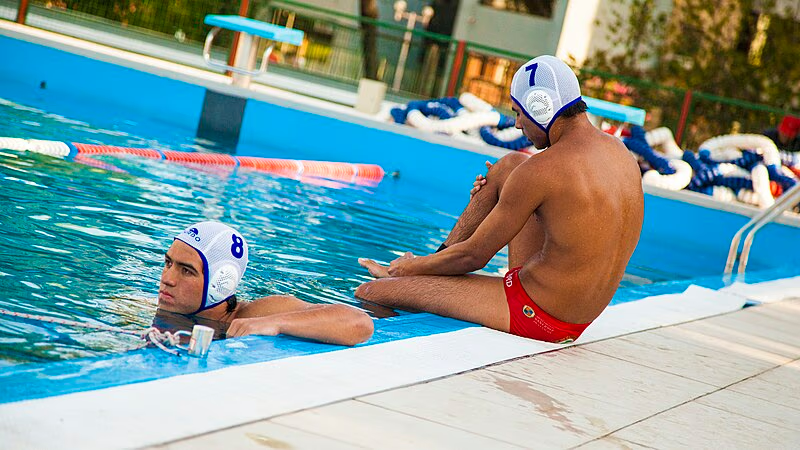
Each team wears distinctly colored caps: one team wears white, the other dark blue (or contrasting dark color); Goalkeepers wear red caps, numbered #1 (starting goalkeeper) or #13 (reserve goalkeeper); Field players numbered 2–13 (excluding 1 and 13 for non-goalkeepers)
Width: 3 m (9.84 ft) between the inner edges of the goalposts; Crossbar underside: 0.90 m (2.95 ft) above the water surface when water depth is 1.50 m (4.92 ft) or more; 2.40 m (7.87 ft) from the bottom when depth is less than 1.50 m; Goals may be rigid (anchored to the pool deck or wall) or floa...
Swimwear: Non-transparent, one-piece or two-piece swimsuit (no body suits extending past shoulders or knees); Mouthguards: Recommended but not mandatory under World Aquatics rules; No jewelry, watches, or hard accessories permitted
Men’s field: 30 m × 20 m (98.4 ft × 65.6 ft) for FINA/World Aquatics and Olympic competitions; Women’s field: 25 m × 20 m (82 ft × 65.6 ft) for FINA/World Aquatics and Olympic competitions; Domestic and junior competitions may use shorter fields (minimum 20 m × 10 m)
2 m line (red/red markers): Marks the zone in front of each goal; ordinary fouls by the attacking team inside this area result in a free throw at the 2 m line; 5 m line (yellow markers): Penalty throw line; also defines the zone where exclusion fouls that prevent probable goals are upgraded to pe...
Visible shot clock (30-second countdown) displayed on both sides of the pool; Game clock showing actual playing time per period; Electronic scoreboard visible to teams, officials, and spectators
In the water: 7 players per team (6 field players + 1 goalkeeper); Roster: Maximum 13 players per team (11 field players + 2 goalkeepers); A team must have at least 7 players to start a match
Unlimited substitutions permitted, but only from the re-entry area during a dead-ball situation or after a goal; Flying substitutions (during play) allowed only at the re-entry area; the departing player must fully leave the water before the substitute enters; Goalkeeper-to-goalkeeper substitutio...
Center forward (hole set / 2-meter player): Positions directly in front of the opposing goal at the 2 m line; primary target for entry passes; Center back (hole-D): Defends the center forward; physical, pressing defense; Wings: Position at the sides of the attacking formation; drive and shoot fro...
Two-Meter Pit Mutual Combat
The positional battle between hole-set and hole guard is understood as a mutually accepted, continuous physical contest. Both players enter this role knowing they will be held, pushed, and maneuvered underwater constantly. Neither complains to officials about ordinary wrestling in this zone — it is the agreed terms of those positions.
The two-meter area is colloquially called 'the pit' at collegiate and international levels, reflecting its brutally physical nature.
The Underwater Contract
Extensive wrestling, holding, and grappling below the surface is treated by mutual consent as an accepted layer of the game. What referees cannot see is implicitly fair game — players on both sides engage in and expect this physical combat throughout a match without complaint.
Most intense between the hole-set (center forward) and hole guard, who maintain a near-continuous wrestling match for position throughout the game.
Ready to dive deeper?