


🏛️Official — World Taekwondo
Loading OpenSourceSports…
Combat Sports
1 players
both
uniform, trunk protector, headgear
10 essential rules
Taekwondo is a Korean martial art that emerged in the mid-20th century, drawing on indigenous Korean kicking traditions and various martial arts influences. The name translates roughly as "the way of the foot and fist" — tae (foot), kwon (fist), do (way or discipline). General Choi Hong-hi is cre...
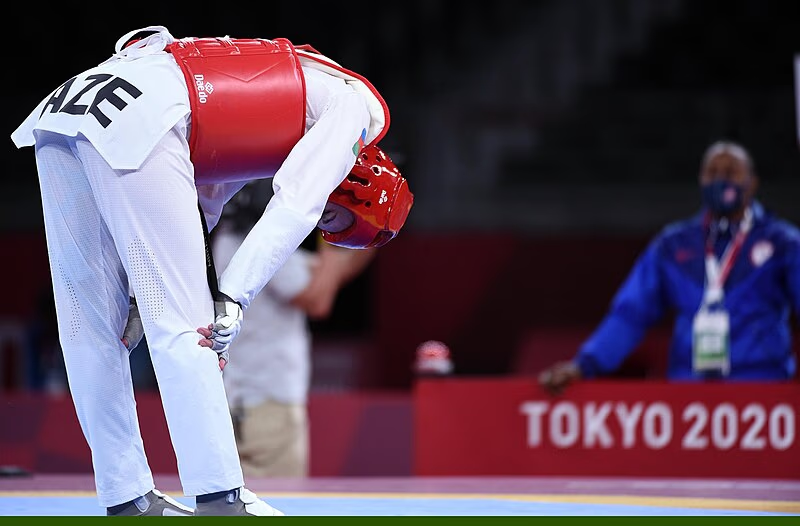
Competitors wear a WT-approved dobok (uniform). The dobok consists of a V-neck pullover top and elastic-waist pants, both made of lightweight, breathable fabric.
The trunk protector (hogu) is the primary scoring target for body techniques. In WT-sanctioned events, electronic trunk protectors integrated into the PSS are mandatory.
The electronic head protector is worn over the head and covers the scoring areas above the collarbone. Since the 2020 rule cycle, WT has mandated electronic head protectors with embedded sensors at all major competitions, replacing the previous sy...
Competitors wear electronic sensing socks (e-foot protectors) that contain transmitters corresponding to the PSS. Only strikes delivered by the portion of the foot below the ankle bone (instep, ball of foot, sole) register on the electronic system.
All protective equipment must be WT-approved and in serviceable condition. The referee may instruct a competitor to replace damaged or non-compliant equipment before the match continues.
The Contest Area must have a flat surface free of obstructing projections and be covered with an elastic, non-slip mat. It may be installed on a platform 0.6–1 m high, in which case the outer part of the Outer Line is inclined at a gradient of les...
The Competition Area envelopes both the Contest Area and the surrounding Safety Area, and shall be no smaller than 10 m × 10 m and no larger than 12 m × 12 m (Article 3.1.1). The Safety Area is therefore the margin between the outer line of the Co...
Two starting positions are marked on the mat: one for the blue (chung) competitor and one for the red (hong) competitor, each approximately 4 m from the center and 1 m apart. The referee's position is marked at the center edge of the mat.
At World Championships and Grand Prix events, multiple competition courts operate simultaneously. Each court is designated by number and operates with its own independent set of officials, PSS equipment, and IVR system.
The competition venue must provide adequate lighting (minimum 1,500 lux at mat level for televised events), temperature control, and ventilation. A scoreboard visible to competitors, officials, and spectators must be positioned prominently.
Bow sincerely to your opponent, not just perfunctorily
While WT rules require a bow before and after a match, the depth, eye contact, and genuine sincerity of the bow carry deep cultural weight rooted in Korean martial arts tradition. A quick, dismissive nod is widely seen as disrespectful regardless of its technical compliance with the written requirement.
Rooted in Confucian values embedded in the sport's founding ethos; applies equally in training and competition.
No excessive celebration after scoring or winning
Taekwondo's five tenets—especially self-control and integrity—create a strong cultural expectation of humility in victory. Taunting, prolonged fist-pumping, or theatrical celebrations are broadly condemned as violations of the art's spirit, even when not formally penalized by referees.
Scrutinized at multiple Olympics; notable incidents drew public criticism from coaches, officials, and fellow athletes.
Do not 'gamjeom fish' — baiting fouls is dishonorable
Provoking an opponent into a penalty (gamjeom) through exaggerated reactions, feigned injury, or manufactured situations rather than winning through technique is widely condemned as contrary to the martial arts ethic of honest competition. A single gamjeom can decide a close match, making the temptation real at elite level.
More prevalent since the electronic scoring era, where a point margin makes gamjeom more decisive.
Ready to dive deeper?