


🏛️Official — ISUIn Season
Loading OpenSourceSports…
Winter Sports
1 players
indoor
skate, race suit, helmet
10 essential rules
Long track speed skating has been an Olympic discipline since the inaugural 1924 Chamonix Winter Games (men's events) and since 1960 Squaw Valley (women's events). The sport is governed by the International Skating Union (ISU) under the ISU Sports Rules Speed Skating, read together with the ISU C...
Rule 224, paragraph 2.a defines a skate as "a passive mechanical extension of the leg, meant to facilitate the gliding technique," consisting of a blade and a shoe connected by a construction that may allow translation and rotation of the shoe rel...
Rule 224, paragraph 1.a requires that "racing suits shall conform to the natural shape of the body of the Skater," and bars insertion or attachment of forms or devices that create a different shape. The only permitted attachments are permanently f...
Rule 224, paragraph 1.a states that competitors "may wear a helmet, neck protection, gloves or mitts (predominantly white) outside the racing suit" — these items are permitted, not mandated, for individual and team races. For ISU Events, any helme...
Rule 203, paragraph 1 defines a Standard Speed Skating Track as a two-lane competition track of maximum 400 m, minimum 333⅓ m, with two 180° curved ends whose inner-curve radius "should not measure less than 25 m and not more than 26 m." Rule 203,...
Ice preparation at ISU Events, the Olympic Winter Games, and the Winter Youth Olympic Games is governed by an ISU Ice Commission consisting of the Referee(s) and the ISU Speed Skating Technical Committee Representative or Technical Delegate (Rule ...
A photo-finish system is mandatory at ISU Championships, ISU World Cup Competitions, and the Speed Skating events of the OWG and YOWG (Rule 251, paragraph 2.d). Where a photo-finish system is in use, its recorded times and order of finish govern t...
Individual races are skated in pairs, one skater in the inner lane and one in the outer lane, changing lanes each lap (Rule 254, paragraphs 2 and 5). Team Pursuit races may be entered with either 3 or 4 skaters per team; regardless of team size, t...
e-f). The Starter separately controls all disputes arising during the starting procedure itself, from the moment competitors go to their lane until a valid start is completed (Rule 217, paragraph 2).
Team Leaders confirm final entries and withdrawals at a Team Leaders' meeting before the opening draw (Rule 239, paragraph 1). b).
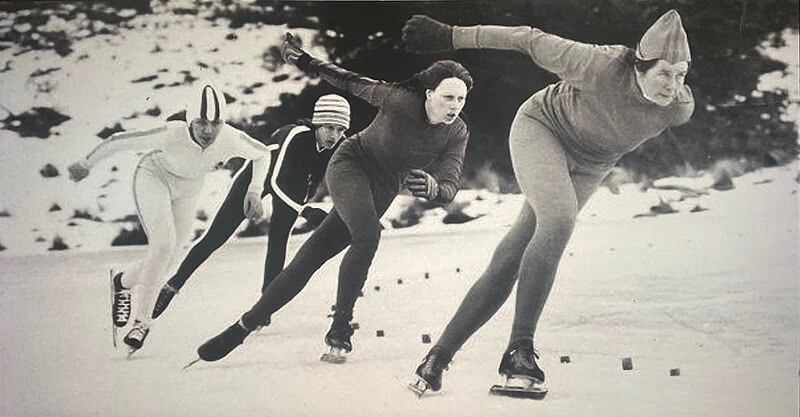
a requires the inner-lane skater to move to the outer lane on the crossing straight — the straight between the end of the curve (marked by movable blocks) and the beginning of the next curve (marked by a cone) — and the outer-lane skater to move to the inner lane, every lap. b).
Yield to faster skaters on the training oval
During open or shared ice sessions, slower skaters are expected to move to the outside lane and yield when a faster skater approaches from behind. Holding your line when a faster skater is bearing down wastes their training momentum and is considered disrespectful. The convention mirrors road cycling: faster traffic has implicit right of way.
Applies primarily to long track 400m oval training. Failure to yield is also a safety concern at racing speeds.
Never touch another skater's blades without explicit permission
Speed skating blades are among the most precisely tuned pieces of equipment in sport — sharpening angle, hollow, and edge alignment are dialed to a skater's exact preference. Touching, handling, or especially picking up another skater's skates without asking is considered a serious breach of respect. Even well-intentioned curiosity is unwelcome.
The taboo is especially strong at elite level where individual blade preparation is a closely guarded technical detail.
Ready to dive deeper?