


🏛️Official — World Lacrosse
Loading OpenSourceSports…
Team Sports
4–8 players
outdoor
lacrosse ball, stick, helmet
10 essential rules
Lacrosse Sixes is the shortened-format variant of lacrosse developed by World Lacrosse to provide a faster, smaller-field, more spectator-friendly version of the game suitable for international and Olympic competition. The format was approved for the 2028 Los Angeles Olympic Games as the lacrosse...
Expulsion fouls are the most serious category and result in ejection from the game for the offending Player (Rule 8.4.1). Under Rule 8.4.2, the penalty is suspension of the offending Player for the remainder of the game, with the team's In-Home serving a two-minute penalty on the Player's behalf.
Officials designate the severity of a time-serving foul by card color: green for a minor foul (30 seconds), yellow for a major foul (one minute), and red for an expulsion foul (Rule 9.5.1).
4 quarters × 8 minutes of regulation playing time (Rule 5.1.1).; A two-minute interval between the first and second quarters and between the third and fourth quarters (Rule 5.1.2); a five-minute half-time intermission between the second and third quarters (Rule 5.1.3).; Teams change direction of ...
Major fouls are more serious in nature (Rule 8.1.1) and carry a one-minute suspension from the game, with the ball awarded to the non-offending team (Rule 8.1.2). Three or more major fouls by the same Player result in fouling out for the remainder of the game (Rule 8.2.1).
Minor fouls cover violations not specifically listed as major or expulsion fouls (Rule 7.1.1) and include interference (Rule 7.2.1), holding (Rule 7.2.3), withholding the ball from play (Rule 7.2.4), illegal procedure (Rule 7.2.7), offside (Rule 7...
Substitution may take place at any time through the Substitution Area, with Players permitted to substitute on the fly (Rule 6.13.1).; Body-checking of an opponent in any form is illegal under Rule 8.3.1 — Sixes is designed around stick skills and loose-ball play rather than body contact, subject...
Under Rule 5.1.4, sudden-death golden goal is no longer used. When the score is tied at the end of regulation, play continues with a full three-minute overtime period of stopped time, and the team leading when that period ends is declared the winn...
Upon a team gaining possession, a 30-second shot clock begins; if it expires without a shot on goal, possession is awarded to the defensive team (Rule 5.3.1).; A team gaining possession in its defensive half must advance the ball across the center-line within a 10-second count (Rule 6.9.1).; Each...
Personal protective equipment — Men's (Rule 2.4.1M): All Men's-discipline Players are required to wear protective gloves and a protective helmet designed for lacrosse, equipped with a facemask and a chinstrap fastened on both sides. Suitable shoes must be worn.
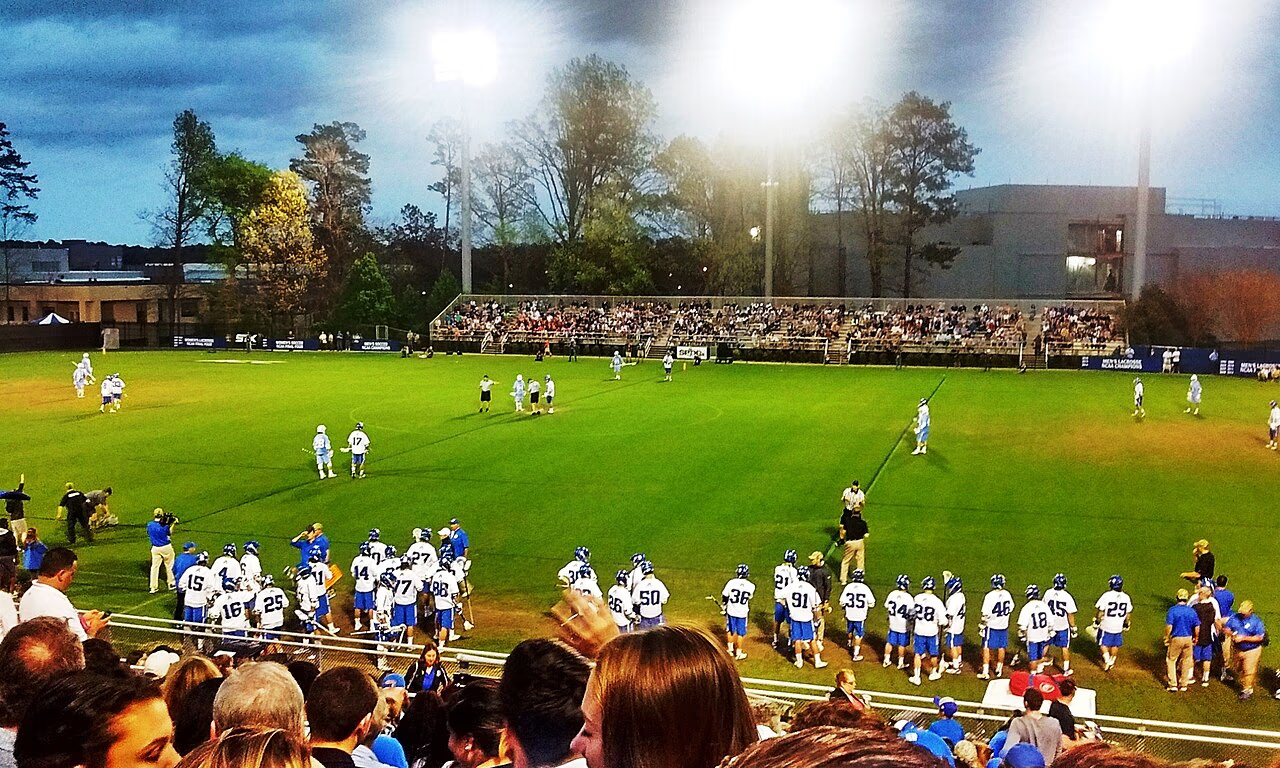
Field (Rule 1.1.1): The playing field for all World Lacrosse Sixes events is rectangular, 70 m long and 36 m wide, with out-of-bounds lines measured from the inside edge of the line. For events not recognized or approved by World Lacrosse, field d...
Shake hands after every match
Post-game handshake lines are a deeply embedded expectation across all lacrosse formats at every level. Skipping or making the handshake perfunctory is considered disrespectful regardless of the result. The tradition carries directly into Sixes from both field and box lacrosse cultures.
Stop active play when a player is seriously injured
When an opposing player is clearly injured and down, the convention is to hold the ball and not press for scoring advantage until the player is attended to and play is officially stopped. Ignoring an injured opponent to score is widely considered poor sportsmanship in all lacrosse formats.
More expectation in amateur/youth levels; pros rely on officials, but the spirit is acknowledged at elite levels too.
Ready to dive deeper?