


🏛️Official — NCAA
Loading OpenSourceSports…
Team Sports
12–24 players
outdoor
lacrosse ball, stick, goal
10 essential rules
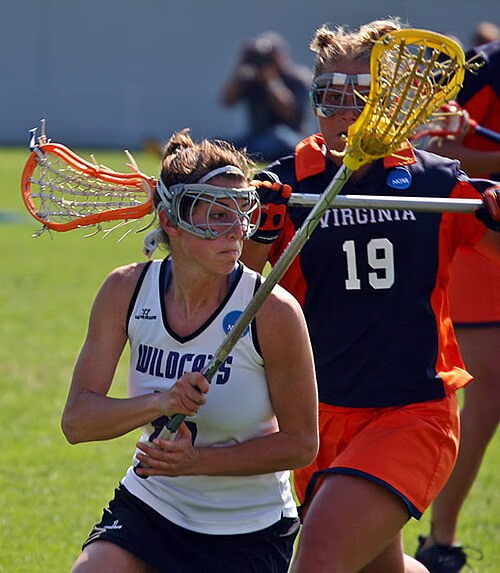
NCAA Women's Lacrosse is the collegiate variant of women's field lacrosse played under the National Collegiate Athletic Association's competition rules. NCAA women's field lacrosse is a fast, twelve-on-twelve field sport in which players use stringed-pocket sticks to catch, carry, pass, and shoot...
NCAA women's lacrosse uses a card-based discipline framework distinct from the men's penalty-box model.
Each team has a head coach and assistant coaches in the team area during the game. Coaches may not enter the field of play except when authorized by an official.
A player with an actual or suspected concussion is removed from play immediately and is subject to a graduated return-to-play assessment before being cleared for subsequent training and competition. NCAA medical observers and team medical staff ha...
The game starts with a draw at the center circle; draws also restart play after each goal and to begin each quarter; Two players (typically center midfielders) hold their sticks above the ground at hip level, back-to-back; the ball is placed in the up-pocket of each stick and pushed against the o...
Center circle of approximately 9-meter diameter (varies by published spec) at the center of the field; the draw is taken at the center hash by two opposing midfielders. Up to four other players from each team may stand on the center line outside the draw circle.
Rectangular field, 110 yards × 60 yards (a 70-yard width is also permissible where space allows under the 2026/27 rules); Center line dividing the field into two halves; Two restraining lines, each 30 yards from the goal lines (sometimes referred to as the "30-yard arc" framework)
Cleats are appropriate to the surface. Uniform numerals must be legible and distinct from teammates'; the goalkeeper wears a contrasting color permitting clear identification by officials.
An 8-meter free position is awarded for major fouls inside the 8-meter arc; the offended player takes a free position on the arc 8 meters from the goal; 2026/27 simplification: 8-meter free positions are set up only at the two adjacent hashes on both sides of the center hash — no longer at arbitr...
Four 15-minute quarters (NCAA women's lacrosse adopted the quartered format in recent rule cycles, replacing the prior 30-minute half format); 2-minute breaks between Q1/Q2 and Q3/Q4; 10-minute halftime; The team in possession at the end of Q1 keeps the ball to start Q2; same for Q3 → Q4 (this is...
A goal is scored when the entire ball passes the goal line into the goal, propelled by an attacking player's stick. The official confirms goals on the field; specific goal/no-goal reviewable situations may be reviewed via NCAA video review.
Hold Up When the Opposing Goalkeeper Is Injured
If the opposing goalkeeper is down with an injury or has left the crease for a medical reason during live play, the convention is to hold possession or allow the ball out of bounds — never to shoot on an undefended cage while medical attention is being rendered. Doing so draws sharp condemnation.
Identical conventions exist in field hockey, soccer, and ice hockey. Lacrosse's non-contact identity makes any exploitation of an injured player especially taboo.
Never Argue with Officials — Accept Calls Without Protest
Women's lacrosse carries an unusually strong cultural expectation that players accept officials' calls without visible dispute. Jawing at referees, prolonged eye contact after a call, or expressive dissent is considered a serious violation of the sport's code — not merely an NCAA conduct issue but a program-culture one.
Directly rooted in the sport's historical self-officiating culture, where players were expected to call fouls on themselves and defer to the process.
Three Cheers for the Opponent After Every Game
After the final whistle, both teams gather near midfield and each gives three synchronized cheers for the other — traditionally 'Hip, hip, hooray!' repeated three times. Skipping this tradition or performing it insincerely is considered a significant breach of the sport's etiquette. It is the defining postgame ritual of lacrosse culture.
Carried to American women's colleges (Vassar, Bryn Mawr, etc.) from English and Scottish school origins in the early 20th century; persists at NCAA programs today.
Honor the Self-Officiating Legacy — Don't Exploit Unseen Infractions
Women's lacrosse evolved from a tradition in which players called fouls on themselves. While full officiating now governs NCAA play, the cultural expectation that players do not exploit contact or infractions unseen by officials — and do not feign fouls — remains part of the sport's identity and is invoked by coaches when addressing program culture.
Most explicit at scholastic and recreational levels where self-officiating still occurs; at the NCAA level it surfaces primarily as a cultural norm against gamesmanship and embellishment.
Ready to dive deeper?