


🏛️Official — NCAA
Loading OpenSourceSports…
Team Sports
10 players
outdoor
lacrosse ball, stick, goal
10 essential rules
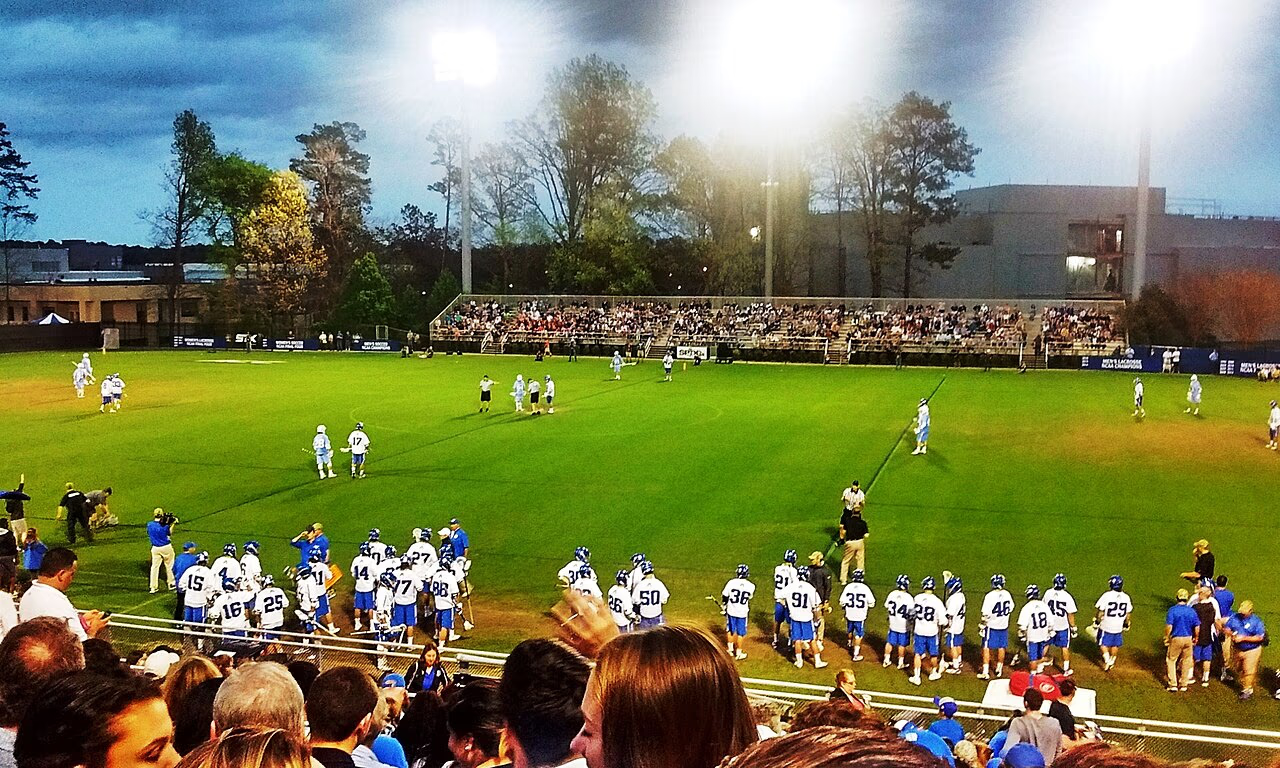
NCAA Men's Lacrosse is the collegiate variant of men's field lacrosse played under the National Collegiate Athletic Association's competition rules. NCAA men's field lacrosse is a fast, full-contact ten-on-ten field sport in which players use long-handled sticks with mesh heads to catch, carry, p...
Each team has a head coach and assistant coaches in the team box during the game. , medical timeout, brief team huddles in dead-ball situations).
A player with an actual or suspected concussion is removed from play immediately and is subject to a graduated return-to-play assessment before being cleared for subsequent training and competition. NCAA medical observers and team medical staff ha...
Attacking players may not enter the crease or contact the goalkeeper while the goalkeeper is in the crease; A goal-mouth-area rule (adopted in recent rule cycles) restricts an attacking player's positioning directly in front of the goal during specific transitions; The goalkeeper has 4 seconds to...
The faceoff is taken at the center "X" at the start of each quarter and after each goal. The two faceoff midfielders (FOGOs in modern practice) line up on their offensive side of the midfield line; their sticks rest on the ground parallel to the l...
The center of the midfield line is the faceoff spot ("X"), where every faceoff is taken — at the start of each quarter, after each goal, and after specified violations.
The 2025/26 cycle replaced the prior "three faceoff violations in a half = 30-second team penalty" framework with a per-player framework. If a faceoff player commits a violation, that player cannot participate in the next faceoff their team takes; the team may replace the violator.
Rectangular field, 110 yards × 60 yards; Midfield line dividing the field into two halves; Two restraining lines, each 20 yards from the midfield line (one in each half of the field)
Cleats are appropriate to the surface; metal spikes are prohibited on most NCAA fields. Uniform numerals must be legible and distinct from teammates'; the goalkeeper wears a contrasting color permitting clear identification by officials.
Four 15-minute quarters; 2-minute breaks between Q1/Q2 and Q3/Q4; 10-minute halftime; Per Rule 4-31, effective with the 2027 season, overtime is played in 15-minute periods, continuing until a goal is scored; timeout and video-challenge rules are unchanged in overtime. (Overtime was previously pl...
A goal is scored when the entire ball passes the goal line into the goal, propelled by an attacking player's stick. The official confirms goals on the field; specific goal/no-goal reviewable situations may be reviewed via NCAA video review (e.g., ...
Don't cheap-shot a player away from the ball
Stick checks and body checks on players who clearly do not have possession and are not an immediate threat are viewed as cowardly and unsportsmanlike. The culture distinguishes hard, competitive physical play from gratuitous hits designed to injure or intimidate rather than compete.
This norm underpins much of lacrosse's self-policing culture; peer judgment and team response (not just officiating) enforces it.
Do not target the head with stick checks
Even in an era before targeting rules were tightened, the lacrosse culture has long held that deliberately slashing at an opponent's head or neck — rather than the gloves, hands, or shaft — is outside the bounds of legitimate physical play. This is treated as a character issue, not merely a rules question.
Rule changes at the NCAA level have formalized penalties, but the cultural condemnation predates the modern rulebook emphasis on head safety.
Honor the game's Native American origins
Lacrosse is widely called 'The Creator's Game' in Haudenosaunee tradition. Players and programs are culturally expected to acknowledge the game's Indigenous roots — through pre-game ceremonies, education, or simple acknowledgment — and to play with the reverence that heritage demands. Dismissiveness toward this history is considered a serious breach of the game's spirit.
The Haudenosaunee Nationals are the most visible embodiment of this living cultural legacy; many programs host Native awareness nights or invite tribal representatives.
Ready to dive deeper?
Do not recklessly crash into the opposing goalie
The crease is the goalie's sanctuary. Even when a goal-front scramble is legal, deliberately barreling into or running over a stationary goalie is seen as cheap and dangerous. Opponents expect attackers to pull up or go around once possession is lost, rather than using body weight to punish the goalie.
NCAA rules penalize crease violations and goalie interference, but the cultural norm extends beyond what referees flag — incidental contact that could have been avoided is still judged harshly by peers.
The post-game handshake line must be sincere
Shaking hands after a game — win or lose — is a deep-seated expectation at all levels of lacrosse. Refusing to participate, phoning it in with limp handshakes, or making disrespectful comments during the line is considered one of the worst breaches of sportsmanship. Emotions are expected to be set aside the moment the final whistle blows.
Incidents where handshake lines devolve into confrontations are treated as significant scandals and often result in formal consequences beyond the cultural censure.