

🏛️Official — JJIF
Loading OpenSourceSports…
Combat Sports
1 players
indoor
mat, gi, belt
10 essential rules
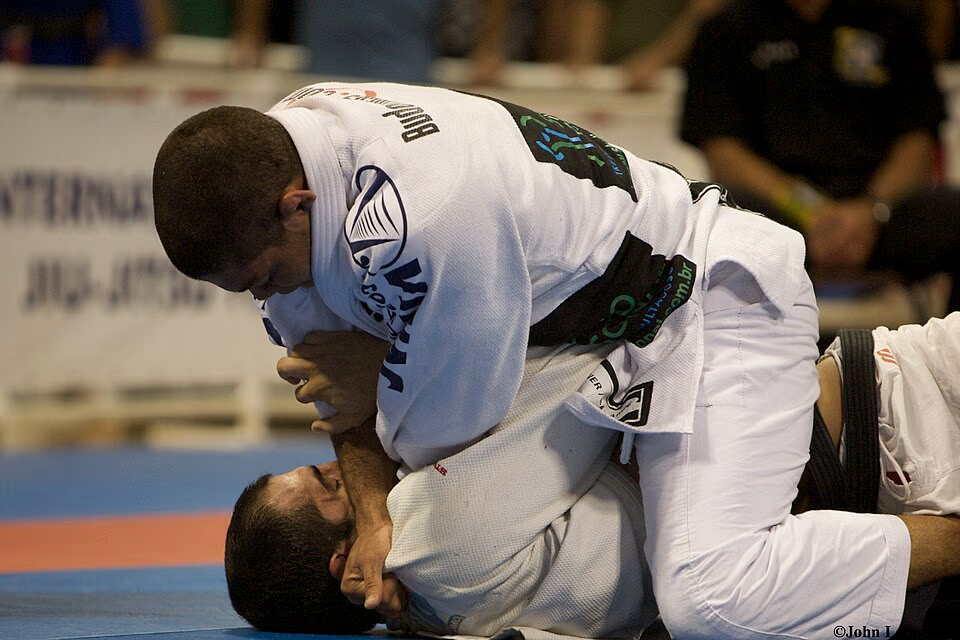
Ne-Waza ("ground-technique") is JJIF's groundwork-only competition discipline, structurally similar to Brazilian Jiu-Jitsu but governed under the IOC-recognized Ju-Jitsu International Federation. JJIF Ne-Waza covers both gi and no-gi categories with a points-based scoring system and submissions a...
5 minutes (single period); If tied: 2-minute golden-score overtime, first scoring action wins
2 points: Takedown, Sweep, Knee-on-Belly; 3 points: Guard Pass; 4 points: Mount, Back Mount
Gi (Kimono): JJIF-approved white gi for Gi category; colored belt + red/blue sash for distinguishing competitors; No-Gi: rashguard + shorts; rashguard color (red/blue) for competitor distinction; Mouthguard recommended; protective cup permitted (men)
JJIF-standard tatami: 8m × 8m competition area + padded safety zone; Multiple parallel mats at major championships
Two competitors per match (red sash/rashguard + blue sash/rashguard); Weight classes follow JJIF schedule; Age categories: Cadet, Junior, Senior, Veteran
5 minutes (single period); If tied: 2-minute golden-score overtime, first scoring action wins; Match begins standing; both competitors approach + engage
Decision priority: submission > points > golden score > referee decision; Tournament: single-elimination + repechage; Gold/Silver/two Bronze per weight + gender + age + format (gi vs no-gi)
Stalling: verbal warning → caution → opponent advantage; Illegal submissions: caution → DQ; Slamming: DQ
Ne-Waza injury profile: joint injuries (shoulder, elbow, knee), neck strain, occasional concussion. JJIF restricts high-risk submissions (heel hooks, twisters) more strictly than ADCC or even IBJJF.
Match begins standing; both competitors approach + engage; Pulling guard permitted but referee may intervene if continuous pulling without action
Release the submission immediately on tap
The moment an opponent taps — whether the mat, your body, or their own body — you release the lock or choke without hesitation. Holding even a fraction of a second past the tap to 'finish' is considered a serious breach of the code and a genuine safety violation. This norm predates written rules and is the bedrock ethic of all grappling arts.
Applies equally in competition and randori. Referees may not catch the tap — competitors are expected to self-police.
Check on an opponent who goes limp in a choke
If an opponent loses consciousness during a strangle rather than tapping, the accepted norm is to release immediately and assist or signal for medical attention rather than celebrating or walking away. The practitioner applying the choke is expected to ease the opponent to the mat safely.
Rare in competition but the expectation is uniform across the community.
Don't crank submissions — apply with progressive control
Submissions should be applied with increasing, controlled pressure, giving the opponent a window to recognize they are caught and tap. Jerking or cranking a joint lock on explosively — especially in randori — is seen as reckless and disrespectful, as it denies the opponent a chance to submit safely.
More strictly observed in training than high-level competition, where speed is legitimate, but even competitors are expected to show awareness of the opponent's capacity to tap.
Ready to dive deeper?