



Section 1: Introduction
1.1 Overview and Governing Body
Equestrian sports have been part of the Olympic programme since 1900 (polo) and in their modern form since the 1912 Stockholm Games. The Fédération Equestre Internationale (FEI), founded in 1921, governs all international equestrian competition under the FEI General Regulations and discipline-specific rulebooks. The FEI is headquartered in Lausanne, Switzerland, and oversees competition in over 130 national federations worldwide.
1.2 Olympic Disciplines
Three equestrian disciplines are contested at the Olympic Games, each with individual and team competitions (6 medal events total):
- Dressage: The art of training a horse to perform prescribed movements with precision, harmony, and apparent ease. Often described as "horse ballet," dressage tests the horse's suppleness, obedience, and the rider's subtlety of aids.
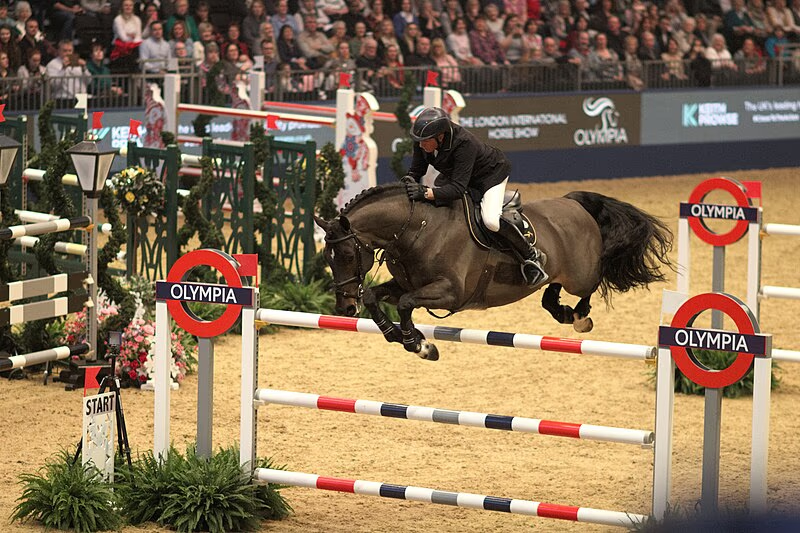
- Show Jumping: Horse and rider navigate a course of colored fences within a time allowed, aiming for a clear round (no rails knocked down). Tests the horse's scope, agility, and the rider's judgement of pace and distance.
- Eventing: A three-phase competition combining dressage, cross-country, and show jumping — testing the complete partnership between horse and rider over multiple challenges. Often called the "triathlon of equestrian sport."
1.3 Unique Characteristics
Equestrian holds several unique distinctions in the Olympic programme:
- The only Olympic sport where men and women compete directly against each other on equal terms — there are no gender-separated events
- The only Olympic sport involving an animal athlete. The horse is considered a full partner, and its welfare is paramount under FEI rules.
- No age limit for riders (the oldest Olympic equestrian medalist was 72 years old)
- Athletes may compete at multiple consecutive Olympics with different horses
1.4 Olympic Qualification
- Team quota: Typically 15 teams of 3 riders per discipline at the Olympics
- Individual quota: Additional individual places allocated by FEI ranking and continental representation
- Horse eligibility: Minimum age 9 years for all Olympic disciplines. Horse must hold a valid FEI passport and meet competition history requirements (Minimum Eligibility Requirements, or MERs).
- Rider eligibility: Must hold a valid FEI riding license and represent their national federation
Section 2: Equipment
2.1 The Horse
Any breed of horse is eligible for Olympic equestrian competition. Horses must meet the following requirements:
- Age: Minimum 9 years old for all three Olympic disciplines
- FEI Passport: Each horse must be registered with the FEI and carry a valid FEI identification document (passport) recording identity, vaccination history, and competition record
- Veterinary inspections: All horses undergo a "jog" (trot-up inspection) before competition, where they are presented in hand and trotted on a hard surface before a Ground Jury. Any horse showing irregularity of gait (lameness) is eliminated.
- Anti-doping: Horses are subject to FEI Equine Anti-Doping and Controlled Medication Regulations (EADCM). Prohibited substances include performance-enhancing drugs, sedatives, and analgesics that could mask pain. Positive tests result in disqualification and potential suspension of the athlete.
2.2 Tack and Saddlery
- Dressage saddle: Deep-seated with long, straight flaps to facilitate a long leg position. No weight restrictions.
- Jumping saddle: Forward-cut seat with shorter flaps to accommodate the rider's shorter stirrup length over fences. Used in Show Jumping and the SJ phase of Eventing.
- Cross-country saddle: All-purpose or specifically designed for cross-country with extra knee blocks for security at speed and over solid fences.
- Bits: Dressage (Grand Prix): double bridle (curb and bridoon) required. Show Jumping: any bit from the FEI-approved list. Eventing: discipline-specific approved bits per phase.
- Boots and bandages: Permitted in Show Jumping and Eventing (cross-country and show jumping phases). Not permitted in Dressage (except in warm-up).
- Whips: Dressage: whip permitted in warm-up but not during the test. Show Jumping: whip maximum 75 cm (29.5 in) including flap. Eventing XC: whip maximum 75 cm.
- Spurs: Permitted in all disciplines. Must be smooth (no rowel spurs) and positioned correctly on the rider's boot.
2.3 Rider Equipment and Attire
- Helmet: ASTM/SEI F1163, PAS 015, EN 1384 (or successor standard) certified riding helmet mandatory at all times when mounted. Chin strap must be fastened. No modifications to the helmet shell.
- Dressage attire: Shadbelly (tailcoat) or short jacket, white or light-colored breeches, tall black boots, white stock tie or collar. Top hat is optional (many now use only helmets).
- Show Jumping attire: Show jacket (any color permitted per national federation), white or beige breeches, tall boots, helmet.
- Eventing cross-country: Body protector meeting BETA Level 3 (or equivalent) standard — mandatory. Medical armband on upper arm containing emergency contact information and blood type. Air vest (inflatable vest triggered by a lanyard) strongly recommended and commonly worn.
- National identification: Saddle cloth must display the national flag and athlete/horse number for Olympic competition
Section 3: Playing Area
3.1 Dressage Arena
- Dimensions: 60 m × 20 m (197 ft × 66 ft) for Grand Prix and Olympic competition. A smaller 40 m × 20 m arena is used for lower levels but not at the Olympics.
- Letters: Marker letters placed around the perimeter define where movements must be performed. Perimeter letters: A (entrance), K, E, H, C (far end), M, B, F. Centerline letters: D, X (center), G.
- Surface: Sand, sand-fiber mix, or specialized equestrian footing. Must provide consistent, non-slip surface that is not too deep (impedes movement) or too hard (stresses joints). Typically 8–12 cm (3–5 in) depth.
- Surroundings: Low boards (approximately 30 cm / 12 in high) mark the arena boundary. Judges are positioned at designated points around the arena. Flowers and decorations are permitted but must not startle horses.
3.2 Show Jumping Arena
- Minimum area: 2,500 m² (26,910 ft²) for Olympic competition, though larger arenas (up to 5,000 m²) are preferred for Grand Prix courses
- Obstacles: 10–16 obstacles with 12–15 jumping efforts (including combinations of 2 or 3 elements). Fences include verticals (poles stacked vertically), oxers (spread fences with two frames), triple bars, water jumps, and walls.
- Fence heights: Olympic Grand Prix individual: maximum 1.60 m (5 ft 3 in). Team competition: maximum 1.60 m. Water jump: minimum 3.50 m (11 ft 6 in) spread.
- Course design: The course designer creates a track that tests the horse's scope, agility, and the rider's ability to maintain rhythm and manage distances. Courses include related distances (combinations), bending lines, and changes of lead.
- Footing: Sand, grass, or all-weather surface. Must be consistent and provide adequate grip for take-off and landing.
3.3 Eventing Cross-Country Course
- Course length: 5,700–6,270 m (3.5–3.9 miles) for Olympic-level (CCI5*-equivalent) competition
- Jumping efforts: 25–40 jumping efforts, including combinations
- Fence dimensions: Maximum height 1.20 m (3 ft 11 in), maximum spread 1.80 m (5 ft 11 in) at the highest point, maximum spread at base 2.40 m (7 ft 10 in). Drop fences maximum 1.80 m (5 ft 11 in) drop.
- Obstacle types: Solid, fixed obstacles including logs, stone walls, hedges, ditches, water crossings (splash fences), banks (up and down), corners, arrowheads, and combinations with multiple elements
- Speed: Optimum time calculated at 570 m/min (approximately 34 km/h or 21 mph) for top-level competition
- Terrain: Undulating terrain with varied footing — grass, packed earth, and purpose-built tracks. Natural features (hills, water crossings) are incorporated into course design.
- Frangible technology: MIM (Maximum Impassable Mechanism) clips or frangible pins on top rails allow fences to collapse when struck with excessive force, significantly reducing the risk of rotational horse falls
Section 4: Players & Officials
4.1 Competitors
- Individual events: Each athlete competes as an individual horse-rider combination
- Team events: Teams of 3 riders per nation. All 3 scores count (no drop score since the team size was reduced from 4 to 3 in recent Olympic formats). Team and individual medals may be decided from the same competition or separate rounds depending on the discipline.
- Gender: No gender separation — men and women compete together in all events
- Nationality: A rider may only represent one nation. Maximum 3 riders per nation per discipline (individual).
4.2 Dressage Officials
- Ground Jury: 5 or 7 judges positioned at designated locations around the arena. Standard Olympic positions: C (at the short end behind the arena), H, M (long sides near C), B, E (center of long sides).
- Each judge scores independently: Judges do not communicate during the test. Each sees different angles of the movements, providing a comprehensive assessment.
- President of the Ground Jury: Sits at C position. Has authority to stop the test in cases of lameness, dangerous behavior, or blood on the horse.
- Stewards: Monitor warm-up arenas for welfare compliance, check equipment, and enforce rules on use of whips, nosebands, and draw reins.
4.3 Show Jumping Officials
- Course Designer: Creates the course, sets fence heights and distances, and determines the time allowed based on course length and prescribed speed (typically 375 m/min for Grand Prix)
- Fence Judges: Positioned at each obstacle to observe and record faults (knockdowns, refusals)
- Timekeepers: Electronic timing from the start line to the finish line
- Ground Jury: Oversees the competition, rules on eliminations, and decides protests
4.4 Eventing Officials
- Cross-country course designer: Designs and builds the course over a period of months or years. Course must be approved by the FEI Technical Delegate.
- Fence judges: Positioned at every obstacle on the cross-country course. Each judge records refusals, run-outs, falls, and penalties. Multiple judges at complex fences with alternative routes.
- Veterinary Commission: Conducts horse inspections before, during (at hold points on cross-country), and after competition. Has authority to withdraw any horse showing signs of distress, lameness, or injury.
- Technical Delegate: FEI-appointed official responsible for ensuring all regulations are followed and course safety standards are met
Section 5: Rules of Play
5.1 Dressage
The rider performs a prescribed test of movements in the 60 m × 20 m arena. At the Olympic level, the tests performed are:
- Grand Prix test: The standard test used for team and individual qualification. Approximately 6 minutes long. Includes all FEI movements: collected/extended walk, trot, and canter; half-passes; pirouettes at canter; piaffe (trot in place); passage (elevated, cadenced trot); one-tempi flying changes (change of lead at every stride); and transitions between gaits.
- Grand Prix Special: A more demanding test used for the individual medal round. Same movements as Grand Prix but with higher difficulty in the sequence and transitions.
- Grand Prix Freestyle: Athletes perform movements of their choice choreographed to music within a prescribed time (5:30–6:00 minutes). Scored on both technical execution and artistic impression (interpretation of music, choreography, degree of difficulty).
Each movement in the test is scored from 0 to 10 by each judge:
- 10 = Excellent, 9 = Very Good, 8 = Good, 7 = Fairly Good, 6 = Satisfactory, 5 = Sufficient, 4 = Insufficient, 3 = Fairly Bad, 2 = Bad, 1 = Very Bad, 0 = Not Performed
- Half marks (e.g., 7.5) are permitted
- Coefficient system: Certain movements carry a coefficient of 2, meaning the mark is doubled to reflect the movement's importance in the test
- Collective marks: At the end of the test, judges award collective marks for the horse's gaits, impulsion, submission, and the rider's position and use of aids
5.2 Show Jumping
- Horse and rider navigate a course of 10–16 colored, knockable fences within a time allowed
- Faults: 4 penalty points per knocked rail (any part of the fence falls). 4 penalty points per refusal (horse stops or runs out at a fence). 1 penalty point per second over the time allowed.
- Elimination: Second refusal at any fence (cumulative, not per fence) = elimination. Fall of rider = elimination. Taking fences in the wrong order = elimination.
- Jump-off: When competitors are tied on faults after the main round, they compete in a jump-off — a shortened course (6–8 fences) over higher or different fences. Fastest clear round wins. If both have faults in the jump-off, fewest faults then fastest time determines ranking.
- Course walk: Before competition, riders walk the course on foot (without the horse) to assess distances, plan approach angles, and determine the pace. Typically 20–30 minutes allowed.
5.3 Eventing
A three-phase competition scored cumulatively across all phases. Lowest total penalty score wins:
- Phase 1 — Dressage: Performed on a standard 60 m × 20 m arena. The percentage score is converted to penalty points (lower is better): penalty points = (100 − percentage score). A dressage score of 75% = 25.0 penalty points.
- Phase 2 — Cross-Country: Speed endurance test over a course of fixed, solid obstacles. Time faults: 0.4 penalty points per second over the optimum time. Refusal: 20 penalties (first), 40 penalties (second at same fence). Third refusal at any fence = elimination. Fall of rider = elimination. Exceeding time limit (2× optimum time) = elimination.
- Phase 3 — Show Jumping: Tests horse's suppleness, obedience, and remaining fitness after cross-country. Same penalty system as standalone show jumping (4 faults per knockdown, 4 per refusal, 1 per second over time). Often decides medal positions when dressage and cross-country scores are close.
5.4 Horse Welfare Rules
The FEI Code of Conduct for the Welfare of the Horse underpins all competition rules:
- Blood rule: If blood is observed on a horse's flank (from spur use), mouth, or body, the horse must be inspected by the veterinarian. The Ground Jury may issue a warning, require the athlete to halt until cleared, or eliminate the combination.
- Limb sensitivity testing (hypersensitivity): Horses may be tested for illegal application of substances that sensitize the legs (making the horse more careful over fences). Positive tests result in disqualification.
- Tongue ties: Prohibited in all FEI disciplines
- Rollkur (excessive hyperflexion): Actively discouraged. Stewards monitor warm-up arenas and may sanction riders using excessive force to lower the horse's head behind the vertical.
Section 6: Scoring
6.1 Dressage Scoring
- Each movement scored 0–10 (half marks permitted) by each judge independently
- Marks are summed, coefficient movements doubled, and collective marks added
- Total marks divided by maximum possible marks × 100 = percentage score
- Judges' percentages are averaged across the panel (5 or 7 judges) for the final result
- Higher percentage = better performance. Olympic Grand Prix scores typically range from 70% to 90%+.
- Freestyle: Technical marks (50%) + Artistic marks (50%) = total percentage. Artistic marks cover rhythm, energy, elasticity; harmony between horse and rider; choreography; degree of difficulty; and music and interpretation.
6.2 Show Jumping Scoring
- Knockdown: 4 faults per rail (only the top element of each fence is counted)
- Refusal/run-out: 4 faults (first instance). Elimination on second refusal (cumulative across the course).
- Time faults: 1 fault per second over the time allowed (calculated from course length ÷ prescribed speed)
- Water jump: 4 faults if any hoof lands on the lath marking the far edge
- Rankings: Fewest faults wins. If tied, fastest time in the round (or jump-off) breaks the tie.
6.3 Eventing Scoring
- Cumulative penalty system across all three phases
- Dressage penalties: (100 − percentage) = penalty score
- Cross-country penalties: Time faults (0.4/sec) + refusal penalties (20/40) + fall penalties
- Show jumping penalties: 4 per knockdown + 4 per refusal + 1 per second over time
- Lowest total penalty score wins. A "sub-30 dressage" (fewer than 30 penalty points from the dressage phase) is considered excellent at the Olympic level.
6.4 Tiebreaking
- Dressage: Collective marks compared. If still tied, the judge at C's score breaks the tie.
- Show Jumping: Jump-off round. If still tied after jump-off, shared ranking.
- Eventing: Best cross-country score (closest to optimum time with fewest jumping penalties) breaks the tie. If still tied, best show jumping score.
Section 7: Violations & Penalties
7.1 Dressage Violations
- Error of course: Performing the wrong movement or at the wrong letter. First error: 0.5 percentage point deduction. Second error: 1.0 percentage point deduction. Third error: elimination.
- Lameness: If the Ground Jury President determines the horse is unlevel during the test, the test is stopped and the combination is eliminated
- Resistance: If the horse refuses to perform a movement for more than 20 seconds, the judge sounds the bell and the rider must move to the next movement (that movement scores 0)
- Leaving the arena: If all four hooves of the horse leave the arena, the combination is eliminated
7.2 Show Jumping Violations
- Knockdown: 4 faults per element knocked from its cups
- First refusal: 4 faults. Horse must re-approach and jump the fence.
- Second refusal (cumulative): Elimination
- Fall of rider: Elimination (rider separating from the horse)
- Fall of horse: Elimination (horse's shoulder and hindquarters touch the ground)
- Wrong course: Taking fences in incorrect order or missing a fence = elimination
- Exceeding time limit: Elimination if the rider exceeds twice the time allowed
7.3 Eventing Cross-Country Violations
- First refusal at a fence: 20 penalty points
- Second refusal at the same fence: 40 penalty points (rider may take the alternative route if available)
- Third refusal (cumulative across the course): Elimination
- Fall of rider: Elimination
- Exceeding optimum time: 0.4 penalties per second
- Exceeding time limit (2× optimum): Elimination
- Dangerous riding: The fence judge may report dangerous riding (approaching a fence at excessive speed, lack of control, or unsafe line). The Ground Jury may issue penalties or eliminate the combination.
7.4 Welfare and Conduct Violations
- Blood on horse: Inspection required. May result in a warning, compulsory halt, or elimination depending on severity and cause.
- Excessive whip use: Stewards may issue a yellow card (warning) or report to the Ground Jury for further sanction. FEI guidelines specify a maximum of 3 uses of the whip in jumping/eventing without excessive force.
- Abuse of the horse: Any act of cruelty or abuse (kicking, punching, or excessive force) results in immediate disqualification, a fine, and potential suspension by the FEI Tribunal.
- EADCM violations: Positive drug test on the horse results in disqualification of results and possible suspension of the athlete for up to 2 years
Section 8: Safety Considerations
8.1 Rider Safety
- Helmet: Certified riding helmet (ASTM/SEI, PAS 015, or equivalent) mandatory at all times when mounted, including warm-up, competition, and prize-giving mounted lap of honor
- Body protector (Eventing XC): BETA Level 3 body protector mandatory for the cross-country phase. Must fit snugly and be in good condition (protectors degrade after significant impacts and have recommended replacement dates).
- Air vest: Inflatable vest connected to the saddle by a lanyard. Activates upon separation from the horse, providing additional torso protection. Strongly recommended and widely used at the Olympic level.
- Medical armband: Mandatory for cross-country. Worn on the upper arm, it contains the rider's name, blood type, emergency contact information, and any medical conditions (allergies, medications).
8.2 Horse Safety and Welfare
- Veterinary inspections: All horses are examined before each phase of competition. The trot-up inspection checks for soundness. Horses failing the trot-up are not permitted to compete.
- Holding boxes (Eventing XC): Compulsory halts on the cross-country course where veterinarians check heart rate, hydration, and soundness. Horses with heart rates above threshold may be held until recovery.
- Frangible/MIM fences: Modern cross-country fences incorporate frangible pins or MIM (Maximum Impassable Mechanism) clips that allow the top element to collapse when struck by excessive force, dramatically reducing the risk of rotational falls
- Course inspection: The cross-country course is inspected after each group of riders to check for fence damage, ground conditions, and safety
- Extreme weather: Competition may be suspended in extreme heat (above 35°C / 95°F), severe thunderstorms, or dangerous footing conditions. The Ground Jury has authority to modify courses, reduce speed, or cancel events.
8.3 Venue Safety
- Medical team (human and equine) on-site throughout competition
- Ambulance (human) and horse ambulance (specially equipped vehicle) available at all times during cross-country
- Screens available at cross-country fences to shield the public and other competitors from viewing any serious incident
- Spectator barriers positioned at safe distances from the course, particularly at landing zones and water complexes
- Security fencing around stabling areas to prevent unauthorized access to horses