


🏛️Official — FIAS
Loading OpenSourceSports…
Release submissions the instant the opponent taps or referee intervenes
Continuing to crank a painful lock or choke after the tap or stoppage signal is one of the gravest breaches of conduct in any Sambo discipline. Beach Sambo practitioners are expected to disengage immediately — hesitation is treated as intentional harm, not a reaction-time lapse.
Uniform is fixed by Article 7.
— Article 7
Why people argue about this
People often assume that beach sambovki (the protective cups) are mandatory for all male competitors, leading to arguments about whether they should be worn or not during matches. However, the official rule actually states that a protective cup is recommended only for men, which can lead to misunderstandings and debates among athletes and officials.
Contest area: 6 × 6 metres, located on the sand (Art. 29); A sound signal (gong) loud enough to be heard; where several contest areas run at once, each must sound different from the others (Art. 30.1); Calibrated weigh-in scales (Art. 30.2)
Why people argue about this
People often assume that the shaded rest areas adjacent to the court are optional, which leads to arguments about their necessity. Actually, these shaded areas are a crucial part of the playing area specification, directly impacting players' comfort and recovery during matches.
Two contestants per bout. Age group: adults, 18 years and older (Art. 3); Weight categories — four per gender (Art. 4):Women — 50, 59, 72, over 72 kgMen — 58, 71, 88, over 88 kg; An athlete may compete in only one weight category, matching the weight shown at the official weigh-in (Art. 5.1, 5.7)
Why people argue about this
People often assume that Beach Sambo's weight class consolidation is solely for convenience, thinking it makes matches easier by reducing categories. However, the actual reasoning behind consolidating to 3-4 categories per gender is to balance the physical demands and skill levels required in each category, ensuring fair competition across different sizes while maintaining competitive intensity.
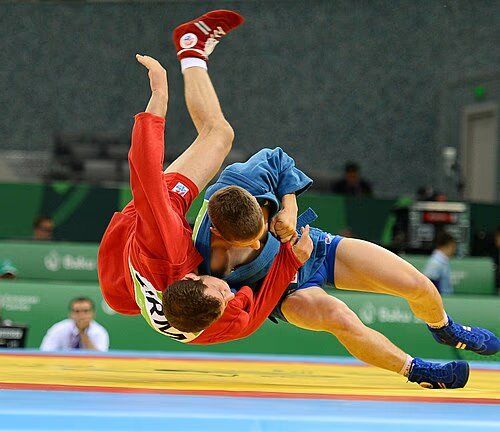
Beach sambo bouts are held only in the standing position. There is no groundwork phase, no hold-downs, and no points — a single successful throw ends the bout (Art.
Why people argue about this
People often assume that joint locks on arms are illegal in Beach Sambo matches, which they misunderstand as a senior level restriction. In fact, the key fact is that these joint locks are perfectly legal at all levels, and it's the match duration of 3 minutes that causes confusion for many players.
Beach sambo records no running score. A bout is won outright, and Article 25 lists every way that can happen.
— Article 25
Why people argue about this
People often assume that in Beach Sambo, scoring priority is solely based on who wins a round, which leads them to overlook the importance of total victory, technical superiority, points, and last-scoring competitor criteria. This confusion stems from not fully grasping how these various factors are interwoven into determining the winner in single-elimination and repechage tournaments.
Article 27 lists the prohibited actions. Each is penalised by immediate disqualification — there is no graduated warning scale: punches and kicks;; locks and strangulations;; throwing an opponent on his head;
— Article 27
Why people argue about this
People often think that just using sand as a weapon in an eye-poke is okay if it's unintentional, but they're actually misunderstanding that even intentional use of sand for such an attack results in disqualification under this rule. The confusion arises because beach sambo rules are quite specific about the nature and intent behind fouls like this one.
The Beach Sambo Competition Rules address athlete safety through the prohibitions and the medical checks rather than a separate safety chapter.
Why people argue about this
People often assume that the mandatory pre-event medical screening is solely for catching pre-existing health issues like asthma or heart conditions, but they overlook how it addresses the unique risk of ankle/knee instability from uneven sand surfaces during throws, leading to misunderstandings about its necessity and scope.